Wordyard

Hand-forged posts since 2002

Archives

About

Greatest hits

Links: “Henry VIIIs of the Web”; social all the way down

September 6, 2014 by Scott Rosenberg

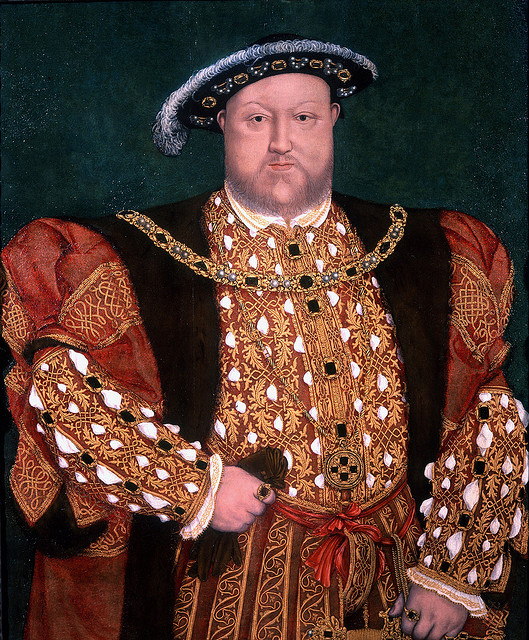
Henry VIII

Big Internet (Nicholas Carr, Rough Type):

…a sense of exhaustion with what I will henceforth call Big Internet. By Big Internet, I mean the platform- and plantation-based internet, the one centered around giants like Google and Facebook and Twitter and Apple. Maybe these companies were insurgents at one point, but now they’re fat and bland and obsessed with expanding or defending their empires. They’ve become the Henry VIIIs of the web. And it’s starting to feel a little gross to be in their presence.

Why Twitter Should not Algorithmically Curate the Timeline (Zeynep Tufecki, Medium): A great exposition of the “hive mind migrates” notion.

But the bigger loss will be the networked intelligence that prizes emergence over engagement and interaction above the retweetable — which gets very boring very quickly. I know Twitter thinks it may increase engagement, but it will decrease engagement among some of its most creative segments.”

Against the “digital detox” metaphor (Dave Roberts, Grist):

I don’t have any illusions about the inherent moral/spiritual superiority of meatspace friends and interactions. I don’t view my online life as some kind of inauthentic performance in contrast to a meatspace life lived as the Real Me. I can trace a great deal of the richness in my life back to digital roots.

The fact is, all our interactions are performances, even those interactions we experience as purely internal (that internal monologue). They are all shaped by larger cultural and economic forces. That’s because human beings are social creatures, not contingently but inherently. We are always ourselves in relation to someone or something; interacting with others is how children form their sense of being separate, autonomous agents. There is no homunculus, no true, authentic, indivisible self or soul underneath all the layers of social intercourse. It’s social all the way down.

There is no self but dynamic, shifting selves, collections of dispositions and inclinations elicited by changing contexts. We are one self to our mothers, another to our friends, another to our children, another to our Twitter followers. A self that remains steady through contexts is not something we’re all born with, it’s an achievement, what we call “integrity,” from the Latin integritatem, or “wholeness.” Most people are, to one extent or another, loose bundles of fragmentary and often self-contradictory selves, none of which holds a particular claim on being “true.”

There are interesting differences among those selves, and I think there are generalizable differences between the kinds of selves we are in person and the kind we are online, but the differences have nothing to do with degrees of authenticity or “realness.” Many people, particularly introverts, the socially inept, the different or alienated, experience the internet as the first place they can express their hidden and most treasured selves. The internet offers the hope (if not always the reality) of expression freed from social and class restrictions, the chance for radical self-(re)definition.

It’s easy for generally privileged classes — like the kind of upwardly mobile professionals who find themselves at gadget-free retreats — to imagine that meatspace = authenticity. But for the subaltern, meatspace can be an oppressive and confining reality, the internet a place of community and empowerment.

inessential: Waffle on Social Media (Brent Simmons):


My blog’s older than Twitter and Facebook, and it will outlive them. It has seen Flickr explode and then fade. It’s seen Google Wave and Google Reader come and go, and it’ll still be here as Google Plus fades. When Medium and Tumblr are gone, my blog will be here.

The things that will last on the internet are not owned. Plain old websites, blogs, RSS, irc, email.


Facebook’s algorithm — why our assumptions are wrong, and our concerns are right (Tarleton Gillespie, Culture Digitally): Yet more on the Facebook mood study, but there’s some important distinctions and arguments here.

On the one hand, we had “trusted interpersonal information conduits” — the telephone companies, the post office. Users gave them information aimed for others and the service was entrusted to deliver that information. We expected them not to curate or even monitor that content, in fact we made it illegal to do otherwise; we expected that our communication would be delivered, for a fee, and we understood the service as the commodity, not the information it conveyed. On the other hand, we had “media content producers” — radio, film, magazines, newspapers, television, video games — where the entertainment they made for us felt like the commodity we paid for sometimes with money, sometimes with our attention to ads, and it was designed to be as gripping as possible. We knew that producers made careful selections based on appealing to us as audiences, and deliberately played on our emotions as part of their design. We were not surprised that a sitcom was designed to be funny, even that the network might conduct focus group research to decide which ending was funnier A/B testing?. But we would be surprised, outraged, to find out that the post office delivered only some of the letters addressed to us, in order to give us the most emotionally engaging mail experience.  

Now we find ourselves dealing with a third category. Facebook promises to connect person to person, entrusted with our messages to be delivered to a proscribed audience now it’s sometimes one person, sometimes a friend list, sometimes all Facebook users who might want to find it. But then, as a part of its service, it provides the News Feed, which appears to be a running list of those posts but is increasingly a constructed subset, carefully crafted to be an engaging flow of material. The information coming in is entrusted interpersonal communication, but it then becomes the raw material for an emotionally engaging commodity, the News Feed. All comes in, but only some comes out.

It is this quiet curation that is so new, that makes Facebook different than anything before. And it makes any research that changes the algorithmic factors in order to withhold posts quite different from other kinds of research we know Facebook to have done, including the A/B testing of the site’s design, the study of Facebook activity to understand the dynamics of social ties, or the selective addition of political information to understand the effect on voter turnout — but would include their effort to study the power of social ties by manipulating users’ feeds.

And Facebook is complicit in this confusion, as they often present themselves as a trusted information conduit, and have been oblique about the way they curate our content into their commodity. If Facebook promised “the BEST of what your friends have to say,” then we might have to acknowledge that their selection process is and should be designed, tested, improved. That’s where this research seems problematic to some, because it is submerged in the mechanical workings of the News Feed, a system that still seems to promise to merely deliver what your friends are saying and doing. The gaming of that delivery, be it for “making the best service” or for “research,” is still a tactic that takes cover under its promise of mere delivery. Facebook has helped create the gap between expectation and reality that it has currently fallen into.
Filed Under: Links, annotated, Project Tagged With: uor

The hive mind migrates

September 3, 2014 by Scott Rosenberg

empty hive

So with all this noise — all right, murmur — about a blog revival, I say, let’s talk about social networks. Because the whole discussion about blogs and social networks has always posited them as a zero-sum game: if social wins, blogs lose. And things are just way more complicated than that.

In one huge dimension, at least, the world of social networks is absolutely identical to the world of the blogosphere: Their value derives from the people who write, post, share stuff there.

Whatever is good in services like Twitter and Facebook — whatever we go there for — comes from all of us. Without people posting their thoughts and pictures and links, these platforms are nothing, nada, zilch.

There’s a whole “digital labor” conversation that tries to analyze the place of digital work in the global economy. That’s important, but I mean something far simpler: that if you and me and millions of other people stopped posting, Twitter and Facebook would spiral down towards worthlessness — a network effect in reverse.

I’m not predicting any kind of mass exodus or espousing a boycott. But there is a less dramatic sort of abandonment that happens to digital platforms more organically over time — like over-farmed turf that gradually enforces its own need to lie fallow, or hives that have served their purpose but lost their inhabitants.

Any successful community-based online enterprise — from the Well to Flickr to the fertile blog community of a decade ago to Twitter — takes off when an enthusiastic group of early adopters embraces the service and starts tinkering with it, inventing new practices and putting its functions to new uses its creators never imagined. There’s a period of excitement and delight and innovation, then a wider adoption. Cue the collective wow.

Then something happens. The early users begin to burn out, or feel neglected, or resent how the platform owner is changing things, or just chafe at problems the service has never been able to fix. Eventually, they lose the love. They start looking for a new home. If there is a hive mind at work in these matters — and there’s almost certainly not just one but many — it rouses itself and, at some critical moment, moves its energy center elsewhere.

This is a natural process, probably an inevitable one, and not cause for mourning. It is how the tech industry has worked for decades, as “developer enthusiasm” moves from one realm of technical spadework to the next.

It might be happening to Twitter right now. That’s what Alan Jacobs says: “For many of the really smart people on Twitter, it’s over.” He’s echoing Adrienne LaFrance and Robinson Meyer of the Atlantic, who wrote a “eulogy for Twitter” last April.

So yes, first, the obvious: Twitter is huge; it isn’t going anywhere. But the Twitterati are definitely restless, at least in the circles I heed. It’s a thin line between “everyone else is there so I’d better go too” and “nobody goes there anymore — it’s too crowded!” All the link-sharing trackers and analytics and tools will cease to hold our interest if the people we’re interested in move their contributions away from the platform that supports them.

This dynamic is actually heartening: It means that, in a digital environment that seems to privilege big platform owners over individual users, we have more power than we think. Another way of making the same observation can be found in Tim Carmody’s recent essay on OKCupid’s defense of its manipulation of user profiles for testing and research.

They’re all too quick to accept that users of these sites are readers who’ve agreed to let these sites show them things. They don’t recognize or respect that the users are also the ones who’ve made almost everything that those sites show. They only treat you as a customer, never a client.

This is an incredibly important point! And one that the people running today’s Web have a strong interest in blurring. In fact,this insight is so critical, so worth holding onto, that I would like to give it a label so we can’t easily forget it.

How about this? Carmody’s Law: The users of Web platforms today are also the creators of almost everything you’ll find on them.

And the inevitable corollary: They are free agents, even if they sometimes feel trapped.

So where does this leave the blogging revival? I don’t think that personal blogging will somehow become the new hotness again; you only get one lap round that track. I do think that as waves of smart people hit the limits of their frustration with Twitter and Facebook, many will look around and realize, hey, this blogging thing still makes a great deal of sense.

Filed Under: Blogging, Features, Project

“Bloggy to the core” indeed

September 2, 2014 by Scott Rosenberg

bring_out_yer_dead

People are talking about blogs. Again! And not just random nameless “people” cited in some clueless trend story. Specific people are talking about reviving their actual blogs. In some cases, they are even following through.

Michael Sippey, who was so early into blogging it wasn’t even called “weblogging” back then, is doing something like what he used to do in his Obvious Filter over on Medium. Elizabeth Spiers, the original Gawker (and author, most recently, of this superb profile), promises to “write mostly badly and more often” on her personal blog. Vox Media’s Lockhart Steele, declaring that “the web ecosystem will always be bloggy at its core,” announced that he is returning to personal blogging. Susannah Breslin, whose work I first encountered in the days of the original Salon Blogs program, is back at her personal blog with some reflections on “autonomy and freedom.” Christian Crumlish, too. These are people in my universe who I know or whose work I know; look around your world and you may spot similar stirrings.

Jason Kottke noticed some of these developments, and, of course, linked. Fred Wilson, the VC blogger par excellence, noticed them, too, and wrote:

There is something about the personal blog, yourname.com, where you control everything and get to do whatever the hell pleases you. There is something about linking to one of those blogs and then saying something. It’s like having a conversation in public with each other. This is how blogging was in the early days. And this is how blogging is today, if you want it to be.

So let’s be clear: Blogging never went away; if anything, we walked away from it. In large groups, for sure — but hardly unanimously. Many extraordinary bloggers never stopped writing.

As someone who spent several years of my life chronicling the brief but colorful history of the blog, and who within the past few months has put some serious time back into my own wee project here, I’m pleased at this ferment, however it rises — or sours.

It’s a trend! And the really fun thing about trends the second time around is that the media machine generally ignores them. The breathless bad stories all got written already a long time ago. There’s nothing novel left to mine.

Are we really going to see the reconstitution of the blogging era of a decade ago? Of course I have some more thoughts about where all this is headed. But I’ll save them for the next post.

Filed Under: Blogging, Features, Project

Links: Studying Facebook right, adjusting to the Net’s vastness

September 1, 2014 by Scott Rosenberg

5625707813_cbdb4ec0a5_z

Why the Facebook Experiment is Lousy Social Science (Galen Panger, Medium): This lengthy, deep exploration of the many ways the Facebook mood experiment went wrong and how it could be improved upon also offers lots of insight into how the service is “designed to be habit-forming and addictive.”

Facebook’s hacker culture is truly something to behold, but it also means the company constantly steps in it. Facebook upsets a lot of people, and often. The culture makes the company more impervious to criticism, but in some ways also maladapted and unempathetic. And so Facebook and its culture will seemingly always be a source of tension — for us users, as well as for the people who work there…

While Facebook’s PR paints the service as an intimate portrait of our lives, keep in mind that it’s not. It’s a performance, not a well-rounded view of our friends’ struggles, travails and ups and downs. Catch yourself when you start comparing your life unfavorably to someone on Facebook, and realize it’s not the full picture.

MSR Faculty Summit 2014 Ethics Panel Recap (Mary L. Gray):

Summary of a symposium featuring these comments from Jeff Hancock, one of the authors of the Facebook mood study:

We have a metaphor for the postal service: messages are delivered without tampering from one person to the next. We have a metaphor from the newsroom: editors choose things that we think will be of interest. But there’s no stable metaphor that people hold for what the news feed is. I think this is a really important thing. I’m not sure whether this means we need to bring in an education component to help people understand that their news feeds are altered all the time by Facebook? but the huge number of e-mails about people’s frustration that researchers would change the news feed indicates that there’s just no sense that the news feed was anything other than an objective window into their social world.

Try Googling This: OKCupid founder reveals what Internet searches really say about us (Paul Kilduff, Berkeley Monthly):


PK: You’re quoted as saying you don’t want to put anything on Facebook that you wouldn’t feel comfortable with Facebook sharing with advertisers, right?

CR: Yeah, sort of. I mean, it’s not like I sit around thinking all day about what I am and I’m not going to put on Facebook. I’m not leading a monklike existence here. But I think that’s a totally good rule of thumb. It always kind of amuses me when people get mad that Facebook shares x, y, and z with advertisers. They say they’re going to do it. That’s how they make money. It’s almost like a physical fact of the world that websites share stuff with advertisers, so I’m not that excited about them knowing things about me.

The Next Generations of Facebook’s News Feed (Adrienne LaFrance, The Atlantic): A great proposal from Nicholas Diakopoulos.

What if, instead of relying on platforms like Facebook to invisibly turn the digital knobs that make each person’s News Feed look different, Facebook users could subscribe to different algorithms — formulas designed by humans who could explain their approach?

News Feed FYI: Click-baiting (Facebook Newsroom): 


When we asked people in an initial survey what type of content they preferred to see in their News Feeds, 80% of the time people preferred headlines that helped them decide if they wanted to read the full article before they had to click through…Over time, stories with “click-bait” headlines can drown out content from friends and Pages that people really care about.

Blogging Redux (Susannah Breslin):

Eventually, I found myself making $100 an hour writing Facebook updates spoken by a bottle of pink medicine manufactured by a multibillion-dollar company obsessed with engagement, branding, and PowerPoint presentations filled with colorful pie charts.

I had become a digital ghost of my former self.

I think if there is a renaissance of blogging it is in reaction to that, the invisibility imposed when you commodify yourself, an attempt to recreate something that was lost, something, one hopes, that’s more about autonomy and freedom than engagement and revenue.

Your Anonymous Posts to Secret Aren’t Anonymous After All (Kevin Poulsen, Wired):

“It’s our job to make sure people feel safe and in control,” he says. “People can’t do that on Facebook. That’s our mission, so people can put this stuff out there and not feel alone. That’s so important.”

Caudill, the hacker, is skeptical that the twin goals of sharing and anonymity can ever be resolved.

“I kind of see where they’re going with it. They’re trying to be kind of the everyman’s WikiLeaks. But at the same time it doesn’t really work that way,” says Caudill. “You can’t both try to connect with all your friends and be really social and network with everything, and that same time try to do all that anonymously. I can’t see a situation where you can have your cake and eat it too.”

waffle → Community Services (Jesper):

People are going to adjust to the vastness of the Internet and implied exposure and it’s going to happen over generations. I’m not saying they won’t. And I’m not saying that “social media” is doing a poor job today in letting people talk to each other. I am saying that there’s a huge gap for solutions and software and ideas that solve problems people actually have today, especially in a way that doesn’t create a new entity in the middle that then has to care about what everyone thinks about it and how it’s relevant, or in a way that creates a standard to avoid those kinds of entities without spending the next two decades in development hell while the world goes on without them.

Social media has come to symbolize, for me, the tyranny of having to appear relevant, visible and clean to everyone else, the inability to define my own boundaries and the uncertainty about what’s going to happen tomorrow to the fundamental structure of this tool that I’m using — all the while someone either makes money off of me or adds to the looming amorphousness trying to stay afloat.

In E-Sports, Video Gamers Draw Real Crowds and Big Money (Nick Wingfield, New York Times):

In Mr. Dager’s view, the physical barriers to becoming an e-sports athlete are far lower than for conventional sports. He lists fingers and a brain as the primary tools people need to get started. What most people lack, he said, is a singular focus on games, a willingness to clear away all other distractions.

His obsession with video games was a sore point with Mr. Dager’s parents during his teenage years, as it was for the parents of many top gamers.

“I, and many players like me, sacrificed everything,” said Mr. Dager, who is almost a senior in college but is not attending school now. “We gave up on sports and friends and school just so we can play more.”

Filed Under: Links, annotated, Project

Links: Twitter’s Iron Dome, anonymous-app dinners, secrets of Postsecret

August 22, 2014 by Scott Rosenberg

bots

Fighting spam with BotMaker (Raghav Jeyaraman, Twitter Blog): This technical description of Twitter’s realtime spam interception program sounds quite a bit like an unholy cross between the broadcast media’s seven-second delay and a missile defense system. Note, also, that “other groups at Twitter have started using BotMaker for non-spam purposes.” Once you start pre-publication review of tweets, it must just be so tempting to find new applications…

BotMaker has ushered in a new era of fighting spam at Twitter. With BotMaker, Twitter engineers now have the ability to create new models and rules quickly that can prevent spam before it even enters the system. We designed BotMaker to handle the stringent latency requirements of Twitter’s real-time products, while still supporting more computationally intensive spam rules.

BotMaker is already being used in production at Twitter as our main spam-fighting engine. Because of the success we have had handling the massive load of events, and the ease of writing new rules that hit production systems immediately, other groups at Twitter have started using BotMaker for non-spam purposes. BotMaker acts as a fundamental interposition layer in our distributed system.

Secret Users Have Started Hosting Secret Dinner Parties, and They Are Brutal (Nellie Bowles, Re/code): Reporter goes undercover to a dinner party assembled anonymously on an anonymous app and encounters an anonymous host’s musings on authenticity. I think the “I want a place where I can be raw and honest” thing has now officially become a virus — or a soundbite.

“We all end up in these silos of an expected life. I know who I am around the people I know, but anonymously? What can I be anonymously?” Kai said, talking as he finished preparations for dinner (beef stew, black rice, mint and strawberries for muddling with vodka). “I want a place where I can be raw again. Where I can be honest. Where it doesn’t always have to be vacation pictures and ‘Look how great I am.’ “

The death of privacy (Alex Preston, The Observer)

I ask Cohen about the differences between our “real” selves and those we project online…. “I agree that the online persona has become a kind of double,” he says. “But where in Dostoevsky or Poe the protagonist experiences his double as a terrifying embodiment of his own otherness (and especially his own voraciousness and destructiveness), we barely notice the difference between ourselves and our online double. I think most users of social media and YouTube would simply see themselves as creating a partial, perhaps preferred version of themselves.”

…This is the horror of social media — that it gives us the impression we are in control of our virtual identities, putting out messages that chime with our “real” selves (or some idealised version of them). In fact, there is always slippage and leakage, the subconscious asserting its obscure power. The internet can, as Cohen tells me, “provide a way of exploring and playing the multiplicity and complexity of the self”. It can also prove to us just how little control we have over how we appear. As William Boyd put it in Brazzaville Beach: “The last thing we discover in life is our effect.”

The Web is Broken and We Should Fix It (Mike Caulfield, Hapgood): One vote for Ward Cunningham’s Federated Wiki project:

There’s actually a pretty simple alternative to the current web. In federated wiki, when you find a page you like, you curate it to your own server (which may even be running on your laptop). That forms part of a named-content system, and if later that page disappears at the source, the system can find dozens of curated copies across the web. Your curation of a page guarantees the survival of the page. The named-content scheme guarantees it will be findable.

Jennifer Ouellette: The english major who taught herself calculus (Ben Lillie):

One of the wonderful things about relying on computers to help us is that if we’re not careful they’ll tell us who we really are.

PostSecret founder has a few things to say about new anonymous apps (Anne VanderMey, Fortune): Interview with Frank Warren, postcard-loving godfather of the digital confessional:

PostSecret has been around for 10 years and it has a tradition of being community-oriented. It has a certain set of values and part of that is not exploiting people’s secrets for commercial reasons. So because of that, even though the website has had over 600 million visits, I’ve never taken one dollar for a paid advertisement. And so I think that’s the kind of environment that allowed people to really trust me with secrets they wouldn’t share with anyone else.

It was a safe place. It was a non-commercial place. That got infused in the DNA of the project, and so that tradition when we created the app the app also had, kind of, the spirit of that project. It had a soul. This culture that was already there, and maybe if it hadn’t been for kind of outside parties acting maliciously, we could have gotten to a place where we could have taken flight, gotten the wheels up….

One of the things I’ve discovered through PostSecret is that when you keep a secret, it feels like this wall that divides us from others. But that’s just an illusion. If we can find the courage and the vulnerability to share our secrets in the right ways with the right people, we can discover that these walls are actually bridges that don’t just connect us with others but with our true selves.

Filed Under: Links, annotated, Project

Why fathoming Facebook’s feed is a rigged game

August 21, 2014 by Scott Rosenberg

switchboard

This month I have watched with fascination the unfolding of what future historians may dub the Great Reverse Engineering of the Facebook algorithm.

It is a noble and important effort! I applaud those who have labored valiantly in its trenches. And I also have to say: It's doomed, hopeless, a dead-end street.

Here's what's been going on: People are playing public games with Facebook in an effort to get a finer-grained understanding of how, exactly, the newsfeed algorithm decides to hoist or bury individual postings.

To wit: Caleb Garling wrote in the Atlantic about his effort to trick Facebook into displaying a post more widely by sprinkling it with ringer language. "Hey everyone, big news!!," he wrote. "I've accepted a position trying to make Facebook believe this is an important post about my life!" Sure enough, the post went into heavy rotation.

Garling's post was content-free — an elaborate self-referential stunt. Next, media scholar Jay Rosen started applying the same technique as a tactic for boosting the visibility of his posts on the future of journalism: "Big news in my family! (You can ignore that. Just messin' with the FB algorithm so maybe you will see this.) I have a new post up at my blog, PressThink." It seemed to work pretty well.

Meanwhile, Wired's Mat Honan conducted an experiment to see what would happen if he "liked" everything he encountered on Facebook for 48 hours. He fell into a rabbit-hole of alienation, and discovered that there is no end to the like — it is an infinite loop.

Elan "Schmutzie" Morgan took precisely the opposite tack, forswearing all use of the "like" button. Morgan found that removing the "like" option from her palette forced her to connect more substantively by writing actual comments on posts if she wanted people to know what she thought:

It seems that the Like function had me trapped in a universe where the environment was dictated by a knee-jerk ad-bot… Now that I am commenting more on Facebook and not clicking Like on anything at all, my feed has relaxed and become more conversational. It’s like all the shouty attention-getters were ushered out of the room as soon as I stopped incidentally asking for those kinds of updates by using the Like function.

One inspiration for all these experiments is the long-term success that outfits like Buzzfeed and Upworthy have found in plumbing the mechanics of virality. Another, I'm guessing, was an event at Harvard's Berkman Center last month, at which scholars talked about the results of a "collaborative audit" of the Facebook newsfeed algorithm.

Their findings were fascinating, but the single most important result was also the simplest: a majority of the people in the study didn't have a clue that Facebook filtered their newsfeeds at all. That should give the rest of us pause: While we struggle to fathom the nuances of Facebook's post filters, it seems likely that a vast number of users don't even understand that their feeds are shaped to begin with. So there’s one beneficial side-effect of these various experiments in fooling Facebook’s machine: they help make people aware of the machine’s presence.

But the biggest problem with the reverse-engineering project is that we are not studying some natural phenomenon or physical product. The newsfeed algorithm is malleable software that's mutating all the time. The harder we game it, the faster its operators will change it.

An algorithm’s flexibility is one of its great strengths. Facebook’s changes for all sorts of reasons — including the well-intentioned efforts of Facebook developers to improve users' experiences, the competitive demands of the social-media marketplace, and the specific needs of Facebook-the-corporation to satisfy shareholders.

But the algorithm also moves in specific reaction to just the sorts of reverse-engineering projects I've compiled here. Any edge you can build by faking Facebook out isn't going to last long. A decade's worth of SEO-expert experience with Google bears this out. It's a game of Whac-a-mole that's rigged in favor of the platform owners, who have a direct line into the code that the rest of us are just speculating about.

Rosen, like many other journalists, expresses a preference for Twitter's structure, which by default shows you all the updates of every user you've chosen to follow. That makes it more transparent and gives users more direct control over their informational diet. There’s less guesswork involved, and that gives it far more value for sharing news.

But you can't count on it to stay that way. Twitter looks likely to evolve in Facebook's direction — it has shareholders to satisfy, too.

In any case, the longer we play this cat-and-mouse game with the social network operators, the clearer we can see that we are the mice. The experiments we perform from the insides of our Facebook compartments will grow increasingly desperate — like the ruckuses prisoners create as they try to capture or divert the attention of their jailer. But they'll never give us answers we can rely on.

All the reverse engineering in the world won't solve our deeper problem as users and builders of digital networks. The more we depend on such networks for our information, our social connections, our government and our entertainment, the more vital it becomes for their workings to be transparent, fair, and organized for the public good — and the less willing we should be to subject ourselves to the vagaries and whims of fickle companies. (This week, for instance, Twitter — which has touted its free-speech credentials — decided to censor controversial images of a reporter’s beheading. The images are loathsome; but do we really want Twitter-the-company to make these calls for us?)

Services like Facebook and Google don’t share the details of their algorithms because that code is their “secret sauce.” We’ve all heard that cliche. Secret sauce can be tasty. But if it's a big part of your diet, sooner or later, you're going to need to want to get a full breakdown of the ingredients.

Filed Under: Features, Project

You think they’re your favorites, but they belong to Twitter

August 20, 2014 by Scott Rosenberg

6552467557_388b33ddea_z

Once upon a time, "retweeting" was something you did by copying the full text of someone else's Tweet and adding "RT @username:" to it. If there was space, you could add your own comment in front.

Then Twitter incorporated retweeting into its software — you just pressed a button to share someone else's message with everyone who follows you. Retweets became a lot easier; and overnight, the old-school technique became known as a "manual" retweet. For a while, old-school users (like me) stuck with it, either out of habit, or as a badge of ur-Twitter cool, or because we actually relished the opportunity to add our two cents. Meanwhile, more modern social-media mavens began complaining that it was a bad practice — it messed up their analytics. Some indignantly told us that manual retweets were actually evil self-promotion, because they go out under your own name rather than that of the author of the original tweet.

Today, those of us who still use it occasionally are like drivers who still like a shift and a clutch. Don't we know the technology has moved on?

Now Twitter is tinkering again! The latest change is that the "favorite" — a tool most users rely on either to bookmark links they want to return to or to send a little head-nod of acknowledgment out to the tweet's creator — is being put to use in a new way. Twitter is experimenting with showing you tweets from users you do not follow if those tweets are favorited by lots of other users (presumably, a lot of other users who you follow).

Like most of Twitter's steady evolution since its debut in 2006, this change pushes the service away from early-adopter enthusiasts and toward a bigger crowd. Twitter already has hundreds of millions of accounts and probably tens of millions of actual real people using it. But that's not enough to support Wall Street's expectations; post-IPO Twitter has billions in its eyes.

Quartz's Dan Frommer thinks that's all OK: "Twitter needs to keep growing," he writes, and "if additions like these…could make Twitter useful to billions of potential users, it will be worth rewriting Twitter’s basic rules."

Over at The Next Web, Jon Russell is less enthusiastic, calling the changes "confusing and seemingly unnecessary." When will Twitter no longer be Twitter?, asks Robinson Meyer in the Atlantic.

Russell argues that, even though you could always look up someone's list of Twitter faves, "favoriting is inherently a private action" — you were saving something for yourself or winking at some specific other person, not broadcasting.

Guess what? Twitter doesn't care. It's doing the same thing that Web platform-builders have been doing since the early days of Web 2.0, when Flickr and Delicious set "public" as the default for bookmarks and photo posts. They did so because there was so much interesting stuff you could surface that way.

Facebook moved that whole dynamic in a different direction by figuring out that if you trained people to share the details of their lives, and then kept changing the rules in ways that made those details more and more public, you could mine a network of billions of people for billions of dollars.

Back in 2007 Jason Kottke observed that what many Web companies do is "take something that everyone does with their friends and make it public and permanent." A decade ago, this technique seemed to be a method of expanding creative horizons, broadening the possibilities of online sharing, and enabling exciting new data mashups. Then we began to see its darker side, as financial incentives drove services to get aggressive about flipping the switch from "private" to "public."

Twitter may find that its "favorites" experiment works well. Maybe it "increases engagement" or improves the experience for casual users. It is also reminding us, as Facebook's mood experiment did, who is in charge, and what their motivations are. They control the vertical; they control the horizontal.

Filed Under: Features, Project

20 years is plenty: let’s stop waiting for online ads to mature

August 19, 2014 by Scott Rosenberg

advertising hell

“I have come to believe that advertising is the original sin of the Web,” Ethan Zuckerman declared last week, in a remarkable essay posted at the Atlantic.

The fallen state of our Internet is a direct, if unintentional, consequence of choosing advertising as the default model to support online content and services. Through successive rounds of innovation and investor storytime, we’ve trained Internet users to expect that everything they say and do online will be aggregated into profiles (which they cannot review, challenge, or change) that shape both what ads and what content they see.

Regular readers here know that I largely agree with this view. It’s possible to imagine a different world in which advertising actually serves us as individuals: This is the work Doc Searls has been doing in defining and building VRM (“Vendor Relationship Management,” which turns the corporate world’s “Customer Relationship Management” on its head). it is also possible to point to ads that are respectful and effective (I admire the way The Deck works, for instance).

But mostly, advertising online today is a plague. I don’t believe advertising itself is inherently evil — so Zuckerman’s “original sin” formulation might ring the wrong bells. But it warps the good things about the Web. It stands between us as we encounter one another online. It creates incentives for publishers to make things less usable and less useful, and to blur distinctions that should be crystal clear (as with the new “native advertising”/advertorial fad). So far, it has kept us from fulfilling the potential of the medium we are building.

I argue that nearly every characteristic of the digital medium that critics abhor — its pileup of distractions, its invasions of privacy, its corrosions of trust — turns out not to be an inherent characteristic of the technology at all. These modern media maladies are byproducts of bad business models.

In a retort to Zuckerman, Jeff Jarvis says, “it’s not advertising itself that’s the problem, it’s that we’re doing advertising online wrong.” Maybe so. But this sounds a little like the insistence by political purists (old-school leftists, or present-day libertarians) that their particular system is The Answer, despite repeated failures to implement it in the real world, because “nobody’s done it right yet.”

I’ve been doing this Web thing for 20 years now, and in all that time, no one has solved the basic problems with online advertising that existed from the start. If someone does, I will cheer along with everyone else. But the calls to “give it time” because “we’re just at the beginning” have started to sound hollow. In the meantime, I will explore other options, and I encourage you too, as well.

If you keep noticing that every implementation of an idea sucks, it might be that you just haven’t found the right one. But it could be that the idea itself is simply wrong.

Filed Under: Features, Project

The sound of the amp in the room

August 18, 2014 by Scott Rosenberg

jonathan richman

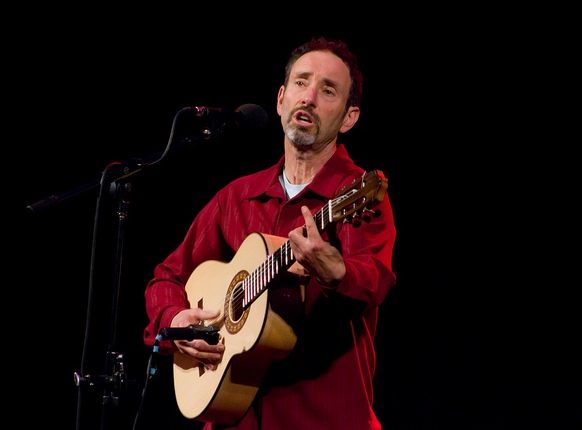
I’m still following up on a deluge of links related to my “Sweet Jane” essay. This weekend I stumbled upon an irresistible podcast honoring Lou Reed’s birthday last March. In it, Jonathan Richman talks about hanging around with the Velvet Underground as a “high school squirt.” Worth a full listen for sure. Richman, a notoriously difficult interview subject, opens up quite a bit.

Here’s one of his observations that resonated for me (it’s at about the 18-minute mark):

I got to hear the sound in the room, the way things were then. Your listeners who weren’t there then should know this: music then didn’t sound at all the way… The Velvet Underground were one of the loudest groups of 1967-68, as far as the volume they played at, and you wouldn’t hear them today. Every high school band that plays at a street fair is louder by far than the loudest bands were then. The equipment they have now wasn’t even invented then, and no one used it like that.

You would hear the sound of the amplifiers themselves in the room. People didn’t plug things into a PA system unless they were playing in a football stadium. So you heard the sound of these amps… The sound was colorful and distorted, and it broke up. People nowadays would say, “Turn up!” They wouldn’t even realize that the band was playing now. Just because volume has changed so dramatically. And it’s not just volume — that actually changes the sound. You heard all these tone colors, it was a very intimate thing.

You’ve got to know that to feel the way the music felt. it was not the way music sounds now. Your ears didn’t ring after every show.

This is fascinating in itself. It’s also useful as a metaphor for thinking about how we all sound online today.

Scale changes tone. Subtleties that are audible when you are speaking to ten or a hundred people may disappear when you address a thousand or a million.

So: Think before you plug your amp into the PA! Literally and figuratively.

Filed Under: Features, Project

Doing is knowing: “Sweet Jane” and the Web

August 10, 2014 by Scott Rosenberg


Lou Reed at Web 2.0 2006

I. Turn around and hate it

Lou Reed cast a stony stare over a hotel ballroom packed with entrepreneurs, venture capitalists and geeks. It was November 8, 2006, the peak of the last Web bubble — remember? the littler one? the one between the monster bubble that ended in a big mess in 2000 and the bubble we’re in now that will end in another big mess one of these days?

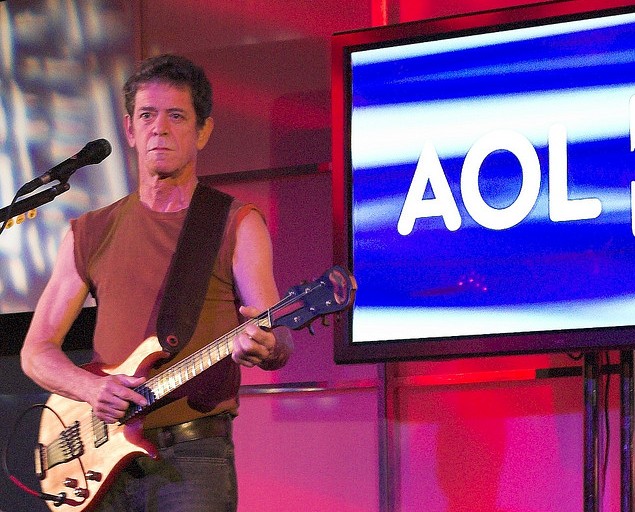
That one, right: the bubble we called “Web 2.0.” That was also the name of the conference that Lou Reed was very visibly getting pissed off at — because, as he stood there and played his guitar and sang his songs, the geeks and VCs and founders weren’t listening. They were talking.

Reed was not known for suffering fools or turning the other cheek; he was famously prickly. (One live track from 1978 captures a rant he directed from the stage at a critic: “What does Robert Christgau do in bed? I mean, is he a toe fucker?”) So maybe the whole idea of having him serve as the after-dinner entertainment for a Web-industry conference hadn’t been so bright. But here we were!

Reed stopped playing. An AOL logo haloed his leathery face. While one of his two accompanying bassists vamped, he began barking at the crowd.

“You got 20 minutes. You wanna talk through it, you can talk through it. Or I can turn the sound up and hurt you.”

This suggestion from the man who wrote “Vicious” elicited a wan cheer.

“You want it louder? Frank, turn it up!”

Turn it up Frank did, to ear-punishing levels. That pretty much ruled out talking valuations and pitch decks and APIs with the person next to you. The whole event now felt like an encounter between hostile forces: disruptive market capitalism versus disruptive confrontational art.

Web 2.0 was supposed to be all about user participation and network value. It was idealistic about building open platforms to empower individuals and crowds — while remaining a little coy, if not outright cynical, about who was going to reap the profits resulting from what those individuals and crowds actually did on those platforms.

Maybe it was only to be expected that the folks who had championed peer-to-peer interactivity and comments and “user-generated content” would not sit back and just passively consume the performance in front of them. Or maybe they were just being rude. Either way, it did not look like it was going to end happily.

If you were sitting near the front of the ballroom, as I was that night, this was the moment when you became aware of some kind of commotion toward the back. Had fisticuffs broken out? Was there a medical emergency? No, it was Tim O’Reilly — the publisher and tech pundit who’d coined the term “Web 2.0” and cofounded the eponymous conference — doing a herky-jerky dance, all by himself, wobbling down the aisle like an off-balance top.

It was brave and a little nuts, and for quite some time O’Reilly was on his own. But it gave us something to look at besides Angry Lou’s glare, and it defused some of the tension in the room. Finally, someone else stood up and joined O’Reilly; then a handful of people more. When Reed broke out the chords to one of his best-known songs, the room burst to life. People stood up, dancing or clapping. With relief, we eased into our role as “the audience.”

That song was “Sweet Jane.”

II. Other people have to work

I first heard “Sweet Jane” in 1970, age 11, sitting on the floor of my older brother’s room in Jamaica, Queens. I had no idea what the words were or what the song was about, and I didn’t care. All that mattered was that riff. Just three syncopated chords! Well, four, really — as Reed will explain for you, and Elvis Costello, here:

Also: a pushy bassline that elbowed its way on either side. A mid-tempo beat like a gleaming railroad track. And Reed’s baritone, deployed in some crazy mashup of Beat recital, Wagnerian sprechgesang, and rap, stepping in and out of the way, spitting out words as if between cigarette puffs. It all worked, just as “Louie Louie” had, and “Wild Thing,” and “Twist and Shout,” and all the other hook-driven songs that most people had stopped listening to by 1970.

Don’t know it? Take a listen:

So I listened, too, over and over — not yet aware that Reed’s group, the Velvet Underground, had started out as Andy Warhol’s house band and explored shadowy frontiers of sex, drugs, and noise for years with no commercial success and had already broken up when Loaded, the album featuring “Sweet Jane,” came out.

It was decades later before I actually paid attention to the song’s words. They had gone through many changes before Reed settled on the version recorded on Loaded, and they remain cryptic in places. But it’s clear what “Sweet Jane” is all about: A rocker glimpses a couple of friends. Thinks about their mundane lives. Weighs taking the cynical view, and rejects it — concluding that no, beauty is not a scam, goodness is not a lie, and both can be found in the stuff of everyday life.

The song is aggressively untrendy, anti-hip, playing against all the fashions of 1970. It rejects both lazy downtown nihilism and counterculture protest. It offers a little nostalgia for old-time “rules of verse,” classic cars — even classical music. It embraces the working life of banker Jack and clerk Jane, and winks at them with a playful touch of cross-dressing kink. (“Jack’s in his corset, Jane is in her vest” — although, for years, I thought Reed was saying “Jack’s in his car,” and to this day so do many of the lyrics sites.) But the song only nods to the demimonde; it’s more the stay-at-home type.

“Sweet Jane” moves, verse by verse, from standing on a street corner to sitting down by the fire to pondering the meaning of life. Near the end it takes full-throated flight with this emphatic credo:

Some people, they like to go out dancing
Other people, they have to work
And there’s even some evil mothers
They’re gonna tell you that everything is just dirt

That women never really faint
And that villains always blink their eyes
And that children are the only ones who blush
And that life is just to die

But anyone who ever had a heart
They wouldn’t turn around and break it
And anyone who ever played a part
They wouldn’t turn around and hate it

It’s easy to get distracted by the curled lip, the black leather, the shades, and the swagger — all part of the “Lou Reed” act, and all intentionally misdirecting your gaze. But in “Sweet Jane” Reed made very clear that, if you could for just one second stop his guitar hook from looping in your brain and listen to his words, he was always, at heart, an idealist.

III. I’m in a rock and roll band

I learned to play the guitar so I could play “Sweet Jane.” There were only three chords. (Oh, right, four.) It couldn’t be that hard, and indeed it wasn’t.

But for the longest time, playing any chords was, for me, a foreign country. No one I knew as a teenager had a guitar — the kids I ran with played D&D, not Dylan. It wasn’t until my mid-20s, in the ’80s, that I figured out this was something I could actually do. I went with a kind and knowledgeable friend to a little shop on Mass Ave. in Cambridge, bought a cheap acoustic, crossed the street with it to my apartment, and realized just how easy it was to put D, A, and G together. I sounded awful for a long time. But the guitar is a forgiving instrument, and I could coax just enough joy from it to keep me going.

“Sweet Jane” was a starter drug, and since then I’ve learned to play other favorite songs. (“Waterloo Sunset.” “Pinball Wizard.” “Welcome to the Working Week.” Half the Mountain Goats catalog. And so on.) I remain a lousy guitarist, a lefty-playing-righty with a vigorous strum and not much else. But I’ve learned what musicians have always known: Playing a song changes your understanding of it. Playing music changes how you listen to it. Doing changes knowing.

Anyone who wants to learn “Sweet Jane” today can look it up on YouTube and get schooled by gawky kids and middle-aged instructional-video peddlers and all sorts of other people who have chosen to say, “I will show you how I do this.” You can listen to and compare a fat catalog of live performances by Reed and covers by others. (You may visit the “Sweet Jane” Museum I have assembled here, if you like.) The Web has, among many other achievements, allowed us all to produce and share the instruction manuals to our DIY dreams. Pickers and strummers everywhere who have posted your clumsy, loving, earnest videos: I thank you and salute you!

Yet this eruption of knowledge-sharing is usually understood, and often dismissed, as an essentially marginal phenomenon. Let the passionate indulge their pastimes, but we’re basically talking hobbies here, right? Consequential things involve cash. They are metricized and monetized.

The same logic was used for years to belittle the rise of blogging, at a time when it was though to be a pursuit fit only for the pajama-clad. “That’s cute,” said the insiders and the media-savvy. “But it is of no consequence.”

Yet the consequences were real and substantial. Large numbers of people discovered a new opportunity to control a media platform and project a personal voice into the network. Before you knew it, blogs were being metricized and monetized. Then Facebook and Twitter came along and made it far easier for people to post, share, and kibitz without committing to a regular publishing project. These platforms moved quickly toward metrics and monetization, too.

Whether we are teaching guitar or ranting about politics or blogging about our lives, the trend here moves inevitably from small numbers to large, from private pursuit to professional endeavor, and from labor-of-love to cashing in or out. There has been no shortage of analyses and tools to help us understand the numbers and the money at each stage of this evolution. And we have held lengthy, valuable, and — yes — repetitive arguments about the impact of these changes on the collective mediasphere. Do they enrich or impoverish public discourse? Is there more variety or less? More choice or less?

But we haven’t kept as close an eye on how each turn of the digital-era wheel affects us, subjectively, as individuals. That is, we have looked at the numbers and the economics and the technology, but not so much at how the experiences we’re having in our newly-constructed digital environments are shaping us. It’s only recently that we have begun to ask whether Facebook makes us happy (or unhappy), Twitter keeps us connected (or distracted), our devices serve us or the companies that supply them.

One thing we can say with some certainty is that, for the first time in the still-short span of human history, the experience of creating media for a potentially large public is available to a multitude. A good portion of the population has switched roles from “audience” to — speaker, creator, participant, contributor, we don’t even have the proper word yet.

Forget whether this is “good” or “bad”; just dwell with me for a moment on its novelty.

Millions of people today have the chance to feel what it’s like to make media — to create texts or images or recordings or videos to be consumed by other people they may or may not know. Whether they are skilled at doing this is as beside the point as whether or not I can play “Sweet Jane” well. What matters about all this media-making is that they are doing it, and in the doing, they are able to understand so much more about how it works and what it means and how tough it is to do right — to say exactly what you mean, to be fair to people, to be heard and to be understood. If you find this exciting, and I do, it is not because you are getting some fresh tickets to the fame lottery; that’s the same game it’s always been. It’s because we are all getting a chance to tinker with and fathom the entire system that surrounds fame — and that shapes the news and entertainment we consume every day.

The Internet, with all its appendages, is one big stage. There is no script and no director. We cast ourselves. There’s no clear curtain rise or drop. Each of us has the chance to shine for an instant, to create a scene, and to embarrass ourselves. The house is crowded and moody and fickle and full of hecklers; sometimes people are paying attention to you, but mostly they’re not. And, let’s face it, the show itself is a mess. Yet there is so much to learn from the experience.

In the pre-Internet era, already receding into the murk, you couldn’t just step out onto this stage — the roles were rationed. To get one, you had to be lucky or wealthy or connected to the right people or so astonishingly good you had a shot at not being ignored. “Those were different times.” We assumed that those limits were eternal, but they turned out to be merely technical.

To this day, two decades after I first glimpsed a Web browser, this change knocks me flat and makes me happy. It doesn’t solve all our problems and it doesn’t fix everything that’s wrong with the digital world. But it gives us a bright ingot of hope to place in the scales, to help balance out everything about the Net and social media that brings us down — the ephemerality, the self-promotion, the arms race for your eyeballs, the spam, the tracking, the ads, and the profound alienation all of the above can induce when you tally its sum of noise.

This hope can be elusive, I know. It is deeply non-metric, invisible to A/B testing, and irreducible to data. It does not register on our Personal Digital Dashboards or vibrate our phones. It is still unevenly distributed, but it is more widely available than ever before. It lies in the gradual spread, one brain at a time, of a kind of knowledge about ourselves and one another that until very recently was held tight by a very small group that made mostly cynical use of it.

(One reason this idea remains relatively invisible in the conversation about social media is that so many of the journalists leading that conversation are professional cynics prone to missing its importance because of the nature of their work. Just as the things I learned about music by teaching myself “Sweet Jane” would be blindingly obvious to a professional guitarist, so the general public’s education in media basics thanks to the Internet elicits shrugs from most of the professional press. That doesn’t make it any less extraordinary.)

Any experience of authorship gives you a piece of this knowledge — the knowledge of the storyteller, the musician, the crafter of objects, the dreamer of code. In a media-saturated world that will eagerly tell us who we are if we let it, acquiring the confident insight, the authority of media-making, is both a necessity and a gift.

What is it that you learn from being a media actor and not just a media consumer? What do you come to know by playing a song and not just listening to it?

I don’t think the answer is reducible to bullet points. For me, two ideas stand out.

One is: Define yourself if you get the chance — if you don’t, others will be happy to do it for you.

The other is: Empathy.

IV. Anyone who ever played a part

Onstage that night in 2006, Lou Reed sure looked like he hated being there. For years afterwards, I kept that show filed in my memory under both “symbolic moments of despair” and “high-water marks of tech-industry hubris.” Today I’m a lot less certain, and much slower on the condemnation trigger.

Yes, the audience had sat there and essentially said: We’re rich and we’re building the future and we’re so cool that we can turn icons like Lou Reed into our private entertainment — and then not even pay attention to him!

And Reed? He responded with a big raised middle finger: “I’m here to serve,” he rambled, icily, during one song break. “It’s the moment I’ve been living for my whole life. I was on St. Mark’s Place and I thought, someday there’ll be a cyberspace, and an Internet…”

All that happened. And yet to frame the encounter as “philistine businesspeople vs. sellout artist” isn’t just reductive; I don’t think it’s accurate.

Remember: The Velvet Underground were famous for having failed to get the world to pay attention to them. Their live recordings, like the beloved Live 1969 album, have always sounded lonely. There are, maybe, three people clapping. The band’s albums sold miserably, to just a handful of devotees — though, as Brian Eno famously quipped, “every one of them started a band.”

I wouldn’t assume that Reed and his bandmates were indifferent to all this indifference. But it didn’t stop them from writing, or playing, or mattering.

I kept thinking about that strange collision-of-cultures show at Web 2.0 over the years, especially after the news of Reed’s death last year. What was he really thinking that night? Pestering Reed with questions about it is no longer an option. So I tracked down Jonathan Miller, then the CEO of AOL and the person who arranged the whole event, and asked him.

Miller and Reed met when Reed appeared in a 2002 AOL video shoot, and they studied with the same tai chi master. “We were trying for more of a presence on the West Coast,” Miller recalled. “We were the primary sponsor of the conference, and that gave us the right to designate a musical act for the night. I thought, we gotta have a little attitude. Lou embodies doing it your own way.”

So Lou Reed was going to lend AOL a little bit of his edge. Could be tricky! How pissed off was he, really?

“We went out for dinner afterwards,” Miller says. “He was okay with it. He said, ‘That wasn’t the first time I had to do that.'”

Neither Miller nor conference host John Battelle remembers (or will say) what Reed was paid for the show. Clearly, on some level, the performance was a simple transaction: Musicians have bills to pay, too, and today they have a harder time than ever — thanks in good part to the disruptions of the tech industry. If Lou Reed could earn a few bucks by renting out his attitude, who are we to throw stones?

On another level, it made absolutely perfect sense for Reed to be there at Web 2.0, talking to (or glowering at) the people building the media platforms of the future. In his own way, Reed was a geek, too, a connoisseur of guitar sounds, electronic gear, and audio experiments.

At the modest peak of his commercial success in the mid-’70s, he’d released a technologist’s dreamwork: a “difficult” double album titled Metal Machine Music presenting a symphony of pure feedback that is, depending on your opinion, either a groundbreaking work of pristine abstraction foreshadowing ambient and techno or a colossally bad joke that fell deservedly flat. (I think it’s kind of cool to write to.) In the late ’70s, Reed recorded several albums using a “binaural audio” technology intended to one-up traditional stereo. In Laurie Anderson’s moving piece eulogizing Reed, her partner and husband over two decades, she recalls the locus of their first date — a music-tech gear show. Patti Smith, in her tribute to Reed in the New Yorker, wrote, “An obscure guitar pedal was for him another kind of poem.”

So Reed could have been quite at home among the Web 2.0 crowd. But nobody felt at home that night — it was an orgy of awkwardness all around. See for yourself: 2006 was pre-iPhone, but there were some people in the device-forward conference crowd who kept their cameras handy, and crude videos of parts of the show turned up on YouTube. Here’s that Sweet Jane performance.

Pretty uninspired and uninspiring, no? What I see most, watching that clip and playing the event back in my memory, is Lou Reed having a lot of trouble, at that moment, being Lou Reed. So he falls back on tired mannerisms, a belligerence and cynicism that the songs he was performing had already transcended.

It never stops being hard to be yourself, whoever you are. To the extent that our time online gives so many of us space to work and play at doing so better, I’m grateful for it. I’m not going to hate it, even when it ignores me, or tracks my clicks, or lobs tomatoes at my face.

That night in 2006 was the last time I saw Reed perform in person, but it’s not how I want to remember him. I prefer this story, a recollection by film director Allan Arkush (as posted last year by Anne Thompson):

I asked Lou when it first struck him that he was indeed ‘Lou Reed.’ He told me that starting with “Transformer” in 1972, people came up to him on the street all the time and shared drug experiences or stories of being on the fringe of societal standards of behavior and how his music had inspired them to these extremes. Hearing those personal tales of decadence just made him uncomfortable and he did not like being the “Lou Reed” connection for only those types of experiences.

He told me a story of when he was most happy being ‘Lou Reed.’ It was in Manny’s Music Store (a very famous place where guitarist Mike Bloomfield bought the Fender he used on ‘Like a Rolling Stone’ on his way to that session, and countless other amps, guitars and basses that mark the history of rock were purchased). Lou was just hanging out, buying some new guitar strings, when he noticed that a young teen with his dad were shopping for his first Fender guitar. The kid was 13 or so and practically shaking with excitement as he had just put on the Telecaster and was being plugged in–a very serious part of the ritual of buying a guitar at Manny’s.

Lou was wondering what this geeked-out teen would play to test out his momentous purchase. After some tuning and a squall of feedback from being turned up to 11, the boy launched into the opening chords to “Sweet Jane”; the riff turned everyone’s head in the store. In his typical dry and penetrating manner, Lou looked at me: “That’s when I said to myself, ‘Hey. I’m Lou Reed!'”

For your listening pleasure: Visit the Sweet Jane Museum

Filed Under: Features, Project

« Previous Page
Next Page »