
Wordyard

Hand-forged posts since 2002

Archives

About

Greatest hits

Archives for June 2014

The simple reason Facebook’s mood study creeps us out

June 30, 2014 by Scott Rosenberg

puppets

By now I’m sure you’ve heard about that Facebook study of “emotional contagion,” in which the company (along with two researchers) tinkered with the newsfeeds of 689,000 users in 2012, to explore whether moods can spread based on the tenor of posts. (This Atlantic roundup will get you up to speed.)

Many academic observers are up in arms because experimenting on people has a long tarnished history, and there are rules around it that this study may have bypassed. The facts remain fuzzy there (just look at the crossouts in this piece!), but the issue is real.

The pushback, in turn, is that Facebook, like all big tech companies, does this sort of thing all the time; nothing happens on Facebook without A/B testing! So get over it.

Finally, there is a contingent of commentary that declares the experiment to have been “creepy,” for reasons that we can’t quite express but we viscerally share. You might say the news of this study has itself become an “emotional contagion.”

The most common explanation for this creep factor is that we recoil from the study’s exposure of Facebook’s “commercial behaviorism.” The researchers appear to have callously treated Facebook users as test subjects, rats in a Skinner box. No one enjoys that role; thus the mass creep-out.

I’m sure there’s plenty to that, but I think the public recoil is based on something even simpler. Facebook’s central idea — its “value proposition,” in bizspeak — is that if we give it a list of our friends, it will provide us with a personally tailored stream of their posts and shares. That stream, the newsfeed, is a phenomenally successful product — a river not of news but of social info. We know Facebook doesn’t show us everything, but to each of us, our newsfeed feels like a space that has been put together just for us.

It feels like home. But in fact, of course, it’s a private space that someone else owns. Most of us have never read the rental agreement. And until something like this mood study comes along, we don’t even think about the terms under which we live there.

So the true creep-out in Facebook’s study isn’t about research ethics or Skinner boxes; it’s about ownership of space. The “emotional contagion” study dramatically rips off a curtain that separated Facebook’s public face and its backstage. Publicly, Facebook woos us with a vision of a social information stream shaped by our individual needs and networks; backstage, the folks behind the curtain are pulling levers to find more efficient ways to hijack our attention and sell us stuff. (The frontstage/backstage theory sounds like The Wizard of Oz but is actually Erving Goffman’s.)

It all works beautifully until something wrecks the, um, mood. Facebook’s endless privacy snafus and “context collapse” disorders do that. Ads can do it, too, which is why Facebook has moved so gingerly to insert “sponsored posts” into the newsfeed.

The mood study is a perfect storm for Facebook because it’s not about privacy or ads or any other longstanding bone of social-network contention. It’s a pure instance of frontstage/backstage collapse. All it does is dramatically illustrate that, in the space so many of us have adopted as our digital home, we don’t call the shots.

Something that we’d embraced as organic and authentic — literally, “friend-ly” — proves instead to be crudely instrumental and manipulative. Everyone hates when that happens!

Of course the dustup won’t kill Facebook. It probably won’t even materially affect its business. But it is one more step in awakening the universe of Facebook users, which is nearly all of us, to ou predicament: We only think the place is ours. And the landlords — well, they really can be creepy sometimes.

Filed Under: Features, Project

Links: Butt-biting facades, fake followers, a new mesh Net

June 28, 2014 by Scott Rosenberg

botox sale

(Fake) friends with (Real) benefits (Gilad Lotan) – Data scientist Lotan spent five bucks to buy 4000 fake followers on Twitter. (You can analyze what percent of your Twitter following is real or fake using this tool.)

Even more interesting, at least to me, was what my fake followers did for me. My Klout score almost instantly shot up. I was not impressed by that until I realized that Microsoft’s search engine, Bing, collaborates with Klout, so that a higher Klout score put me higher on Bing’s search results.My completely fake numbers on one platform had a very real effect on a completely different service.

Inside the Mirrortocracy (Carlos Bueno): Sharp analysis of how tech startups use “culture” and “fit” as code to justify a diversity-limiting (and self-defeating) approach to hiring only “people like us.”

The Culture can’t really be written about; it has to be experienced. You are expected to conform to the rules of The Culture before you are allowed to demonstrate your actual worth. What wearing a suit really indicates is — I am not making this up — non-conformity, one of the gravest of sins. For extra excitement, the rules are unwritten and ever-changing, and you will never be told how you screwed up….If spam filters sorted messages the way Silicon Valley sorts people, you’d only get email from your college roommate.

The music industry is still screwed: Why Spotify, Amazon and iTunes can’t save musical artists (Andrew Leonard): Nearly 20 years into the digital music revolution, we still haven’t really figured out how to properly support creative artists. But we’re working on it!

But $2 million in 12 months for Patreon artists is nothing to sneeze at. Clearly, as a society, we do want to support the creation of art and music. So we are faced with a terrific, inspiring challenge: finding ways to use technology to build connection and community even as the old world disintegrates around us. Michael St. James is right to worry about what will happen around the corner, but probably wrong to fret about music itself being doomed. Because we’ll still need it to free our souls. And if people stop making it because they can’t make a living from their streaming royalties, then we’ll be forced to flock to places like Patreon, to keep music alive.

Pay it forward (Karen McGrane): A New York Post feature described how some professionals, particularly time-starved freelancers, are beginning to tell youngsters who approach them for “informational interviews” that they’re going to have to pay. McGrane, like me, thinks that’s a mistake.

Not everything in our professional lives is a transaction, scrutinized and evaluated against how much it costs us, how much someone should pay. Not every teaching relationship must be formalized—a mentoring opportunity, a coach, an internship. Not every investment of time has to be “worth it.”

Our Incredible Journey: You know when a big company gobbles up a little one and the founders of the little one announce how excited they are and how unfortunately the service that they built must now be shut down, but thanks for joining them on their incredible journey? This Tumblr gathers instances — where “acquihire” means users lose. [Via Lane Becker @monstro]

Sex and Silicon Valley: the veritable arms race of the dating app industry (The Guardian): What lengths will people go to dress up their online dating profile pictures? Long lengths indeed. The following quote is remarkable not only for the metaphor overload but for the plastic surgeon’s bluntness about about the nature of his work.

Before taking their profile picture, some trek to dermatologists like Seth Matarasso, who runs an upscale clinic, for Botox injections. “It can backfire, almost like false advertising,” he said. “You put up a facade, eventually it’ll bite you on the butt.”

Is there such a thing as the self? (Jim Holt): The invaluable Holt reviews two books on identity, one by philosopher Barry Dainton and the other by science journalist Jennifer Ouellette.

According to neuroscientists, there is no single place in the brain that generates a self. According to psychologists, there is no little commander-in-chief in our heads directing our behaviour. According to philosophers, there is no “Cartesian ego” unifying our consciousness, no unchanging core of identity that makes us the same person from day to day; there is only an ever-shifting bundle of thoughts, feelings and memories… The basic question about the self is: what, in essence, am I? Is my identity rooted in something physical (my body/brain) or something psychological (my memories/personality)? Normally, physical and mental go together, so we are not compelled to think of ourselves as primarily one or the other. But thought experiments can vex our intuitions about personal identity.

On Taxis and Rainbows (Vijay Pandurangan): Anonymity is hard! Fascinating description by a developer of how simple it was (for him, with a little help from Amazon cloud services, elastic mapreduce and other tools) to de-anonymize a year’s worth of New York City taxi data.

To digital marketers, “Onboarding” means loading your offline self into your browser’s cookie: An FTC report fascinatingly defines the marketers’ process of connecting your offline identity with your online profile and delves into the mechanics. [via Alexis Madrigal’s Five Intriguing Things email]

Maybe it’s time to build a new internet (Mehan Jayasuriya): After the NSA and Comcast and all, “might we be approaching the point at which the internet’s centralization begs for a technological solution?” I say: yeah.

The thought of building a new global network from scratch might seem herculean but similarly ambitious projects have been successfully undertaken in the past by hobbyists…. Remarkably, both FidoNet and Usenet were crafted using technology that now seems downright antediluvian: phone lines, dial-up-modems and computers less powerful than modern calculators. The situation today is, of course, very different. Powerful, WiFi-enabled devices can be found in the majority of American homes, be they laptops, smartphones, tablets or routers. This provides massive potential for so-called “mesh networks”—networks that connect devices directly to each other, forming a sort of daisy-chained connection that requires no central access point.

Filed Under: Links, annotated, Project

Interviewing the ex-audience #2: Sylvia Paull

June 27, 2014 by Scott Rosenberg

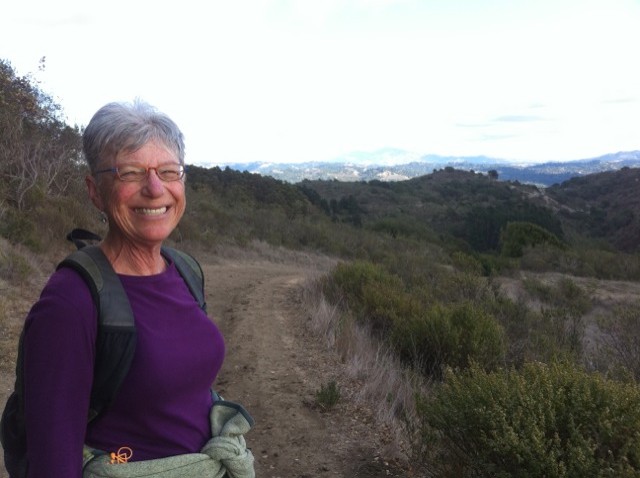
Sylvia Paull

This is the second post in my homage to Spalding Gray’s “Interviewing the Audience” — this time, with a spotlight on someone I’ve know for two decades. I first met Sylvia Paull when I somehow stumbled on the Cybersalon she was hosting in her Berkeley living room in the early ’90s. She is a great connector of people and ideas; these days she runs two different lunch series (one tech-oriented and one for women to share ideas) and hosts speaking events at the Hillside Club, still under the Cybersalon rubric.

A Fast Company profile once called Paull “a public relations icon.” Yet unlike so many who have labored in that field, she is fearless about speaking her own mind. I’m grateful for the time she took to answer my questions.

Who are you and what are you up to? Tell us a little about yourself — or a lot.

Who is Sylvia? That’s my email moniker, the title of a Shakespeare sonnet and a Schubert lieder, and it’s a question I ask myself every day. I’m a writer who makes her living writing for high-tech startups and nonprofits that want to be covered by media, attract an audience, and become famous for what they do.

I was the first U.S. citizen born in Germany after WWII, in 1946, and General Dwight D. Eisenhower came to visit me and my parents at the U.S. Army hospital in Frankfurt am Main. My father, trained as a conductor, was Eisenhower’s bandleader; he met my mother, a German Holocaust survivor, right after WWII when he went to find missing relatives at the Jewish refugee services, where she was working. They regarded my birth as something of a miracle. My birth certificate, which is in German, identifies me as neither German nor American but as “Israelisch.” Like many Jews of my generation, I was named after a dead relative. One of my first memories is of two Yahrzeit candles burning on the mantelpiece of our San Francisco home and my mother telling me they stood for her father and her mother.

Our house was filled with music, food, and absence. My father was gone for 18 months when he led a U.S. military band in South Korea during the so-called Korean conflict. He said that General Douglas MacArthur, the military commander, refused to let his soldiers put on winter clothing until the final victory march. There was no victory, and all of the men in my father’s band were left behind to freeze in Chinese prison camps. My father, because he was an officer, albeit the lowest ranking chief warrant officer, was in the last batch of troops ferried to an escaping ship.

Another early memory: I am five years old waiting for my father to come off a troop ship anchored in San Francisco Bay. If I listen, I can still hear the ship’s horn echoing through the fog. The ship’s passengers are quarantined because of some illness, and we stare out of the window in the Sunset District, waiting for our father to appear out of the mist. He finally comes, much heavier than before, wearing a thick winter coat. Every week during his absence, my mother had baked a marble cake — swirling chocolate into vanilla batter, which my sister and I got to taste by licking the prongs from the electric beater and the mixing bowl — and sent the cake to Korea. Dad lived on those cakes, and also canned beans, because he wouldn’t eat non-kosher meat.

I asked him if he ever shot anyone, and he wouldn’t tell me. He did say the band played live music at the front lines while the Chinese placed tape recorders and speakers in the terrain to rouse their troops to battle.

We later moved to Bremerhaven, Germany, where I got my first bicycle and pedaled over cobblestone streets. We lived in a military zone, occupied by the British and the U.S. I had to be careful never to go off road because of live landmines. Convoys of tanks regularly commandeered the roads, and I’d weave my one-speed bicycle, decked out with embroidered badges and flags, between them. At the U.S. Army school, we played ghost in a bomb shelter left over from WWII, and on Sundays, my dad would take us to a desecrated Jewish cemetery and read us stories from the Old Testament. On weekends, we went to the local opera house, rebuilt after the war, and listened to light operas like Die Fledermaus, and ate chocolates filled with real liquor.

I am a product of WWII, and although I am and have always been an American, I feel European and also part of a world that no longer exists. It’s ironic, because I make my living by celebrating the disruption of former worlds.

What does “being yourself” mean to you? what do you do that makes you feel most yourself?

Writing and bicycling make me forget who I am. Instead, I become what I do. Once I dreamt I was writing a great novel — in German — and when I woke up, I had the certain feeling that I would write that book some day. When I was 50, I took up amateur bicycle racing and raced all over Northern California. I remember a breakthrough race when my body just took over — my mind disappeared — and I felt as if my purpose in life was to bicycle fast. When my mind did reappear, it said, “This is what life is all about.” Having a child was like that, too.

Is there anything (or things) about the Web and social media today that you think get in the way of you “being yourself” — or other people being themselves?

It’s scary how ubiquitous computing has become. Going anywhere, people are always checking their mobile devices. Maybe this puts them more in touch with themselves than looking at random people and objects in the street would do, but it just seems weird and kind of habit-forming.

I used to smoke cigarettes, and the need to constantly check one’s mobile device reminds me of the nicotine habit.

What’s your media diet? How do you go about choosing what you read, see, listen to?

I read good writing, usually in print form because it’s easier on the eyes and I’m used to print. (I used to work in the UC Printing plant, where typesetters laid lead type by hand.) Every day I read The New York Times, which is delivered to my place. I start with the obituaries, then the op-ed columns, the arts, business, and finally, the “news,” which is old by the time it appears in print. I choose to read whatever my favorite reporters write, people like Patricia Leigh Brown, Kim Severson, David Carr, and Dwight Garner (these are all NY Times bylines).

I read Re/code for tech news because the writing and curation demonstrate a standard for selection, whereas most tech sites churn out whatever press releases come their way.

I’ve been reading The New Yorker since I was nine. I take handwritten notes on articles and stories I like and look up words I don’t know.

I don’t have a television and do not watch TV shows on the Internet. The only live videos I watch are bicycle races like the Giro d’Italia and the Tour de France. I watch Netflix movies, mostly foreign films and particularly German movies, which are usually grim. I also go to movie theaters regularly, as well as Berkeley Rep, and the Hillside Club for concerts.

I listen to a variety of Internet radio stations, from college stations across the country to the Mozart channel and Cajun music. I rarely listen to radio news, except once in a while I’ll turn on NPR while I’m preparing a meal. I used to co-produce a radio show on science for UC called Science Editor, so I’m jaded about radio news and interviews. I know what goes into the sausage.

I give money to KQED, Grist, the Center for Investigative Reporting, and Berkeleyside because I support independent journalism, but I don’t always read everything they send me. If I only have two hours a day for absorbing news, then I’ll stick to the Times and Re/code.

Give us a link to something you made, or something you love, or something that you want the rest of us to see!

Years ago, Dave Winer got me started on a blog: whoisylvia.typepad.com. It’s become a forum for me and myself, since most people don’t have time to read other people’s blogs, myself included. I also host several events, more like salons, where I like to get people questioning the way we think about work, play, and life in general. These are listed on my web site at www.sylviapaull.com.

Filed Under: Interviews, Project, Uncategorized

IndieWeb ho! A brief intro to a little movement with big ideas

June 26, 2014 by Scott Rosenberg

Independent Rider Rally
If you believe, as I do, that

  • Good things start small;
  • Open technology is more attractive and reliable than proprietary technology;
  • The Web works best when we connect as autonomous individuals in public space rather than as customers in private space;
  • Playing around with new Web tools is fun even when they’re not quite ready for prime time;

then you will be as excited as I am about the IndieWeb. Self-described as “a people-focused alternative to the ‘corporate web’,” the IndieWeb is an umbrella term describing what is at once a movement, a concept, and a set of nascent software tools.

To date it has manifested itself mostly in the form of informal working meetups called IndieWebCamps (the first was in 2011). The next one is this weekend, taking place both in Portland and in NYC, with some farther-flung outposts checking in as well. Since Wordyard is both a place for me to write about stuff like the IndieWeb and also to put some of these tools to use, I’m going to Portland — both to report and to participate.

There is no single iconic IndieWeb project, protocol, or standard. Here are some exemplary initiatives (these are just the ones I’m most familiar with — there’s a fuller list here):

  • IndieAuth: Method for using your own domain name to sign in to websites.
  • Bridgy: Service that feeds social-media comments on your posts back to your personal site.
  • Known: Personal publishing/community platform in development, based on IndieWeb principles.
  • P3K: Personal publishing and status updates, based on IndieWeb principles.
  • IndieBox: “Personal cloud”-style hardware for managing personal data.

That should give you a quick sense of the breadth and heterogeneity of the work by IndieWeb enthusiasts. The spirit here isn’t “let’s conquer the world”; it’s “let’s stop just talking about this stuff and start getting it to work for ourselves.” The IndieWebCamp “Principles” page is a good read if you want to understand the ideals at work behind these projects.

Wired ran a thorough write-up last summer under the headline “Meet the Hackers Who Want to Jailbreak the Internet.” Since then the IndieWeb has largely flown under the tech-media radar.

In a world where the press is mostly occupied with handicapping the participants in a corporate Battle of the Behemoths, that’s only to be expected. But I think it’s a mistake.

Unless you enjoy tinkering with unfinished software on your website (some of us do!) most of these projects aren’t going to serve your needs — yet. The IndieWeb’s collective project is simply not ready for prime time or mass adoption. And sure, it’s possible that it may never be. It may always be for pros and semi-pros, developers and technical sophisticates.

On the other hand, every time I hear that line about some new technology, I think, you know, that’s what they said about the Internet in 1993.

Filed Under: Features, Project, Uncategorized

Why Amazon vs. Hachette should have news publishers quaking

June 25, 2014 by Scott Rosenberg

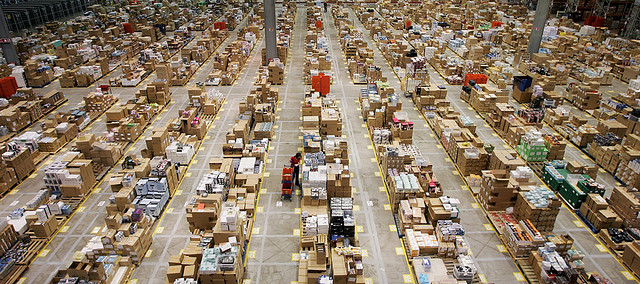
Amazon UK Warehouse

Proposition: Amazon is to Hachette as Facebook is to all news publishers.

You know about Amazon’s dispute with book publishing giant Hachette, right? Amazon and the collective book publishing industry have been locked in a long-term war over the price of ebooks, and that’s now left the World’s Biggest Bookstore with some unusual gaps on its shelves. There is no underdog in this fight; it’s two colossal, unsympathetic combatants rolling in the mud — the Eastern Front of the online trade wars. (Here’s a good primer on the fight.)

Amazon is powerful today because over the past 20 years it has become the central chokepoint for distribution of both physical books and ebooks. It’s not a full-on monopoly yet; it’s got one ailing large-company competitor still in Barnes & Noble, and a sea of plucky independents will still sell us books. But it’s the key player. So when it says to a publisher like Hachette, “If you don’t play along you’ll pay a price,” it can extract a price.

Amazon vs. Hachette is a fascinating story in its own right, but today I want to use it as a lens to look at a different conflict — one that hasn’t flared yet.

Over the past 2-3 years, Facebook has begun to assume an Amazon-like role in the ecosystem of online news. We have quickly moved from a Web in which you got your readers either from search or from “organic” traffic sources (home-page visitors, regulars, and e-mail subscribers) to one where you get an enormous chunk of your readers directly from Facebook shares.

Partly this has happened naturally; so many of us love to graze on Facebook links! More recently, Facebook itself has goosed the process by deliberately opening a spigot of traffic to news publishers by tweaking its News Feed algorithm to favor their links.

When this happened last year, once it became clear that the changes favored actual quality journalism over viral linkbait, there was much celebration in newsrooms. Facebook was a savior. All you had to do was beef up your social-media team, A/B test your headlines and you could count on steady, impressive traffic growth from now till doomsday.

But there is an actual doomsday on this timeline. We know this because not that long ago Facebook pulled this same act with the entire world of consumer-facing business (or “brands,” as they’ve been dubbed in this arena). Facebook sold the “brands” on using its platform to connect with Real People, and brands leapt at the opportunity, pouring money and effort into building brand pages and huge followings, and everything was great until Facebook turned around and said, “Now we are demoting your posts — if you want to reach people you’ll have to pay us.”

If you are an editor or publisher or news executive today, you must know that Facebook is going to pull exactly the same bait-and-switch move on you. Feast on free traffic! Tailor your business around it! Now, pay up! Facebook has big post-IPO revenue goals it needs to deliver on; there is no question that this is going to happen — the only uncertainty is when.

I understand that publishers today have no choice but to engage with Facebook on some level: you go where your readers are, and right now, the readers are there. But smart ones will keep an eye on the world beyond Facebook. Sooner or later they are going to find themselves, just like Hachette, locked in a commercial struggle with the entity that increasingly controls their distribution. And they’re going to have even less leverage than Hachette does.

In upcoming posts, I’ll look at what concrete steps publishers can take to avoid the Facebook trap and build a more sustainable future.

MICROECONOMICS ADDENDUM: There’s an unusual wrinkle to my analogy that is of quantitative interest. Amazon wants Hachette to sell its ebooks cheaper than Hachette wants; it’s the classic Walmart squeeze-your-suppliers tactic. With Facebook and news publishers, the news publishers (almost but not quite universally) are already giving away their product for free. So the “lower your prices” squeeze manifests itself as a negative price — i.e., Facebook ends up asking the publishers for a fee to distribute their goods.

Filed Under: Features, Project, Uncategorized

Troll-slayer or name layer? How the Times/Post/Mozilla project could matter

June 23, 2014 by Scott Rosenberg

troll

Last week’s announcement of the latest big Knight-Foundation-funded effort to build a better digital mousetrap for news organizations prompted a wave of coverage that framed it as the latest effort to “solve the comments problem.” The new collaboration between developers at the New York Times and the Washington Post will be overseen by the folks at Mozilla Open News and funded by $3.9 million from the Knight Foundation.

Despite the announcement’s promise of providing readers with tools to “submit pictures, links and other media; track discussions; and manage their contributions and online identities,” virtually every story dubbed the project as a “new comments system” that would help large news sites like the Times and the Post surface the best reader comments algorithmically (the way Gawker’s Kinja platform does) — and maybe reduce the population of trolls and spammers.

Certainly, all this seems to be part of the project’s portfolio. But it is not — as the Washington Post’s piece put it — the “most ambitious aim” here. Coverage huddles around that idea only because we’ve collectively narrowed our understanding of the ways newsrooms can open themselves up. If the only thing readers can do is post a comment, then managing “reader engagement” boils down to catching trolls and starring valuable contributions.

But it looks like there’s a much broader ambition at work in this enterprise. “This isn’t another commenting platform for publishers; it’s a publishing platform for readers,” the Post’s Greg Barber says. Mozilla’s Dan Sinker, who will lead the project, writes on his own blog that the plan is to create “building blocks for engaging communities throughout the web” and that the resulting platform will be “open source at its core, and focused on giving users unprecedented control over their identity and contributions.”

See how this word “identity” keeps rearing its head? That’s because it’s the key to understanding the scope and promise of the project’s ambition. If you’re building a toolkit for two big competing newspapers to share (and for other publishers to adopt), you know that these institutions are never going to share user information. So this project can’t rely on any single proprietary approach to user accounts and identities. It will need some kind of open authentication standard or model.

In the past, news sites have typically either handled this problem in a one-off way on their own. Or they’ve handed it off to a third-party platform like Disqus or (increasingly today) Facebook.

There’s good reason for this! The technical community has long understood identity across systems as a profoundly difficult challenge. (Talk to the good people at the Internet Identity Workshop, who have been pursuing solutions for a decade.) Meanwhile, the business community has recently concluded that this game is over and Facebook won.

But if the Internet is going to serve us well in the future as a public sphere and a platform for self-expression, we must solve this problem with an approach that no single company owns and that everyone — from big publishers to individuals — can use.

This is what’s most exciting about the Times/Post/Mozilla project. Sinker seems to agree. “To me, the loftiest of these goals is the potential for an open identity layer for the web,” he told Nieman Lab. On Twitter, in an exchange with Jay Rosen, he said: “Comments isn’t really the focus of the project… identity and user ownership/control of same is a key element.”

This is important. If this project aims not just to “fix comments” but to become a new kind of platform for news organizations to apply Dan Gillmor’s “my readers know more than I do” principle, then the individual readers matter, and it matters who they are. They’re not just eyeballs or pageview-generators, they’re experts and sources and contributors and critics (and, yes, spitball-throwers and grudge-bearers, too). The most valuable contributions won’t get made by the most knowledgeable contributors unless they have some sense of ownership and control. We’ve all been there and done that; we won’t get fooled again. (Yeah, fingers crossed on that one.)

The value to readers is clear; why should publishers want such a system? Because the alternatives — led by Facebook — trap them in somebody else’s system. Though publishers may wish they could “own” their readers as customers, they’re coming to understand how impossible that has become. But at least they don’t have to hand their readers over for some other company to own.

The Times embraced RSS early on in its spread, in 2002, helping that open model for content-sharing become a key part of the Web’s infrastructure today. Today the Times, Post, and Mozilla together are in a position to kickstart a similarly valuable standard for user identity, if they get it right.

It will be anything but easy. The project has all the markers of a potential software trainwreck: multiple stakeholders with conflicting interests. Broad but somewhat fuzzy goals. Lots of ideals and principles everyone wants to honor. And a pot of money.

The ingredients look familiar to me because they overlap a lot with those of the Chandler project that I wrote about in Dreaming in Code. Chandler is essentially dead today but a lot of good came out of it, including stuff like the CalDAV standard that’s now widely used in group calendaring.

If two years from now, the headline verdicts on the Times/Post/Mozilla collaboration complain that it didn’t “fix comments,” I won’t be terribly surprised. But what if, in the meantime, we emerge with some useful steps towards an independent, open, usable online identity system? Then, I think, the Knight Foundation will have gotten every penny’s worth of its investment and more.

Other comments on the project:

Dave Winer says fixing comments isn’t the problem. At GigaOm, Mathew Ingram is cautiously optimistic. In the Daily Dot, Rusty Foster is not.

Filed Under: Features, Project

Links: Twitter trolls, data doppelgangers, Obama anon

June 21, 2014 by Scott Rosenberg

Twitter just got significantly crazier

Basically, a bunch of misogynist pranksters from 4chan have recently taken to creating fake Twitter accounts to impersonate feminist caricatures. This campaign in turn seems to be part of a broader effort, according to this Buzzfeed summary, “Activists Are Outing Hundreds Of Twitter Users Believed To Be 4chan Trolls Posing As Feminists”:

Operation: Lollipop is a propaganda campaign run largely by members of the Men’s Rights and Pick-Up Artist communities. The idea is to pose as women of color on Twitter and guide activist hashtags as a way to embarrass the online social justice community.

This loathsome and ridiculous development raises all sorts of disturbing questions — particularly for journalists who increasingly rely on Twitter for “person in the street” quotes and story leads. It’s good to see the pushback against these buffoons, but it’s also one more reason to use caution when relying on Twitter as a source of actual information, human sentiments, and quotations.

Personalization and its discontents

Data Doppelgängers and the Uncanny Valley of Personalization is a provocative argument by Sara Watson, in the Atlantic, about the imperfection of personalized ad-targeting and the creepy feelings it induces, with a nod to Freud:

Ads seem trivial. But when they start to question whether I’m eating enough, a line has been crossed…

My data doppelgänger is made up of my browsing history, my status updates, my GPS locations, my responses to marketing mail, my credit card transactions, and my public records. Still, it constantly gets me wrong, often to hilarious effect. I take some comfort that the system doesn’t know me too well, yet it is unnerving when something is misdirected at me. Why do I take it so personally when personalization gets it wrong?…

Personalization appeals to a Western, egocentric belief in individualism. Yet it is based on the generalizing statistical distributions and normalized curves methods used to classify and categorize large populations. Personalization purports to be uniquely meaningful, yet it alienates us in its mass application. Data tracking and personalized advertising is often described as “creepy.” Personalized ads and experiences are supposed to reflect individuals, so when these systems miss their mark, they can interfere with a person’s sense of self. It’s hard to tell whether the algorithm doesn’t know us at all, or if it actually knows us better than we know ourselves. And it’s disconcerting to think that there might be a glimmer of truth in what otherwise seems unfamiliar. This goes beyond creepy, and even beyond the sense of being watched.

We’ve wandered into the uncanny valley.

Obama <3 Anonymous

Obama Adviser Valerie Jarrett: President Has ‘Cabin Fever’:

“I might walk up to the Lincoln Memorial, sit on there,” Obama said when asked on the “Live with Kelly and Michael” talk show what he would choose if he could do anything unrecognized. “Maybe I’d wander around and find myself at a little outdoor cafe or something and sit and order something and just watch people go by. The thing you miss most about being president is anonymity.”

Before you laugh, remember that the presidential panopticon seems to be where everyday life for the rest of us is heading.

Of course, there’s always the Henry V “go incognito amongst your troops the night before battle” solution:

Gawker anatomized

Great description of Gawker in Michael Hastings’ posthumously published novel, as quoted in Dwight Garner’s review:

…Wretched, a website that resembles Gawker. It’s a site he admires and reviles, where the contributors harbor “a desire to be noticed and to criticize the criticizers of the world, to gain its acceptance by rejecting it, breeding a strange kind of apathy and nihilism and ambition.”

There is, I think, a direct line of descent — ideologically, at least — from Spy to Suck.com to Gawker.

thinksmallRequiem for a copywriter

Ad man Julian Koenig created Volkswagen’s classic “Think Small” campaign, which must have left a deep impression on the young Steve Jobs. This obit for Koenig, who also created memorable campaigns for Timex and the first Earth Day, is full of fascinating bits.

In 1966, he was inducted into the Copywriters Hall of Fame of the Advertising Writers Association of New York. He expressed his gratitude by skewering the association for giving awards based on creativity or artfulness.

Sales, he suggested, were the only important measure.

“The hardest thing in the world to resist is applause,” he said at his induction. “Your job is to reveal how good the product is, not how good you are, and the simpler the better.”

…Advertising earned Mr. Koenig a very good living, and it was important to him that he received proper credit for his work. But throughout his life he also questioned whether it was a valid profession.

He spoke candidly about his concern in a 2009 interview for the public radio program “This American Life.” The segment was produced by [his daughter] Sarah Koenig, a “This American Life” producer.

“Advertising is built on puffery — on, at heart, deception,” he said. “And I don’t think anybody can go proudly into the next world with a career built on deception — no matter how well they do it.”

Filed Under: Links, annotated, Project, Uncategorized

Interviewing the ex-audience #1: Ken Hittel

June 18, 2014 by Scott Rosenberg

Spalding Gray used to do a show called “Interviewing the Audience,” turning the tables on his usual format, in which he presented monologues about his own life. Spalding, alas, is gone, and the word “audience” itself has lost most of its meaning. But I still love the spirit of that idea, so I want to play around with it here. Let’s call it “Interviewing The People Formerly Known As The Audience.”

I asked for volunteers from subscribers to my weekly email and got a few. At some point in the future I’ll probably just randomly email visitors and subscribers asking if they want to participate. As you can see, this is not a tough interview — just a way for me to get to know you better, for you all to hear one another’s ideas, and for Wordyard to be less one-way and more in-the-round.

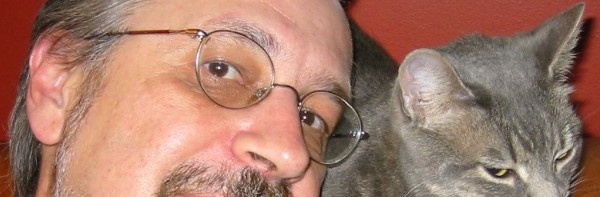
Our first interview is with Ken Hittel, who blogs at SocraticObserver.com. Here he is with a cat that appears to be named Jane Austen, which is a pretty great name for a cat:

Ken Hittel

Ken, who are you and what are you up to?

Long time, now-retired corp exec, built & managed digital presence (web sites, seo/sem, email, lead gen, sales tracking and ROI, mobile, social presence, you name it) for New York Life Insurance Company — widely regarded as the best in that business, he says somewhat immodestly… & now attempting to spread a little bit of practical digital know-how and wisdom more widely…

What does “being yourself” mean to you? what do you do that makes you feel most yourself?

Teaching (and listening & learning) — whether through writing or personal contact.

What’s one good thing you want to see happen on the web over the next year?

Roll back efforts to kill/curtail/impede net neutrality.

What’s your media diet? How do you go about choosing what you read, see, listen to?

Twitter; google+; nytimes.com; salon.com; slate.com; several select bloggers; cable news (to shout at); whymycatissad.tumblr.com; lots & lots of other random stuff (friends, family; neighbors; friendly people in Riverside Park, etc.)

Choosing stuff? much is old habit, rest is serendipity.

Give us a link to something you made, or something you love, or something that you want the rest of us to see!

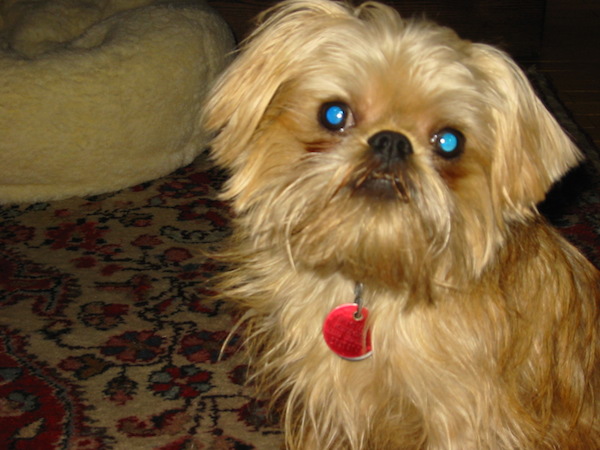
Well, there’s a lot of good stuff — but I won’t resist the temptation to name my own blog: SocraticObserver.com and my constant and faithful day-time companion, Spike of Broadway:

Spike

Filed Under: Interviews, Project

The power in playing small rooms

June 16, 2014 by Scott Rosenberg

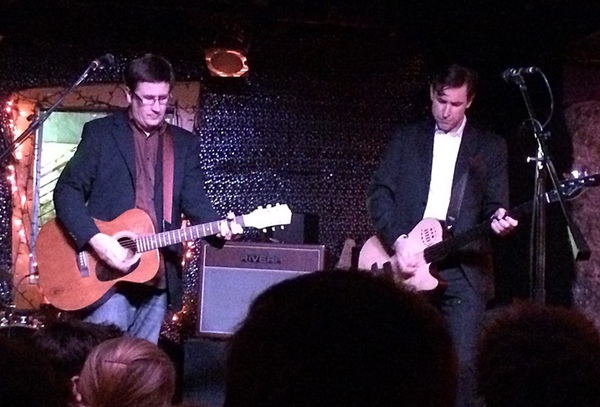
tmg 2014-06-15I thought I came late to John Darnielle and the Mountain Goats. By the time I discovered them in 2004, they already had a dauntingly extensive catalog of tapes and albums under their belt. But it turned out to be good timing: they were on the cusp of a creative leap. Now I’ve been a fan for a decade (previous posts here, here, and here).

I love this music, and I spent the past weekend in a happy haze of it. The band, which has built a devoted and growing following, played three remarkable shows at the Bottom of the Hill in San Francisco. It’s a tiny place, a club that holds maybe 200, 250 people. Most performers who’ve reached the stage Darnielle is at would play bigger places exclusively.

These gigs have downsides, I’m sure, for him: Less money, no doubt. More of his time (you play three nights to reach the same number of people you could reach in one at a bigger hall). And, I have to assume, some sacrifice in the amenities available in the performers’ lounge. But the plus is a kind of familiarity and intimacy with the crowd that you simply can’t fake.

Each night this weekend, the Mountain Goats played the full sequence of songs from one of the cassette tapes they’d recorded on a boombox in the ’90s. And each night, as they dusted off these for-diehard-fans-only tracks, a significant proportion of the audience sang along.

This kind of choice may not support Darnielle in his retirement, I guess. But if one of the goals of an artist is to have one’s work connect with others — and to know that the connection has been made, to feel the circuit completed — it’s got to be a powerful thing.

There’s a parallel here between the Mountain Goats’ decision to play a smaller venue and the choice we can each make to favor meaningful exchanges over “social reach,” friend counts, and follower numbers.

If you listen to the Mountain Goats’ music or read Darnielle’s Tumblr or Twitter feeds, you get a pretty strong sense that he knows exactly what Jeff Pooley meant by the “authenticity bind.” And he has a pretty powerful strategy for, if not defeating it, at least side-stepping it.

Part of that comes from being an incredibly talented and defiantly idiosyncratic songwriter and performer. (He’s also got a novel coming out later this year.) Part of it, I imagine, also comes from a whole career spent tracing the contours of authenticity.

Last night, between songs, Darnielle delivered a disarmingly intense monologue about the challenge any performer faces in trying to stay “real” onstage night after night. It also very much applies, I think, to our everyday lives, and our online selves, too. Here it is (transcribed from the recording here):

There are some people who’ve been here three nights in a row. I don’t script what I say between songs. But then if I’m describing a song, I’m gonna say something generally in the same ballpark that i said the other night. And I’m really self-conscious about this.

Because a friend of mine waited like 15 years to see Leonard Cohen, she went to see Leonard Cohen — Leonard Cohen is of course God, and we can say nothing bad about him, he’s the best, the best among us are really not fit to shine his shoes.

But at the same time, he’s got a very different idea about performance, insofar as he didn’t do it for like 15 years… So he came out to play the show, everybody in my town went to see it and just was knocked over. He’d tell these stories between songs, he doesn’t have a teleprompter, it looks and feels like it comes straight off the dome, but that’s because he’s a performer.

The next time he came back, everybody bought tickets for two nights. They went back night two, it was the same set-list, and the same patter, some of which sounds very improvised. And they were all grief-stricken.

Now I wanted to defend Leonard Cohen, but at the same time — because, I think, this has to do with being Catholic — a deep fear is instilled in me, that if I do anything of the sort, someday I will look out at the person who I saw the previous night and I’ll be telling the same story, and their face will fill with sorrow, and they will give me a look which says: “You have betrayed me. And I didn’t need you to betray me.”

Each of us distills life into stories we tell one another — in person, in media, in art. Repetition is inevitable. Keeping it real is hard.

You can take Cohen’s road: become transcendently good at repeating yourself, at creating the performer’s magical illusion that each scripted moment is spontaneous. Or you can take Darnielle’s road: look people in the eye and pledge to do your damnedest to make each presentation of yourself as fresh and open as you know how.

I think both approaches are honorable. But Darnielle’s holds up better on the second night.

Filed Under: Features, Project, Uncategorized

Links: Twitter as distributed Turing Test; tracked till you drop; we’re all superheroes now

June 13, 2014 by Scott Rosenberg

bender applause

Twitter: It’s bots vs. brands, we’re just caught in the middle

Twitter seems to be becoming a giant unstructured experiment in blurring boundaries — like a massively distributed Turing Test. Who’s a human, who’s a bot? Who’s a person, who’s a company?

Kate Losse’s New Inquiry essay on “Weird Corporate Twitter” explores the latter question:

Now, a Denny’s tweet can sound more casual and on meme than any individual’s Twitter account…Just as corporations have become “persons” in law, they have also become “persons” on social media, bearing all the fruits of personhood while retaining all the massive advantages of being an entity that defies individual personhood. At the end of the day, @Dennysdiner is just a legal structuring entity housed somewhere in Delaware, formed to serve mediocre diner food in cities across America. And yet in spite of — or maybe even because of — this uncanny act of assuming personhood, we like it. Corporations can’t be lonely, but with their newfound “cute” voices they are becoming more popular than people….It isn’t enough for Denny’s to own the diners, it wants in on our alienation from power, capital, and adulthood too.

It’s a great piece — and also a perfect case study in how the authenticity bind works.

Meanwhile, MIT Technology Review tells us that Advanced Socialbots Have Infiltrated Twitter:

A significant proportion of the socialbots…not only infiltrated social groups on Twitter but became influential among them as well. What’s more, Freitas and co have identified the characteristics that make socialbots most likely to succeed…. The socialbots that generated synthetic tweets (rather than just reposting) performed better too. That suggests that Twitter users are unable to distinguish between posts generated by humans and by bots. “This is possibly because a large fraction of tweets in Twitter are written in an informal, grammatically incoherent style, so that even simple statistical models can produce tweets with quality similar to those posted by humans in Twitter,” suggest Freitas and co.

Bots might fool human Twitter users, but they’re a more serious business for the ad industry, which is finding it more and more difficult to distinguish between real human views and clicks and fake bot-generated traffic designed to inflate ad payments. The Internet Advertising Bureau trade association now has a Trustworthy Digital Supply Chain Initiative, and first on its list of imperatives is this: “We must identify bot-generated, non-human traffic and remove it from the supply chain.” (Link courtesy Alexis Madrigal’s delightful 5 Intriguing Things.)

Finally, NPR put a person at the helm of one of its automated Twitter accounts, Nieman Lab reports, and the network won more click-throughs and more new followers as a result. But human employees cost more than bots, and NPR’s budget is tight, so the bots may win on a cost-per-click basis.

Facebook extends its ad-tracking eye

Not content to mine the likes and posts you enter directly into its system to figure out what ads to show you, Facebook has announced it will also track your forays elsewhere online. But hey — you can also look behind the ads to see exactly why Facebook is targeting you a certain way. And if you want to take the time to twiddle with your preferences, you can even volunteer more info to help Facebook refine its targeting. You can do the algorithm’s work yourself!

According to Facebook this is all part of “Making Ads Better And Giving You More Control.” I’ll believe that if the preferences option — when it finally rolls out, which isn’t yet — also lets me just turn the ads off. Not counting on that one.

Of course, it could be worse. Instead of just looking at your online activity to determine what ads to show you, companies could review your social activity to make decisions about, say, whether to offer you a loan. Surely that sort of crazy thing will never come to pass? Oh, wait:

Rather than rely on FICO credit scores, Affirm calculates the risk of borrowers based on a range of personal data including information gleaned from social-media profiles as well as the cost of the items being purchased. It then determines what rate and structured payment makes sense to offer the customer.

We’re all superheroes now

Secret Identities – Online Privacy & Invisible Disease | Comics Should Be Good:

The superhero secret identity is a powerful metaphor on many levels, and one which ought to become an important device again soon. Primarily, the secret identity is an excellent metaphor for our own dual lives on and offline. There is increasing interest in reserving our privacy as we lose more and more of it to voluntarily to social networks, to (hopefully benign) NSA information mining, and to smartphone location-sharing…. When social networks first popped up it was generally assumed that (as in our real-space social lives) it would be possible to maintain a level of separation between them and our professional lives. Over time that has become increasingly difficult and it has generally accepted that most of us can no longer maintain a separation…. After years of embracing social networks people are becoming more careful about which aspects of their lives are publicly shared online in order to maintain a degree of privacy. Having everything out in the open might have felt liberating at first, it has spiraled into a sort of trap and the concept of a secret identity is starting to sound appealing again.

Update link: In Salon, Andrew Leonard is tired of Silicon Valley’s hubris in promising to deliver “superpowers” with every new app. I guess if we’re all going to need secret identities, we might as well get the x-ray vision, too.

Decentralization everywhere

Jon Udell has begun mapping the decentralization movement in a tag bucket on Pinboard. There are lots of interesting projects and ideas to explore there.

Here’s one broad concept worth including: the growth of grassroots mesh networks as a return to the Internet’s roots in the idea of a truly distributed network. The Atlantic’s Adrienne LaFrance offers a great overview and explainer:

the idea behind mesh networking is to skip those checkpoints and cut out the middleman service provider whenever possible. This can work when each device in a network connects to the other devices, rather than each device connecting to the ISP….

“The original vision of the Internet was in fact a mesh,” said Michael Liebhold, a fellow at the Institute for the Future. “Unfortunately, what has happened over the 20 or 30 years we’ve been working on the Internet, all the traffic ends up handled by a very small number of network carriers or cloud or service operators. There’s a very small number of connection points… but they’re highly vulnerable and they’re being attacked from all directions now.”

For Liebhold, who uses a mesh network to connect to the Internet at home, mesh networking isn’t a way to “reinvent the web,” but the natural next step toward reclaiming the kind of Internet people want. It’s a way of “connecting everybody in the world and bypassing the original Internet, which is struggling in governance, cyber crime, data mining, pervasive passive surveillance, and massive hacks.”

Not everyone is trying to boost their Klout score

Invisibles by David Zweig is a new book about people in skilled but backstage or behind-the-scenes roles. The New Republic has an interview with Zweig:

In a culture that values attention above nearly everything else, who are these people who choose to go into lines of work in which, when they do their job perfectly, they’re completely invisible? What motivates them? What makes them feel fulfilled? In a culture where everyone strives for recognition both personally and professionally, what can we possibly learn from these people?

I spoke with a number of career recruiters, and they see more and more people who want careers in high-profile fields and fewer and fewer pursuing the careers of craftsmen or people who are behind-the-scenes. The larger culture has a very powerful ethos that attention equals success. In the fabric of social media, the metric for value is attention. The number of “likes” you get on a post, the number of followers you have. These are the metrics by which we’re guiding ourselves.

Filed Under: Links, annotated, Project

Next Page »