
Wordyard

Hand-forged posts since 2002

Archives

About

Greatest hits

Who lost Iraq?

April 24, 2007 by Scott Rosenberg

The controversy over Senate majority leader Harry Reid’s statement that the war in Iraq is “lost” is an exercise in capital Kabuki.

Everyone in Washington knows that Reid was speaking the truth. The war in Iraq is indeed lost. The war the politicians are fighting now is over who takes the blame for the loss.

By rights it should be President Bush. He started the war. He got everything he asked for from a compliant Republican Congress. He did it his way, and he failed, colossally. The Iraq adventure has damaged U.S. standing, U.S. interests, U.S. allies and the U.S.’s struggle with Al-Qaeda. It has killed and maimed thousands of Americans and hundreds of thousands of Iraqis. It is a global train wreck, today, now, whatever happens in the budget battle on Capitol Hill.

Politicians have been reluctant to state, forthrightly, how futile the situation has become; they worry about being framed as undermining morale in the field — just as Reid is now being charged. But the endgame of the Bush administration is forcing some bluntness on the Beltway.

Everything that Bush and his people do between now and 2008 needs to be understood through the lens of their “run out the clock” strategy. The attorney purge scandal, for instance, happened as part of an effort to polish up the resumes of “loyal Bushies” before lame-duckness sets in.

In response to the clear verdict of the 2006 election rejecting the war Bush chose to escalate the conflict instead, with one goal in mind: keep total defeat at bay, prevent a humiliating-retreat fiasco for two more years, then hand the hot potato off to his successor. Let the helicopters lift off from the Green Zone roofs any time after Jan. 20, 2009, just not on my watch, Bush wants to be able to say — no matter how many more soldiers and civilians have to die so he can say it.

That’s why Reid is saying the war is already lost. And why it’s important that he’s saying it today, with nearly two years still left of the Bush presidency. The Bush White House never takes responsibility for anything; the bad stuff was always someone else’ fault. (Remember the ludicrous argument that the Bush team started during its first administration about who was to blame for the recession that mired the country for Bush’s first few years: “It had already begun when we took office!” was the administration dodge.) If we’re honest that the war is already lost, and that everything we do henceforth is about cleaning up the mess, it’s that much harder for Bush and Cheney to turn around and somehow lay blame for the war’s disastrous conclusion at the feet of the Democrats who are trying to wind it down.

That’s the importance of Reid’s statement about the war: It’s about responsibility. President Bush started the war; President Bush lost the war. And he did both in a cloud of lies. Everything else is a footnote.
[tags]iraq, iraq war, harry reid, president bush[/tags]
Filed Under: Politics

Journalists’ “see no evil” stats

April 24, 2007 by Scott Rosenberg

Dave Winer writes:

A J-school prof at Cal told me that most reporters have absolutely no idea which of their stories people read or don’t read. They’re flying blind. I bet TV news people are too.

But wait, it’s even worse than it appears. Not only do most reporters have no idea which stories are read, many if not most don’t want to know.

The traditional view in journalism is that such knowledge is corrupting. If you know what’s popular and what isn’t, you will be driven by such knowledge to degrade your product. So the proverbial “Chinese wall” that’s supposed to segregate editorial decision-making from business influence has generally kept readership data out of the newsroom.

At a crude level, journalists fear that, the more granular the information about readership and popularity, the faster the suits will crank up celebrity gossip and defund serious coverage. The falllacy here is that, sorry, the suits already know everything they need to know about the relative popularity of different kinds of content — it’s just the editorial people who are (often) in the dark.

And then there is a more sophisticated level: the idea that writers and editors themselves, unpressured by crude strongarming by the business side but simply motivated by their own human need for attention, will find their judgment subtly but inexorably shaped by detailed usage stats.

The second concern is, I think, at least partly real, but I don’t lose sleep over it. From day one at Salon, when we were a half-dozen people in sublet space who could barely access our servers, we circulated traffic data to our editors; it simply blew our minds that we could. Over the years we took some heat for the practice, but I still think it makes sense. Ignorance is never a very good state for a journalist. Why choose blindness? Knowing where readers click doesn’t have to dictate your decisions — unless your decisions are poorly reasoned to begin with. In the soup out of which good coverage bubbles, traffic data should be one ingredient of many.

The real defense against what used to be called “page-view pandering” is strong, smart editors and writers with their own moral compasses. If you have them, then they deserve access to as much information as exists. If you don’t have them, then you’ve got bigger problems, and restricting access to your traffic stats won’t save you.
[tags]journalism, ethics[/tags]

Filed Under: Business, Media, Salon

Links for April 23rd

April 23, 2007 by Scott Rosenberg

  • rc3.org: How programming is like golf
    “No matter how easy it is to get close to the hole, you have to make those seemingly easy putts in order to finish, and the small bits at the end can wind up costing you just as much as the big chunks of progress did early in the project.” Or: First you do the first 80 percent, then you do the second 80 percent…
  • Papers’ Web Hopes Dim a Bit – WSJ.com
    “Roughly 70% to 80% of [newspapers’] online revenue is tied to a classified ad sold in the print edition.” If true, yikes: classified is going online anyway…

Filed Under: Links

David Halberstam, RIP

April 23, 2007 by Scott Rosenberg

The journalist, who died in a car crash near the Dumbarton Bridge here in the Bay Area, was 73. (SF Chron; Mercury News.)

I first read his 1972 masterpiece, The Best and the Brightest, as a curious teenager trying to figure out how and why our country was stuck fighting a war that could not be won on behalf of people who plainly did not want us to do so. It’s fair to say that the book shaped my view of U.S. foreign policy, and of the need to curb our government’s predilection for fighting unnecessary wars. Halberstam’s chronicle of the arrogance of power illustrated how the confidence of Kennedy’s Harvard-trained managers meshed with the cupidity of the Cold War military-industrial complex to produce the Vietnam quagmire. The title, in other words, was ironic.

In some of his later works Halberstam allowed his reputation as a Pulitzer-garlanded star to inflate his style. But The Best and the Brightest was taut and tragic. Today it reminds us that the “Vietnam complex” was not some debilitating national illness that needed to be shucked off; it represented experience of imperial power’s limits, hard-won through an ill-begotten war. How shameful that those lessons vanished from Washington so soon, and that another generation of Americans must once more seek the answers I found in Halberstam’s book.

UPDATE: This from Clyde Haberman’s Times obit:

William Prochnau, who wrote a book on the reporting of that period, “Once Upon a Distant War,” said last night that Mr. Halberstam and other American journalists then in Vietnam were incorrectly regarded by many as antiwar.

“He was not antiwar,” Mr. Prochnau said. “They were cold war children, just like me, brought up on hiding under the desk.” It was simply a case, he said, of American commanders lying to the press about what was happening in Vietnam. “They were shut out and they were lied to,” Mr. Prochnau said. And Mr. Halberstam “didn’t say, ‘You’re not telling me the truth.’ He said, ‘You’re lying.’ He didn’t mince words.”

[tags]David Halberstam, journalism[/tags]

Filed Under: Media, People, Personal, Politics

Apple and Brooks’s Law

April 22, 2007 by Scott Rosenberg

Apple recently announced that it had to delay the release of the next version of Mac OS X, Leopard, by a few months — too many developers had to be tossed into the effort to get the new iPhone out the door by its June release. Commenting on the delay, Paul Kedrosky wrote, “Guess what? People apparently just rediscovered that writing software is hard.”

In researching Dreaming in Code, I spent years compiling examples of people making that rediscovery. I’m less obsessive about it these days, but stories like this one still cause a little alarm to ring in my brain. They tend to come in clumps: Recently, there was the Blackberry blackout, caused by a buggy software upgrade; or the Mars Global Surveyor, given up for lost in January, which, the LA Times recently reported, was doomed by a cascading failure started by a single bad command.

Kedrosky suggests the possibility of a Brooks’s Law-style problem on Apple’s hands, if the company has tried to speed up a late iPhone software schedule by redeploying legions of OS X developers onto the project. If that’s the case, then we’d likely see even further slippage from the iPhone project, which would then cause further delays for Leopard.

This is the sort of thing that always seemed to happen at Apple in the early and mid-’90s, and has rarely happened in Steve Jobs Era II. I write “rarely,” not “never,” because I recall this saga of “a Mythical Man Month disaster” on the Aperture team. If the tale is accurate, Apple threw 130 developers at a till-then-20-person team, with predictable painful results. We’ll maintain a Brooks’ Law Watch on Apple as the news continues to unfold.

UPDATE: Welcome, Daring Fireball and Reddit readers! And to respond to one consistent criticism: Sure, iPhone isn’t late yet, but Apple is explicitly saying it needed to add more developers to the project to meet its original deadline. If that all works out dandy, then the Brooks’s Law alarm will turn out to have been unwarranted. Most likely, given Apple’s discipline, the company will ship iPhone, with its software, when it says it will. What we won’t and can’t know is whether, and if so how much, the shipping product has been scaled back. And sure, of course this is all conjecture. Conjecture is what we have, given Apple’s locked-down secrecy.
[tags]apple, leopard, os x, software delays, brooks’s law[/tags]

Filed Under: Dreaming in Code, Software, Technology

Links for April 20th

April 20, 2007 by Scott Rosenberg

  • Wii and DS Turn Also-Ran Nintendo Into Winner in Videogames Business – WSJ.com: Guess I was wrong about the Wii, which I derided for its absurd name!
  • BBC NEWS | Business | Blackberry reveals failure cause: Surprise — it was a failed, or “insufficiently tested,” software upgrade, that brought down the Blackberries.
  • Your Daily Awesome: Ira Glass on Storytelling: Four videos in which the This American Life host talks about his craft

Filed Under: Links

Michael Wesch’s “Machine” video

April 20, 2007 by Scott Rosenberg

Before the opening talk at the Web 2.0 Expo earlier this week, the conference organizers played Michael Wesch’s video-ode to the participatory Web, “The Machine is Us/ing Us”. Given the insider-y nature of the crowd, I have to assume that most of the attendees had already seen it — it had rocketed to blogospheric celebrity in early February. But I didn’t realize the guy who made the video, a professor of cultural anthropology from Kansas State University, was at the conference.

On Tuesday afternoon I literally stumbled upon his talk in the hallway (on a tip from my neighbor Tim Bishop); it was a part of the free, informal “Web2Open” parallel conference. Across the hall, a hubbub made it hard to hear Wesch — the Justin.tv people had set up camp there and needed to be asked to pipe down.

Wesch turns out to be a rare combination of ingenuous Web enthusiast and smart cultural critic. In my experience, the cultural critics are usually pickled in cynicism and the Web enthusiasts are often blinded to their technology’s drawbacks. Maybe the discipline of cultural anthropology has helped Wesch maintain some balance; or maybe his sheer distance from Silicon Valley-mania — whether in the flatlands of Kansas or the mountains of Papua New Guinea — has helped him find a fresh perspective.

The came-out-of-nowhere saga of Wesch’s video neatly serves to mirror its message about the generated-from-the-bottom-up nature of the Web. Wesch originally made the video, he explained, because he was writing a paper about Web 2.0 for anthropologists, trying to explain how new Web tools can transform the academic conversation. He created it “on the fly” using low-end tools. Its grammar, with its write-then-delete-and-rewrite rhythms, emerged as he made goofs and fixed them: “The mistakes were real, at first. Then I thought they were cool, and started to plan them.” The music was a track by a musician from the Ivory Coast that he found via Creative Commons. (Once the video became a hit, Wesch says, he got a moving e-mail from the musician, who said that he’d been about to give up his dreams of a life in music, but was now finding new opportunities thanks to the attention the video was sending his way.)

The video’s viral success took Wesch by surprise. He’d forwarded it to some colleagues in the IT department to make sure that he hadn’t erred in his definition of XML. They sent it around. It took a week to go ballistic.

At one point someone in the small audience asked Wesch a question about his field research in Papua New Guinea. He paused for a second, asking, “There’s about a two-hour lecture there, I’m not sure I can compress that into a five-minute answer — should I try?” I couldn’t help myself; I blurted, “Hey, you did the entire history of the Web in four minutes — go ahead!”
[tags]web 2.0, web 2.0 expo, michael wesch, the machine is us/ing us, viral video[/tags]

Filed Under: Blogging, Events, Technology

Why Gonzales may stick around

April 20, 2007 by Scott Rosenberg

After his feeble attempt to defend his record of deception and cronyism before the Senate Judiciary Committee yesterday, Attorney General Alberto Gonzales must surely be polishing up his resume. Right? Well, under normal circumstances, that would be inarguable. But these aren’t normal circumstances at all.

Unless the Senate chooses to impeach Gonzales, the only person who can remove him from office is the man who selected him. So far, President Bush has remained steadfast behind his old friend. That’s no coincidence. The Justice Department is the tip of the iceberg; there are heaps more corruption and lies waiting to be aired throughout this administration, and now that the Democrats are running Congress, some of that information is beginning to come out.

Having a loyal “Bushie” fixer like Gonzales in the A.G. chair is the Bush crew’s chief defensive bulwark. Replacing him with a similar toady would, today, be impossible.

Under normal circumstances, given the revolt against Gonzales not only among Democrats but in his own party, a president would eventually bow to the inevitable; otherwise, he’d understand, he’d be unable to get anything else done for the remainder of his administration.

Here’s the catch: The Bush administration isn’t trying to get anything done any more. All these guys want to do is hang on for the next 18 months without ending up in jail or accepting the inevitability of defeat in Iraq. That’s it. How does firing Gonzales help them achieve those goals? While the Senate smolders over the arrogance and incompetence of Bush’s attorney general, the clock keeps ticking. The longer they deliberate over Gonzales, the less time they have to investigate everybody else.

I won’t be surprised if Gonzales survives a lot longer than pundits are presently predicting. Bush’s stubbornness isn’t just a character flaw; it’s a desperate by-the-fingernails defensive tactic.

Filed Under: Politics

Rick Kleffel interview, podcast

April 19, 2007 by Scott Rosenberg

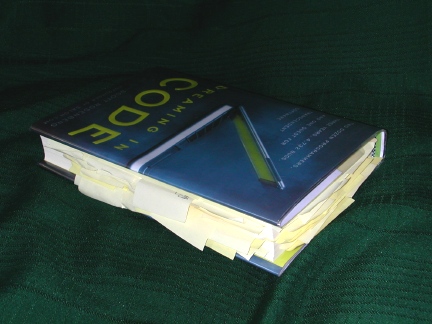
Rick Kleffel has a review site called the Agony Column, does a radio show for KUSP, and also podcasts, and sometimes contributes to NPR. So he keeps busy. I met him recently at KQED for an interview about Dreaming in Code, and he showed up with a copy of the book that bristled with more post-it-note bookmarks than I’d have thought physically possible:

Kleffel's encrusted Dreaming in Code

It’s great that Kleffel liked my book enough to pay it this kind of close attention. He also recognized my effort to find, in the saga of a software project, some broader themes: for instance, how strange and difficult it is for groups of people to work together creating anything that’s abstract. He wrote: “The book, though it stays focused on software engineering, is clearly applicable to every other realm of life.”

Here’s Kleffel’s review; here’s the audio of our interview. A version of it is scheduled for broadcast on KUSP on Friday at around 10 AM, if you’re in the general Santa Cruz vicinity.

Filed Under: Dreaming in Code, Events

Schmidt on scaling Google

April 17, 2007 by Scott Rosenberg

The first time I heard Eric Schmidt speak was in June 1995. I’d flown to Honolulu to cover the annual INET conference for the newspaper I then worked for. The Internet Society’s conclave was a sort of victory lap for the wizards and graybeards who’d designed the open network decades before and were finally witnessing its come-from-behind triumph over the proprietary online services. It was plain, at that point in time, that the Internet was going to be the foundation of future digital communications.

But it wasn’t necessarily clear how big it was going to get. In fact, at that event Schmidt predicted that the Internet would grow to 187 million hosts within 5 years. If I understand this chart at Netcraft properly, we actually reached that number only recently. (Netcraft tracks web hosts, so maybe I’m comparing apples and oranges).

I thought of this today at the Web 2.0 Expo, where Eric Schmidt, now Google’s CEO, talked on stage with John Battelle. (Dan Farber has a good summary.) He discussed Google’s new lightweight Web-based presentation app (the PowerPoint entry in Google’s app suite), the recent deal to acquire DoubleClick, and of Microsoft’s hilarious antitrust gripe about it, and of Google’s commitment to letting its users pack up their data and take it elsewhere (a commitment that remains theoretical — not a simple thing to deliver, but if anyone has the brainpower resources to make it happen, Google does).

But what struck me was a more philosophical point near the end. Battelle asked Schmidt what he thinks about when he first wakes up in the morning (I suppose this is a variant of the old “what keeps you up at night”). After joshing about doing his e-mail, Schmidt launched into a discourse on what he worries about these days: “scaling.”

It surprised me to hear this, since Google has been so successful at keeping up with the demands on its infrastructure — successful at building it smartly, and at funding it, too. Schmidt was also, of course, talking about “scaling” the company itself.

“When the Internet really took off in the mid 90s, a lot of people talked about the scale, of how big it would be,” Schmidt said. It was obvious at the time there’d be a handful of defining Net companies, and each would need a “scaling strategy.”

Mostly, though, he was remarking on “how early we are in the scaling of the Internet” itself: “We’re just at the beginning of getting all the information that has been kept in small networks and groups onto these platforms.”

Tim O’Reilly made a similar point at the conference kick-off: In the era of Web-based computing, he said, we’re still at the VisiCalc stage.

Google famously defines its mission as “to organize the world’s information and make it universally accessible and useful.” But the work of getting the universe of individual and small-group knowledge onto the Net is something Google can only aid. Ultimately, this work belongs to the millions of bloggers and photographers and YouTubers and users of services yet to be imagined who provide the grist for Google’s algorithmic mills.

I find it bracing and helpful to recall all this at a show like the Web 2.0 Expo — which, while rewarding in many ways, gives off a lot of mid-to-late dotcom-bubble fumes. Froth will come and go. The vast project of building, and scaling, a global information network to absorb everything we can throw into it — that remains essential. And for all the impressive dimensions of Google, and the oodles of Wikipedia pages, and the zillions of blogs, we’ve only just begun to post.

[tags]google, eric schmidt, internet growth, web 2.0, web 2.0 expo[/tags]

Filed Under: Blogging, Business, Technology

« Previous Page
Next Page »