
Wordyard

Hand-forged posts since 2002

Archives

About

Greatest hits

Archives for May 2008

Gates and Ballmer at D: Lament for lost youth

May 27, 2008 by Scott Rosenberg

I’m keeping my head down in my book writing, mostly, this year, but I allowed myself one trip to one industry event, so here I am at Walt Mossberg’s and Kara Swisher’s D conference again. New owner (who’ll be here tomorrow); same friendly proprietors.

Things kicked off tonight with a double interview with Bill Gates and Steve Ballmer. After last year’s psychodramatically rich confrontation between Gates and the other Steve in his life, this event was decidedly more tepid. Gates has had one foot out the door of his company for a long time, of course, but as he prepares to depart fully from active duty next month, he might have figured on taking something of a victory lap here.

No such luck. Mossberg, inconveniently, kept bringing up the Vista fiasco. Gates wryly commented, “We have a culture that’s very much about, ‘We need to do it better,’ and Vista’s given us a lot of opportunity for that.”

Ballmer predicted a release of “Windows 7” — the successor to Vista — by late 2009. (Danger, Will Robinson! Remember the Longhorn slippages! Haven’t they learned?) There was a suggestion that we might get a look at the new Windows 7 interface here; but what was actually on display was some neat tricks involving multitouch interfaces for applications –a la the iPhone’s pinch-and-tap approach to using more than one point of contact on a touch screen to manipulate stuff. (The demo included an onscreen piano keyboard, but nobody actually tried to play a chord, which I’d have thought would be the obvious way to show off multitouch.) All this was neat enough, but not much to go on — and unless Windows 7 fixes a lot of Vista’s problems there will be a dwindling base of users to experience its neat touches.

Ballmer declared, unconvincingly, that he’s not stewing over the collapse of his attempt to acquire Yahoo: “I’m not frustrated at all. They’re great guys, they built a great company. We couldn’t agree on a price.” As he spoke, a blown-up Wall-Street-Journal woodcut portrait of Jerry Yang stared down at him from the wall. (Yang will be here tomorrow.)

Both Gates and Ballmer remained almost pathologically unable to utter the syllables “Google.” Ballmer attempted to explain how he sees Microsoft responding to the Google challenge: “You need scale, and business innovation, and technological innovation. You need breakthrough innovation and incremental innovation. You need it in search and in advertising. You need to bring it all together. And you need it at all levels of the stack.”

Whenever I hear a CEO say, “We need to do it all!” I translate: “We really don’t know what the hell to do here.”

Gates and Ballmer seemed most comfortable, and genuine, in reminiscing about their youth, as Harvard friends and then as partners in building Microsoft from the ground up. Are their best days behind them? They would never admit it, but no matter how brave a face they put on, or how rosily they paint Microsoft’s prospects, I think that on some level even they sense it.

AllThingsD’s John Paczkowski did the live-blogging thing here. No doubt there will be video up soon too.
Filed Under: Business, Events, Technology

Amanda Congdon’s back — but, er, not first

May 19, 2008 by Scott Rosenberg

I have a special place in my heart for video-blogging star Amanda Congdon, since through some total coincidence she ended up briefly plugging my book before it even came out. Thanks, Amanda! So I read with interest in today’s Times about her return to the web after apparently unsuccessful attempts to transition into more traditional broadcast gigs.

Then I read this:

“She was really one of the first, if not the very first, Internet blog stars,” said Dan Goodman, the president of digital media for Media Rights Capital. “She has been entertaining people in the digital space since there were people to entertain there.”

Where to begin? Congdon’s Rocketboom began, I’m pretty sure, around 2004. I do believe there were a few “Internet blog stars” already at that time.

As for the second claim: I think that “digital space” had its share of entertainment even back in the Usenet days. And certainly, even if your definition of “digital space” begins with HTTP, the first ten years of the Web pre-Rocketboom had its share of laffs, too.

I can’t say I’m surprised that some digital entertainment lawyer might be ignorant of this stuff. But, you know, the Times really shouldn’t be printing such silliness.

Filed Under: Blogging, Net Culture

Links for May 18th 2008

May 18, 2008 by Scott Rosenberg

Had my head buried deep in writing this past week. Getting some traction, at the expense of other communications.

  • JoshKornbluth.com: My friend the monologuist has a great new website and revamped home for all his disparate activities. Ahh, the things one can do with WordPress these days!
  • Can You Become a Creature of New Habits? – New York Times: Don’t try to rid yourself of bad habits; just overwrite them with new ones. “New habits we deliberately ingrain into ourselves create parallel pathways that can bypass those old roads.” In other words, build the new interstate and the old state highway will fall into disuse!
  • YouTube – UKULELE – BLITZKRIEG BOP: Says it all.
  • The story of Obama, Written by Obama: New York Times does a full take on Obama’s literary career, gives my extraordinarily talented editor Rachel Klayman her due credit for fishing Obama’s first book out of the dead pile (after reading about Obama in Salon early in 2004!) and ordering a reprint. But what an odd piece otherwise — there’s this critical undercurrent about the money Obama has made from the books (the first real money he’s ever made in his career, and still a fraction of the personal coffers of the Clintons or McCain). On the spectrum of ways that politicians can earn some cash, surely writing books is at the more innocent end. And in this case it’s evident that the guy, you know, actually wrote them himself.

Filed Under: Links

McCain’s bearings

May 9, 2008 by Scott Rosenberg

Bearings are the calculations a navigator makes to stay on course. “Losing your bearings” means, essentially, losing your compass — going off course.

When Obama last night suggested that McCain was “losing his bearings” in suggesting that Obama was in cahoots with Hamas, the choice of words was provocative, sure. Obama was saying that McCain presents himself as an unconventional high-road politician, but here had instead taken a low potshot. He’d lost his moral compass.

Here are Obama’s words:

“This is offensive, and I think it’s disappointing, because John McCain always says, ‘Well, I’m not going to run that kind of politics.’ And then to engage in that kind of smear, I think, is unfortunate, particularly since my policy toward Hamas has been no different than his,” Obama said.

The Illinois senator added: “For him to toss out comments like that, I think, is an example of him losing his bearings as he pursues this nomination. We don’t need name-calling in this debate.”

But the McCain people’s charge that it was a cheap shot about the candidate’s age suggests that they have, um, further lost their bearings.

Now, if Obama had said “McCain has lost his marbles”? Yeah, that might’ve been a comment about age. And — since “bearings” also has another meaning, for mechanical parts that are similar to, er, marbles — maybe there’s even a little bit of a taunt behind the word choice, an extremely subtle reference to McCain’s reputation for sputtering anger. But that’s not what the McCain people are complaining about.

With one campaign organization on guard against racial digs and the other defensive about age-ism, it’s going to be a fun election season!

Filed Under: Politics

Links for May 8th 2008

May 7, 2008 by Scott Rosenberg

  • The Nature of the Beast (according to Susan McCarthy): I first met McCarthy via the Well, many years ago; later she sublet an office cube at Salon’s offices. She is a writer of deep knowledge and great wit; her specialty is writing about the ways of animals. This is her delightful new blog.
  • Pentagon's Accounting Mess – Portfolio.com: Yet Another Federal Software Quagmire (cf. the IRS, the FBI, the FAA, etc.). An account of the Pentagon’s failure to upgrade its ancient mainframe-era accounting system; the tale unfolds in a building in Indianapolis the size of 28 football fields, and explains why the U.S. military cannot be audited. The Pentagon literally cannot tell you how much it has spent or what it has purchased. If you ran your family this way, they’d disown you.
  • How the White House lost 5 million e-mails — Farhad Manjoo: Another tale of “upgrade failure.” The punchline here is that the Bush White House abandoned a Clinton-era automatic archiving system in favor of a manual system.
  • Race Is On to Advance Software for Chips — John Markoff: Stanford, Berkeley and University of Illinois all plan labs to experiment with better ways to write code for multicore processors.
  • Pursuing the Next Level of Artificial Intelligence – New York Times: Profile of computer scientist and Bayesian expert Daphne Koller:

    “I find it distressing that the view of the field is that you sit in your office by yourself surrounded by old pizza boxes and cans of Coke, hacking away at the bowels of the Windows operating system,” she said. “I spend most of my time thinking about things like how does a cell work or how do we understand images in the world around us?”

  • ongoing · Multi-Inflection-Point Alert: Tim Bray essay suggesting that everything in the software world is changing at once.
  • Esquire Interview with Vint Cerf: “Over a period of a hundred or a thousand years, the probability of maintaining continuity of the software to interpret the old stuff is probably close to zero. Where would you find a projector for an 8mm film these days? …” (Actually, it’s still quite possible to do transfers of 8mm film today. Analog is more forgiving than digital in this way.)

Filed Under: Links

What deep pockets say

May 7, 2008 by Scott Rosenberg

When the history of this strange and soon-to-be-concluded Democratic primary season is written, let it be noted that the candidate whose income was modest (in political-class terms) until his books became bestsellers was somehow framed as the representative of the elite — while the one who was able to dip into her own personal coffers to fund her campaign to the tune of $6 million succeeded, with a little help from the media, in casting herself as a woman of the people.

Filed Under: Politics

Rare sighting of Google error message

May 6, 2008 by Scott Rosenberg

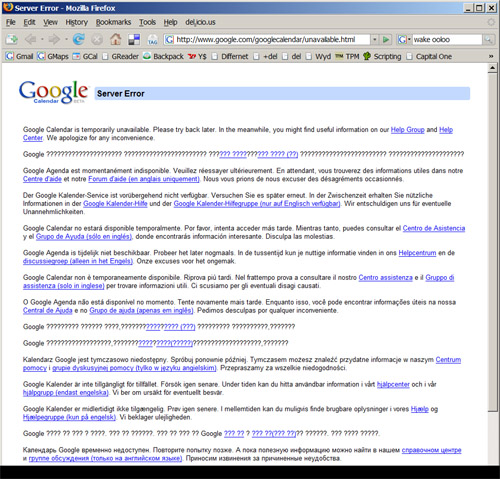
We have become dependent on Google as a part of our Web infrastructure (too dependent, some say), in part because Google’s reliability record is so superb. All of which makes the receipt of any sort of error message from any dimension of the Googleverse worthy of note.

Today I tried to access my Google Calendar. Instead I saw this:

GoogleCal Error

A minute later, my calendar returned. But for an instant, I got to thinking about life without Google.

Filed Under: Net Culture, Personal, Software

Feelies redivivus

May 5, 2008 by Scott Rosenberg

I discovered only by chance that Glenn Mercer, one of the key figures in one of my favorite bands of all time, the Feelies, put out a new solo album last year. This led me on a whole rediscovery-tour of the post-Feelies bands: Wake Ooloo, Wild Carnation (just ordered their 2006 Superbus), Speed the Plough, Yung Wu.

If you don’t know them, the Feelies started out on their first album with a sort of jittery New Wave hyper-strum (one song was aptly titled “The Boy With the Perpetual Nervousness”). Then the original rhythm section (including drummer Anton Fier) left, and with a new lineup they took a more pastoral turn on album two, The Good Earth, and finally settled into a Velvet-Underground-meets-Television groove for a handful of further albums before breaking up.

I loved pretty much everything they did, and when I pick up a guitar and idly strum, more often than not it’s one of their tunes. Their choice of covers was always spot on: you can find live recordings from the ’80s of them playing Jonathan Richman’s “Egyptian Reggae” and Wired’s “Outdoor Miner,” and Yung Wu, whose lineup seemed to include the entire Feelies, even recorded that wonderful Brian Eno/Phil Manzanera ditty, “Big Day”.

I don’t think they were capable of recording a bad track, and at their best (as on “Higher Ground”) the exquisite guitar leads are like a flight of angels. But their vocals were always modestly buried in the mix (I think this heavily influenced early REM) and they never found the following they deserved.

Now, according to the Feelies Myspace page, it appears the Feelies are reuniting to play some dates in NY over July 4. Too bad I won’t be there.

Filed Under: Music

Yahoo/Microsoft collapse, the morning after

May 4, 2008 by Scott Rosenberg

I thought the Microsoft/Yahoo merger would be a disaster for both companies, but the news of Microsoft’s withdrawal of its offer should not be greeted with cheers in any quarters yet. Most reports of the story have noted the possibility that this is just a feint on Microsoft’s part. I could be wrong, obviously, but I can’t believe Ballmer and company are abandoning the field. It’s just not their DNA. They fight to win. They hate to lose. They throw chairs at walls when they’re frustrated. The antitrust ordeal made them more cautious in public, but I can’t believe they’ve become pussycats in private. If they’re really giving up, it means that Microsoft has become an utterly different company from what it used to be, and I just don’t see that.

Sure, after the last few months they may feel (accurately) that an acquisition would result in mass exodus from Yahoo because of corporate-culture incompatibility –i.e., it appears that everyone at Yahoo hates Microsoft’s guts, and everyone at Microsoft despises their counterparts at Yahoo (I’m talking about the corporate leadership — engineers tend to be more catholic in their perspective, at least sometimes). But what Microsoft wants from Yahoo is market share, not talent, so I don’t think this really matters to them.

Instead, they’re saying to Yahoo, “OK, you don’t like our price? Let’s see how you like what the market does to your share price, what the shareholder suits do to your legal budget, and what the withdrawal of our offer does to the other negotiations you’ve got going.” It’s a smart hardball move, at least in the short term. We’ll see how it plays out over the next couple of weeks.

Other interesting first takes:

Paul Kedrosky — “Yahoo (and maybe Microsoft too) reminds me of that crack suicide squad in Monty Python’s Life of Brian.”

Kara Swisher — “Kind of like Oscar Madison and Felix Unger, but not funny in any way at all.”

Mike Arrington — “Google was the big winner in a Microsoft/Yahoo acquisition attempt, no matter what the outcome. But among the possible outcomes, a broken Yahoo and a frustrated Microsoft almost certainly result in increased market share for Google.”

Filed Under: Business, Technology

Clay Shirky and the cognitive surplus

May 1, 2008 by Scott Rosenberg

“You know, much of England was drunk on gin for 20 or 30 years during the 18th century.”

I studied English history, but my brother studied it more deeply than I did. So when he told me that, a long time ago, I filed it away in the back of my brain as an odd fact worth exploring at some point in the future. The file has been undisturbed ever since, until I watched Clay Shirky’s talk at the Web2.0 Expo.

Shirky tugs on that bit of information as part of a much larger argument that’s well worth a view (it’s about a 15-minute video — he’s also posted a transcript). In brief, he suggests that the English were so stunned and disoriented by the displacement of their lives from the country to the city that they anesthetized themselves with alcohol until enough time had passed for society to begin to figure out what to do with these new vast human agglomerations — how to organize cities and industrial life such that they were not only more tolerable but actually employed the surpluses they created in socially valuable ways.

This is almost certainly an oversimplification, but a provocative and fun one. It sets up a latter-day parallel in the postwar U.S., where a new level of affluence created a society in which people actually had free time. What could one possibly do with that? Enter television — the gin of the 20th century! We let it sop up all our free time for several decades until new opportunities arose to make better use of our spare brain-cycles — Shirky calls this “the cognitive surplus.” And what we’re finally doing with it, or at least a little bit of it, is making new stuff on the Web.

This argument is in some ways just an extension of Shirky’s book Here Comes Everybody (I’m in the middle of it, so, you know, maybe it’s all in there, though he says it’s not). But it also frames the larger sense I’ve had, from the moment I first saw the Web in 1994, that its importance lies in its potential for displacing TV.

It was the first medium I’d encountered in my life that looked like it had a chance of somehow challenging or eroding TV’s primacy in our world, and eliminating some of the distortions TV has rendered in our culture and politics. I’d spent the first part of my career chronicling a venerable medium — live theater — that has never properly recovered from the ascent of TV, so you know who I was rooting for.

Recalling a conversation with a TV producer skeptical that the participatory Web was anything more significant than LOLcats and World of Warcraft addicts, Shirky argues, “However lousy it is to sit in your basement and pretend to be an elf, it’s worse to sit in your basement and try to figure out if Ginger or Marianne is cuter….It’s better to do something than to do nothing.”

And so, because somebody chose to write a Web page rather than watch another sitcom, today you can read all you want about Britain’s Gin Craze on Wikipedia.

Filed Under: Blogging, Media, Net Culture