Wordyard

Hand-forged posts since 2002

Archives

About

Greatest hits

Tools for an informational self-audit

July 28, 2008 by Scott Rosenberg

“Pay attention to what you’re paying attention to.” I believe I first heard this exhortation from Howard Rheingold. Don’t know if he said it first or got it from some other wise person. It’s always struck me as good advice. And as I return from a week spent entirely offline I find myself wanting to take it — in a systematic way.

People go on diets where they watch what their bodies consume. Some of us keep budgets where we track the money we earn and spend. What about pursuing a similar approach to the information we feed our minds?

I’d like to do this: take some period of time — a day, a week? — and track exactly how I’m spending my media time. I’ve read about the concept of the media fast, but this is something different — more like keeping a food diary for one’s media intake.

Are there any tools out there for doing this? Examples of other people who’ve done it? I’ve googled “Media audit” but, alas, this phrase appears to have been monopolized by the advertising industry. Maybe Lifehacker has posted on this? Post me some pointers and I’ll follow up.
Filed Under: Media, Personal

BlogHer and beyond

July 20, 2008 by Scott Rosenberg

Whenever anyone says “the blogosphere” (yes, this includes me), you need to back them up and ask, “Which blogosphere would you be referring to?”

If you come from the tech-news world, as I do, you will think of that realm. Or perhaps you’re immersed in the political blogs, and that’s what you mean.

Today there are a myriad blogospheres, scattered like alternative realities across the Web. I was reminded of this, forcefully and delightfully, over the last day and a half at Blogher. I got some interviews done for my book, met some great people, but mostly marveled at the energy and the stories.

There’s so much more to write. But we’re getting ready for our final trip of the summer — off for a few days in the mountains, and off-the-grid. So all that will have to wait. Keep things together while we’re away, ok?

Filed Under: Blogging, Personal

Rustication

June 23, 2008 by Scott Rosenberg

I’ll be offline most of this week with my family, camping, during the difficult interregnum between end of school and start of summer day camp season.

For those of you who’ve been following the AP takedown letters story, I don’t think it’s over yet, but it seems to have hit a lull. If you want to stay tuned in, Mary Hodder (in her blog and on Twitter) has been keeping on it.

Filed Under: Personal

Rare sighting of Google error message

May 6, 2008 by Scott Rosenberg

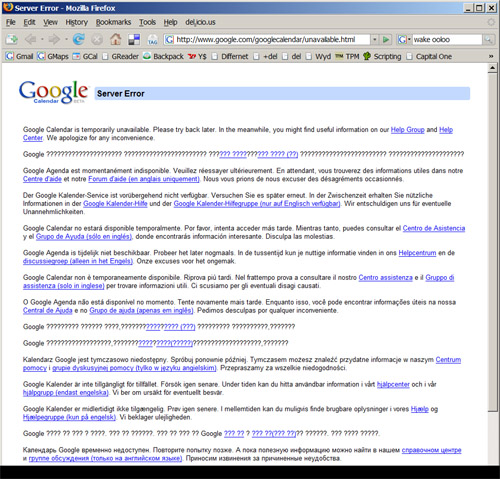
We have become dependent on Google as a part of our Web infrastructure (too dependent, some say), in part because Google’s reliability record is so superb. All of which makes the receipt of any sort of error message from any dimension of the Googleverse worthy of note.

Today I tried to access my Google Calendar. Instead I saw this:

GoogleCal Error

A minute later, my calendar returned. But for an instant, I got to thinking about life without Google.

Filed Under: Net Culture, Personal, Software

Everything connects

April 29, 2008 by Scott Rosenberg

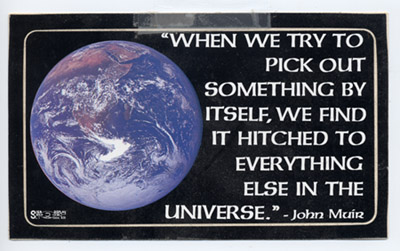
For something like 25 years I have had a postcard (now tattered and brown-edged) taped near wherever I write:

John Muir quote

One reason I became a writer is that I love the sensation of finding connections. It can stun me, make me laugh, or help me feel that I understand the universe just a little bit better.

I’ve spent the last few months researching my next book. I’m nowhere near done (and will continue!). I could conceivably, and profitably, devote whole additional years to further research.

But I’ve also reached a point in my labors that I now recognize from previous large writing projects. My brain feels like it’s overflowing. And everywhere I look, whatever I’m looking at seems to connect to what I’m writing about. Everything is hitched to everything else.

That means it’s time to start writing.

The exhilarating and painful work of trying to preserve that apprehension of interconnectedness on the page always involved some amount of disappointment, at least for me; where the apprehension is oceanic, the written end-product is finite.

But a completed book has one advantage over a vague sensation: it can be shared. So here goes!

Filed Under: Food for Thought, Personal

Checked out for a bit

April 25, 2008 by Scott Rosenberg

We’ve been on vacation this week — springtime on the Pacific coast! — so no posts about Hillary vs. Obama, the transformation of the WSJ by Rupert Murdoch (the original Mediogre) or anything much else.

LATE CLARIFICATION: There was no seal massacre! These mothers and pups are just taking a little break (as we were).

Filed Under: Personal

Disk — raw or cooked

March 25, 2008 by Scott Rosenberg

I returned from my travels, sat down at the desk yesterday morning, fired up my email program, and — ffftt!!! — encountered one of those awful Windows system messages (something to the effect that the system had been unable to write back to the disk and it was very sorry but some data had been lost) that can mean only one thing: hardware failure. I took a breath, ran the disk utility, and got another message informing me that there was insufficient disk space to fix the bad clusters, which made no sense, since there was plenty of empty space on the drive — unless, like, massive gigabytes’-worth of clusters had gone south.

The bad news was, this was the big 500 GB drive I use to store basically everything. (Another drive is for the system and applications.) The good news is, I’ve become religious about backups, I have copies of all my important data, including online backups; but it’s scattered about.

I can recall many hours spent hostage to CHKDSK back in the late ’80s, fixing my own or friends’ wayward drives, watching patiently as the little grid filled out with marks for good and bad clusters. This was when the disks held 10 or 20 megabytes. Then in the mid 90s I wrestled with bad Mac disks on the cruddy machines Salon was trying to make do with. But since then, either the quality’s gotten a lot better or I’ve had a good run of luck. This is the first disk disaster I’ve had in a decade.

I took another breath and began poking at the drive with various tools and utilities. Sometimes the system could see it, sometimes it couldn’t. Then, at the lowest ebb of my fight, my system told me that there was zero Kb of data in zero files on the drive, and that the drive, in fact, could not be examined at all because “the type of the file system is RAW.”

Raw? As in, not cooked? By now I was doing all my research on the old laptop. Google told me that this error message indicates that a drive is close to unformatted — in, as it were, the state of nature. Only I knew there was tons of data on the disk, and it hadn’t been erased, and it didn’t seem like the disk had massively failed (a la “head crash”).

A couple of hours digging through the tech forums led me to a fine utility called GetDataBack. Several hours later, this program had painstakingly reassembled the file-system tables of my drive and enabled me to ferry my precious information back to safety in (roughly) one piece rather than having to reassemble it from patchwork backups.

This morning, I purchased and installed a new drive. Spent the rest of the day restoring files. Now I’m back. Phew. Only two days lost.

My motherboard fried during the middle of my labors on Dreaming in Code. So maybe I get one technical disaster per book project, and now the one for my new book is behind me. (I also notice that the previous disaster also occurred after a week away. I wonder whether it’s the temperature change of sitting unpowered after weeks of constant use that’s stressing the gear.)

If you’ve read this far, you don’t need me to remind you of the moral of this tale: you must have a backup plan.

Filed Under: Personal, Technology

On the road

March 17, 2008 by Scott Rosenberg

This week I’m in NYC doing interviews for the new book. So posting will likely be light.

I have now been living in the Bay Area so long (over 20 years!) that I have become totally de-acclimated to the east coast weather of my native city.

But I still know when a cabbie makes a wrong turn at the Kew Gardens interchange!

Filed Under: Personal

Word processing, then and now

February 25, 2008 by Scott Rosenberg

Clive Thompson writes about how software can shape our creative work:

Our tools, of course, affect our literary output. And all this made me wonder how other writing tools affect what’s written. I use Movable Type to write my blog, and I’m constantly annoyed by how small the text-entry boxes are. Whenever I write an entry, the text quickly flows down several box-lengths, which can make it hard to keep track of my argument. The problem, of course, is that the tool was designed with the idea that people would be writing extremely short, pithy entries … whereas my entries tend to drag on and on and on. It reminds me of the writing on one of those old, proprietary-hardware word-processors from the 80s, which were outfitted with screens that only let you see seven lines at a time.

WordPress lets you set the posting box to any size you want. But for longer posts, I compose in a text editor. It’s just handier. I have no doubt, though, that browser-based editing will eventually evolve to the point where I don’t need to do that.

Thompson also references Virginia Heffernan’s recent Times piece on word processors, which recommends the Zen-like blank-screen approach of the Mac-based WriteRoom. (Of course, the dominant DOS-based word processor, WordPerfect, offered what was very close to a blank screen; in a pre-Windows world, you didn’t have a browser or e-mail always competing for screen real estate.)

For those of us who learned Basic on a Zenith Z19 and started word processing on a Kaypro (anyone?), the retro green-and-black now takes the breath away. It’s not just the vintage features available on WriteRoom, it’s also that the whole experience is a throwback to a time before user-friendly interfaces came to protect us from technology’s dark places. In those days, the mystery of the human mind and the mystery of computation seemed both to illuminate and to deepen each other.

All of which brings back involuntary, wincing memories of one of my earliest word-processing experiences, at the Boston Phoenix. In the early ’80s the Phoenix had some ancient minicomputer sitting in a back room, feeding the newsroom’s small and much-fought-over handful of dumb terminals. When I say dumb, I mean really dumb. In a limitation that is inconceivable today, these terminals had so little memory that they could only handle a few hundred words at a time. Most Phoenix reviews were way longer than that, yet many of us composed directly on this system (who could afford one’s own PC on what that alternative paper paid its writers?).

To compose a lengthy piece you had to write a chunk (a “buffer”), then save it — sending it on a leisurely journey back to main memory — to make room on the terminal for the next installment of your opus. Unfortunately, these terminals also had a habit of crashing. Too often you’d press that “send” key only to see the screen freeze, and you’d know then that you’d just lost all your work stretching back to the last time you’d saved your work. Only sometimes pressing “save” would itself trigger the dreaded freeze — a tragic Catch-22 indeed.

As a result — in a tableau that somehow seemed to epitomize all the pain of human composition in a technological age — you might occasionally spy some desperate writer hunched over notebook and pen in front of a frozen screen, painstakingly copying the slim remnant of his verbiage that was still visible, rescuing some fragment of inspiration before the inevitable reboot wiped the words clean.

Filed Under: Media, Personal, Technology

Customer service is the what?

February 3, 2008 by Scott Rosenberg

Tomorrow I plan to attend the “Customer Service is the New Marketing” conference that the folks from Get Satisfaction are holding at the Presidio. This doesn’t sound like my normal field but it’s actually a topic close to my heart.

At Salon I was a big believer in customer support as an ambassadorial function for the company. At the site’s launch in 1995, I manned the e-mail barricades, responding personally to most of what came in. (In those days, getting a few hundred messages for a Web site launch was a sign of runaway success.) When we launched Salon Premium in 2001, I handled the customer support myself for the first two weeks. If you’re an executive in charge of a Web launch, there is no better way to get a handle on what’s working and what’s not. And while it’s good to keep developers in the feedback loop as well, you can’t expect them to handle all the response — they’re likely to be busy fixing any of the problems users are uncovering.

Way back in the Pleistocene Andrew Leonard wrote a piece for Salon that I edited, describing a future in which more and more tech support problems could and would be solved by a quick Web search. Today, I don’t even bother attempting to communicate directly with most companies; who wants to navigate phone-tree hell? If I have a problem, I poke around on the Web until I find an answer. If I don’t, I’ll post a question on the likeliest Web forum.

So there’s interesting stuff happening in this area. I’ll see what’s worth reporting on tomorrow.

Filed Under: Business, Events, Personal, Salon

« Previous Page
Next Page »