Wordyard

Hand-forged posts since 2002

Archives

About

Greatest hits

“Heretic Pride” from the Mountain Goats

February 22, 2008 by Scott Rosenberg

Earlier this week I received my (pre-ordered) copy of the new Mountain Goats CD, “Heretic Pride.” My enthusiasm for the music of John Darnielle now dates back four years, and this is one infatuation that has only grown deeper with time. I am, unabashedly, a fan.

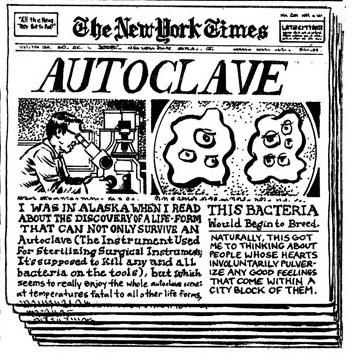
And yet I think I’d love “Heretic Pride” even if I encountered it with no grounding in the Mountain Goats’ stuff. This is what passes for an upbeat album from Darnielle: it’s full of joy, but that’s joy in the face of terror. Heretic Pride, by the Mountain Goats The title track, for instance, is a defiant hymn soaring out of the throat of some unspecifiedly nonconformist protagonist who has been dragged out of his house and through the streets toward his doom. Of this song, Darnielle writes: “Spoiler alert: The main character here will not live long after he gets done lauding his imminent demise.” (This commentary appears in notes to the album that were apparently provided in the press kit; an artist named Jeffrey Lewis took them and illustrated them in tabloid-comic strip form — the style of those salvation-in-six-frames handouts that evangelicals used to distribute, and perhaps still do.)

There are songs here (you can sample them at the 4AD site) about Chinese sea monsters and pulp novelists, murdered reggae singers and imaginary cults. Titles include “Lovecraft in Brooklyn” and “Marduk T-Shirt Men’s Room Incident.” The pace is livelier and more varied than on the Goats’ somber last outing, “Get Lonely”; superb drumming from Jon Wurster drives the faster numbers, and majestic string arrangements by Eric Friedlander bathe the slower ones.

If the album doesn’t sate you, you can also enjoy the satirical ditty about this year’s elections that Darnielle knocked off for a recent public radio show. Titled “Down to the Ark,” it imagines the whole civic process as the triumph of a satanic cult. You can listen to it here.

Three Mountain Goats shows are lined up here in the Bay Area next weekend. I intend to be at all of them! Come say hello.

LATE ADD: Darnielle dissects the characters in five of his songs in this interview on Emusic.
Autoclave, by the Mountain Goats

Filed Under: Culture, Music

Code Reads update

February 20, 2008 by Scott Rosenberg

I haven’t been able to keep the Code Reads project going at all this year. And what with work proceeding full bore on my next book project, that, alas, is unlikely to improve much. I’m not quite ready to totally abandon it but I did want to acknowledge the situation. I think we’d just better consider it an erratic, wheneverly sort of thing.

But I am going to do a new one shortly — it will be on Mark Bernstein’s series of posts on what he calls “Neo-Victorian Computing.”

Filed Under: Code Reads

Spolsky: how programmers redefine their way around hard problems

February 20, 2008 by Scott Rosenberg

I only just caught up with Joel Spolsky’s amusing and insightful Yale talk posted last December — a return-of-the-prodigal-son sort of thing for this Yale graduate. (Here’s parts one, two and three.)

These quotes were worth highlighting:

Time and time again, you’ll see programmers redefining problems so that they can be solved algorithmically. By redefining the problem, it often happens that they’re left with something that can be solved, but which is actually a trivial problem. They don’t solve the real problem, because that’s intractable.

This is a failing, in one sense — it’s why certain Big Problems in the field never seem to get solved. On the other hand, in the face of deadlines or business pressures, we can surely see the value in a programmer’s ability to take some problem that’s impossible to solve (given available resources) and redefine it as a job that can actually be accomplished.

And:

Being able to write clearly on technical topics is the difference between being a grunt individual contributor programmer and being a leader.

The hardest problems facing most programmers don’t involve communicating with the computer; they arise in the course of communicating with people — colleagues, customers, users.

Filed Under: Dreaming in Code, Software

Eugenides on valentines: “cheapening and commodification”

February 14, 2008 by Scott Rosenberg

Overheard at the end of Michele Norris’s interview with Jeffrey Eugenides on last night’s All Things Considered:

MN: Happy Valentine’s Day to you.

JE: Thanks for having me.

MN: I was going to ask you if you’re doing anything special for Valentine’s Day, but your someone special might be listening.

JE: I’ll tell you, one of the first things my wife and I decided when we got together was that we would never celebrate Valentine’s Day.

MN: What?

JE: One of the first things that made me fall in love with her was our mutual antipathy to Valentine’s Day.

MN: Wait a minute — an author who puts together a collection of love stories has total antipathy for Valentine’s Day?

JE: Oh yeah. Don’t you think it’s the cheapening and commodification of something rare that we’d all like to celebrate in private and on our own time?

MN: I personally like flowers and chocolate.

JE: Well, your special person, I hope, is listening.

I have always come down on Eugenides’ side of this argument. Fortunately, my “special person” does too.

Filed Under: Culture, Food for Thought

The road goes ever oon

February 12, 2008 by Scott Rosenberg

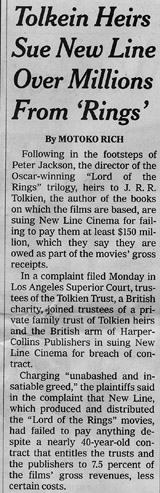
NYT on Tolkien films

I don’t know which is more lamentable here:

The revelation that the Tolkien estate has apparently received zero dollars for the (phenomenally good) movies New Line made of the “Lord of the Rings” trilogy…

or…

The inability of the New York Times, at this very late date, to spell the author’s name right in a headline.

Surely the paper’s staff is riddled with people weaned on “The Hobbit” and the trilogy — people whose brains, at the first peripheral-vision scan of that misspelling, light up with red “error” messages shooting from axon to dendrite?

[This image is from the National Edition on paper, distributed here in the Bay Area. One can only hope that it got fixed for the later editions…]

Filed Under: Culture, Media

Obama and Clinton split the states alphabetically

February 5, 2008 by Scott Rosenberg

As of around 7:30 pm California time here on Super Tuesday night, a look at the New York Times web site shows a remarkable pattern in the Democratic primaries:

NYTimes Democrats

As you can see, Obama wins the states up until “M”; Hillary wins from M through Z. (If you can’t see, click the picture for a full-sized image.)

If the pattern holds, the Obama folks may have a big win in California on the way.

This is about as reliable as the numerology that sometimes passes for market-timing prediction on Wall Street. But, hey, it’s a pattern!

Filed Under: Politics

Notes from “Customer Service is the New Marketing”

February 5, 2008 by Scott Rosenberg

Here are some things I heard and learned at yesterday’s “Customer Service Is the New Marketing” conference, which was quite good:

(1) My anecdotal experience of great service and a generally great experience shopping online for shoes at Zappo’s — your order seems to show up at your door before you’ve even finished deciding what to buy — turns out to be the product of a fanatically service-oriented corporate culture. Zappo’s CEO Tony Hsieh presented the evidence. Early on the company learned that offline advertising was mostly not paying off, so it focused on growing its repeat-customer business. The results are evident in the chart of year-to-year sales increases, which are headed toward $1 billion this year. Interestingly, the Zappo’s trend is linear — there’s none of the hockey-stick-shaped mega-growth that Web companies often shoot for. On the other hand, something tells me that Zappo’s is unlikely to suffer as much as other online companies in the next downturn.

(2) Robert Stephens, founder of the Geek Squad (now a part of Best Buy), described how he built his company’s brand identity — they’re the guys in black-and-white cars who do tech-support housecalls — by borrowing bits and pieces of pop culture (old gas station logos, old photos of NASA scientists in black ties and white shirts) to invent a persona for his “agents” that’s some sort of cross between the FBI, Ghostbusters and the Matrix. Stephens is an art-school dropout (“everybody’s creative in art — nobody’s creative in computer support”) and takes a certain flip, almost Situationist pleasure in inverting business norms. (Or maybe he just never outgrew adolescence.) I’ve never imagined I’d never be a Geek Squad customer — I’m pretty much the resident, if uncredentialed, geek squad in my home. But it seems that I’ve been missing a great theater-of-capitalism show.

(3) Marc Hedlund, founder of personal-finance site Wesabe, talked about the company’s decision to provide its CEO’s personal contact information right on the home page. Since they’re asking people to upload financial information, they figured it would help build trust. Turns out that most of the calls the CEO gets are people just checking it out to see if it’s really him at the other end.

(4) Heather Champ of Flickr showed a chart of the site’s “oh crap” moment: in June 2007, when Yahoo shut down Yahoo Photos and moved everyone over to Flickr, the site’s growth chart took a sharp upward shift — it’s now approaching two billion photos, with 3-5,000 uploaded per minute.

(5) Hedlund also talked about finding blogposts about his service and responding to questions or complaints as he finds them on the Web. Of course, he admitted, he’s running a startup with 12 employees and a relatively small customer base today. How do you handle this when you get big?

One thing I’ve seen over and over is that, if you do this sort of job right in the early stage of a service, and you establish a level of openness and responsiveness in the formative weeks and months of your site’s community, you put yourself on a sort of “virtuous cycle” or beneficial trajectory: over time, as you grow and responding to everyone becomes less realistic, other people — your enthusiastic users — pick up the slack for you. Whereas if you screw up the early stage — if you establish a sense that your company or site is unresponsive or inattentive — it’s extremely hard to change that later. So the argument that “being responsive doesn’t scale” is an unhealthy one: Be as responsive as you can for as long as you can!

(6) In the final panel on “customer service as community,” I heard the presenters agree on two different points that struck me as contradictory.

Gina Bianchini of Ning declared that too many people today think that, when they’re posting as employees, they have to “write professional business-speak that makes them sound like an asshole.” People should feel free to express their passions and be genuine — otherwise they sound like corporate tools.

That’s true enough. But only a few minutes before, Patti Roll of Timbuk2 (they make shoulder bags beloved by bike messengers and others) told an anecdote of how easy it is to get agitated and confrontational when people attack your product in an online forum. That doesn’t help your company; you just have to learn to, well, be professional.

Hmmm. The “professional” demeanor in speech (and online speech) — however impersonal, and depersonalizing, it can often be — exists precisely to help people who represent a brand avoid the temptation to scream at jerks (who may well deserve it). So really the challenge in navigating these waters is to find a voice that is personal enough to not sound fake but professional enough to help you avoid getting into a flame fest.

Which is all somewhat more complex, and harder to pull off, than I think the discussion allowed.

Filed Under: Business, Events

Customer service is the what?

February 3, 2008 by Scott Rosenberg

Tomorrow I plan to attend the “Customer Service is the New Marketing” conference that the folks from Get Satisfaction are holding at the Presidio. This doesn’t sound like my normal field but it’s actually a topic close to my heart.

At Salon I was a big believer in customer support as an ambassadorial function for the company. At the site’s launch in 1995, I manned the e-mail barricades, responding personally to most of what came in. (In those days, getting a few hundred messages for a Web site launch was a sign of runaway success.) When we launched Salon Premium in 2001, I handled the customer support myself for the first two weeks. If you’re an executive in charge of a Web launch, there is no better way to get a handle on what’s working and what’s not. And while it’s good to keep developers in the feedback loop as well, you can’t expect them to handle all the response — they’re likely to be busy fixing any of the problems users are uncovering.

Way back in the Pleistocene Andrew Leonard wrote a piece for Salon that I edited, describing a future in which more and more tech support problems could and would be solved by a quick Web search. Today, I don’t even bother attempting to communicate directly with most companies; who wants to navigate phone-tree hell? If I have a problem, I poke around on the Web until I find an answer. If I don’t, I’ll post a question on the likeliest Web forum.

So there’s interesting stuff happening in this area. I’ll see what’s worth reporting on tomorrow.

Filed Under: Business, Events, Personal, Salon

Why I’m voting for Obama

February 3, 2008 by Scott Rosenberg

This year we Democrats are in a rare and lucky position: we’ve got two good candidates to choose from. On Tuesday, I’m voting for Obama over Hillary. But in November, I’ll be happy to vote for either of them.

Right now, my preference is based on the following considerations:

Pressing the reset button internationally. After the last eight years, the U.S. needs to start over with the rest of the world. It’s hard to remember today, but there was a brief moment after 9/11 when the whole world was behind the U.S. What that moment called for was a unity government — and indeed, a diplomacy of global unity. Bush threw all that away in a blaze of arrogant partisanship and a go-it-alone rush to a misbegotten war. In the process he wrecked his own reputation and the nation’s.

Obama’s in a position to clear the decks and press “reset” with all of the strategic goofs and moral gaffes of the last eight years — and he’s in a better position to do so than Hillary. He was against the Iraq war, unequivocally, from day one. His briefer sojourn in the Beltway means there’s more of a chance he’ll be willing to try new approaches.

The Muslim factor. Obama’s time spent abroad, including his familiarity with Indonesia’s Muslim culture, has led to a scurrilous whisper campaign against him, suggesting that he’s Muslim himself. (Hey, change one letter of his name and you get Osama!) It’s a lie, but lies have been known to turn elections.

It seems certain to me that if Obama is the candidate, he’ll have to confront this lie directly at some point. More importantly, I think he can turn it around to his advantage. Because at this moment in history, we could really use a person in the White House who actually knows something about Muslim culture and society.

As we struggle to defeat Al Qaeda and its sympathizers, we need to carry the conflict back to the hearts and minds of the moderate Muslim world, which Bush — through policy errors, strategic blindness and moral failures — has ceded to our enemies. Obama represents a rare opportunity to reclaim this ground.

Electability. Hillary Clinton is a known factor to the American electorate. She has a lot of support. But it’s hard for me to see how she’s going to get too much more than she has today. And while this year’s GOP is comatose, her face remains one of the few stimuli that could conceivably cause the Republican right to hold its nose and vote for McCain.

Obama is simply a wild card. It could be that large numbers of white Americans will smile and nod and, in the privacy of the voting booth, decide not to support a black man. I think it’s worth testing that legacy against contemporary reality.

In the primaries so far, Obama’s been rallying young and disaffected voters back into the voting booth. That could make a huge difference in November: rather than limiting a Democratic campaign to a desperate hunt for one point over the 50-50 line that has marked Bush-era politics, Obama’s new throngs could tip the election in a stalemate-breaking way. It’s hard to see how Hillary could manage that.

Positive vibration. It’s hard to remember any political campaign as relentlessly upbeat as Obama’s, or as unwilling to sling mud. That’s part of his success story, and, evidently, part of his personality. It has worked beautifully to date, and it might work all the way through the election. But it worries me a bit.

When the GOP turns the slime machine on full blast, will Obama be able to deflect or defeat it? We just don’t know. Maybe his charisma will pull through; maybe he’ll show the charm and grace that Kerry just couldn’t muster and, with smiles and deft one-liners, sidestep the crap that will surely fly at him and defang the attack dogs.

But the hard-earned conventional political wisdom of the last decade is that when they come at you swinging slurs, your only choice is to hit back hard and fast. That doesn’t seem to be Obama’s way. And it’s a little troubling for any Democrat to contemplate a candidate who isn’t ready to rumble.

Still, I’ve always believed in voting one’s hopes over one’s fears!

Filed Under: Politics

Microsoft plus Yahoo? The sum is less than the parts

February 1, 2008 by Scott Rosenberg

I don’t know whether Microsoft will win its unsolicited takeover offer for Yahoo (AP story here, on Yahoo) — the legal and financial road for such hostile bids is always unpredictable. But I do know this: it is a path to failure for both companies.

The business press is going to go into paroxysms over this move: it combines the frisson of a big tech-industry acquisition story with the raw testosterone of a hostile-takeover battle saga. In newsrooms everywhere this morning, you can practically hear the salivation. Don’t get distracted. These big takeovers — AOL/Time Warner was the biggest — are always about failure in the present and fear of the future. And they nearly always end badly.

To understand what the takeover would mean for Yahoo, just look at the fate of the previous company to end up in this circumstance. When Netscape, then a dominant portal site and purveyor of a declining but still widely used Web browser, got bought by AOL a decade ago, we heard all the usual pieties about the strength of the brand and the value of its franchise. But AOL’s acquisition of Netscape meant its doom: the remaining talent headed for the exits, and its assets were quickly cannibalized. AOL itself entered another disastrous merger a couple of years later, and today it is a shadow of its former importance — while Netscape isn’t even a phantom.

Similarly, if Microsoft wins Yahoo, you will see most of Yahoo’s smart people depart, and its customers gradually parceled out to attempt to bolster Microsoft’s ever-faltering efforts to build an online business. Much of the talk in the business press surrounding this deal will be about Yahoo’s ad business, and it’s true that Microsoft will find it useful, but it’s hard to see what new power a combined Microsoft and Yahoo business will have to challenge Google that the two companies didn’t have as separate entities.

For Microsoft, this move is a final admission of the utter failure of the company’s effort to build an online business for itself over the past decade — in services, advertising or content. Winning Yahoo would surely bolster Microsoft in this area in the short term. But in the long term, these efforts at lashing together two failures in hopes of sparking a success have never prospered. For Google, the target of Redmond’s chess move, there is really no danger here. Google today needs to worry about the drag on its stock from the broader market troubles, and the drain on its brainpower by the lure of new startups. Microhoo is hardly a threat.

UPDATE: Kevin Kelleher has an amusing take over at GigaOm:

[Ballmer] finally called Yahoo on the Oz-like illusion it’s been fostering for a couple of years: “You had a year. You lost. All your base belong to us.”…

Yahoo has been admirably laissez-faire with Flickr and del.icio.us. Will they be preserved or folded into to services we’ve all eschewed? How will Yahoo mail accounts be reconciled with Hotmail accounts? Will those of us who use Yahoo Finance and all its features adapt to MSN Finance? What is MSN Finance?

A 62 percent premium, hmmm — we Yahoo users have a new choice: Learn to love life under Ballmer, or migrate to Google.

Not hard to guess where that choice will fall…
[tags]microsoft, yahoo, takeovers[/tags]

Filed Under: Business, Technology

« Previous Page
Next Page »