Technorati’s survey: head-scratchers and brand-y swill

I don’t think I’ve ever taken Technorati’s annual blogger survey before, but the company’s annual reports have usually been a useful source of information, so when I got an email inviting me to respond I took a few minutes to do so.

I began to think something was off when I saw this question:

WordPress’s hosted service at WordPress.com, which has gazillions of users, is free. I host my own blog using the WordPress.org open-source version. I do pay an ISP for server space, so maybe that’s considered “a paid third-party hosting service,” but boy is this confusing! Meanwhile, it’s 2010 — how many people handcode their own HTML? Isn’t it, like, statistically insignificant?

On to the next head-scratcher:

Um, my Twitter account is linked to my blog. Like a horde of other bloggers I use a widget to display my tweets on my blog. But like so many other bloggers I don’t feed my posts automatically into Twitter, because Twitter works better when you actually speak as a person. So there’s no accurate way to answer this question.

Then there was this:
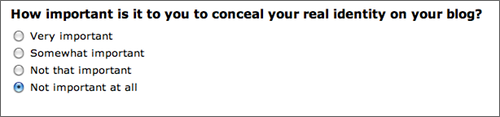
The question’s wording presupposes that the respondent is blogging anonymously, which is just plain weird, since most bloggers identify themselves.

This question began to suggest where Technorati’s head was at.
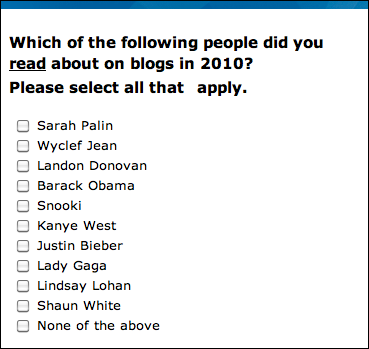
It turned out that the survey was heavily focused on the role of “brands” in blogging, which is usually a signal that somebody somewhere has dollar signs in their eyes.
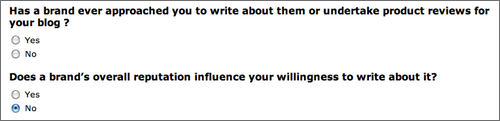
“Has a brand ever approached you…?” How exactly would a brand do that? Have brands grown mouths and legs?

I’m usually courteous but I guess I snapped.
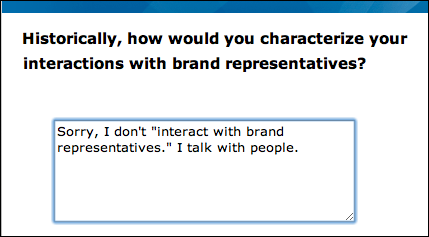
An experiment with Storify

Storify is a new service for building on-the-fly curated “stories” out of disparate elements like Tweets, Flickr photos, Facebook postings and so on. It’s in beta now; I gave it a whirl just now. I’m embedding my first Storify story here.

I couldn’t figure out how to add my own text other than the summary at the top; it would have been nice to weave the quoted tweets together with my own words.

I also couldn’t figure out how to use Storify to edit the story after I saved it.

I assume these are on the “features” list somewhere!

UPDATE: As you can see I have now figured out how to do both these things. Memo to interface designers: some of us actually find text labels more useful than naked icons… Still, can’t complain too loudly here. Storify is pretty easy to use!

Independent commercial Web publishing: still exhausting?

You’ve probably heard by now that Mike Arrington has sold TechCrunch to AOL. Congratulations to him and to AOL, which has bought itself some talented people, some good traffic and no doubt some headaches down the road.

This paragraph in Arrington’s explanatory post jumped out at me:

The truth is I was tired. But I wasn’t tired of writing, or speaking at events. I was tired of our endless tech problems, our inability to find enough talented engineers who wanted to work, ultimately, on blog and CrunchBase software. And when we did find those engineers, as we so often did, how to keep them happy. Unlike most startups in Silicon Valley, the center of attention at TechCrunch is squarely on the writers. It’s certainly not an engineering driven company.

This description jumped out at me because it was so familiar — and also because it surprised me. I guess I hoped and trusted that the “endless tech problems” that were at the heart of my experience at Web 1.0-era Salon.com (they led me to write a book) were a thing of the past. What Arrington is saying is that the stuff that was hard 10-15 years ago is still hard today. I guess I should have expected that.

At Salon, we had some highly gifted people working for us at different times on the technology side, we built a robust CMS that’s still operating (and that spawned its own open source version), we built our very own pay wall in about a month in 2001, and we pioneered all sorts of useful things in our day. But it was exhausting for an organization that was driven by its editors and writers to also have to figure out how Web publishing worked, technologically and economically; to build systems that would scale well and bend to our needs; and to work out how sales and marketing could make sense in the new medium.

By the second half of the decade I spent at Salon I know I spent far more of my hours dealing with those issues than writing or editing copy. I remember thinking enviously of the position our sometime rivals at Slate occupied; they’d always had the benefit of being tied to a larger enterprise — first Microsoft, then the Washington Post. No doubt that had its own frustrations. But it meant they could concentrate on the fun stuff without having to invent and manage the entire business and technology operation simultaneously.

This is why I always stop and think when I hear friends and colleagues repeat the truism that “the journalism is the hardest part.” We said that a lot at Salon, and I still hear it today, but I no longer think it’s true. Good journalism is always work, sure — but it’s known work. We know what it takes to do it right.

The challenges of independent publishing online, on the other hand, are the real “hard part” of this industry. I bet any entrepreneurial publisher you ask will agree — go talk to Rafat Ali or Om Malik or Pete Rojas or anyone else who has tried to build their own Web-based publishing enterprise over the past decade.

The thing is, if you’re the sort of entrepreneur that I’m guessing Arrington is, the hard stuff may be exhausting, but it’s also what gets you up in the morning. That’s one reason startup founders so often spin their wheels after they’re acquired; designing and building your own little speedboat is just a lot more absorbing than managing how to integrate your personal craft with a battleship-scale corporation. It’ll be interesting to see how this plays out for the TechCrunch crew.

Slate: Don’t close that corrections window — open it all the way!

Craig Silverman had a fascinating column last week about changes that Slate has made in its corrections policy in the wake of an embarrassing dustup with Politico. Here’s Craig’s pithy summary of this bizarre Escher-esque episode (which I also wrote about at the time):

In July, Slate published an article that provided evidence that Politico was routinely scrubbing errors out of its stories without adding a correction or similar notice for readers. Slate’s story, of course, was noticed by many journalists and many of us, myself included, weighed in with criticism and reaction. Then the tables began to turn: Politico pointed out several mistakes in Slate’s reporting and, in the end, Slate admitted that its correction policy had a provision that allowed for it to scrub factual errors from stories without the addition of a correction. (Provided that the error was spotted within twenty-four hours of publication, and it was spotted by someone at Slate.) Pot, meet kettle.

Slate is not the only publication with a post-publication window for tinkering with stories. At MediaBugs, we keep encountering this issue — as with this bug filed about a New York Times story earlier this summer. If you read that discussion, you’ll see a Times editor admitting the paper made substantive changes (though not technically the correction of an outright error) to an article after it was posted on the Web. Does the Times have a window, like Slate’s, in which it considers it okay to alter published articles online? How about headlines? Both Slate and the Times have always been extra meticulous in thinking through their approach to corrections, yet this post-publication change policy is a problematic area for both.

As a result of the Slate-Politico fracas, Slate has now decided to close its 24-hour window. This seems to be the upright, ethical response. It’s plainly well-intentioned and carefully thought out. But I think it’s the wrong direction to go: it’s a step backwards. It continues the tradition of allowing the limitations of print-think to govern our online behavior. The Web lets us improve our stories after we publish them. Why should we tie our hands?

We do so, of course, out of a sense of accountability. We don’t want to seem to be pulling fast ones on our readers. We don’t want it to appear that we’re “scrubbing” the record, as Silverman puts it.

There is a simple solution to this problem: Throw open the windows — and keep them open! Let yourself make changes; just don’t hide them. The same technology that lets us keep tinkering with words we’ve published also lets us store and display every alteration we make.

Instead of agonizing over the duration of the period in which we allow ourselves to change an already-published story, we should just be transparent about all the post-publication changes we make. Let’s give readers the “history” of our articles the way Wikipedia shows all the changes to each of its pages. As James Bridle puts it: Everything should have a history button!

This achieves two useful goals at once: It frees your hand to keep improving your articles even after you’ve published them, which is one of the great advantages Web publishing offers over print; and it makes sure that your readers will never think you’re hiding anything from them. Most readers will never need or want to see the revisions you’ve made; they just want to read the current version of the story. But in the rare case that someone raises a question or a dispute about a change, the record will be public.

If and when there are major substantive errors that you need to correct, you can still go the whole distance and add a traditional correction notice to any page. But if you’re fixing small errors or little details that don’t warrant that, you wouldn’t have to bother.

The technical hurdles to such an approach are minimal; most modern content management systems store all the revisions to each story in a database anyway. There’s a small amount of design work in figuring out how to expose the revisions to your readers. But it’s not a hard problem. I’m already showing all my revisions here on this blog — just look at the bottom of the full-page version of this, or any, post. (And if you run WordPress, you can install the WordPress Post Revision Display plugin too if you like!)

I’m firmly convinced that over the next few years this practice will become as commonplace in online publishing as “print this page” buttons and comments. So my challenge to Slate, the Times, and every other online publisher is: why not become a leader in this realm? Stop closing your “windows.” Instead, open them up and show your changes.

Journalists follow their voices, vote with their feet

As the beleaguring of traditional news organizations continues, newsrooms are actually growing elsewhere. You may have noticed that places like Yahoo, AOL and the Huffington Post are all hiring these days — and they’re hiring, um, actual journalists.

Yesterday we learned that New York Times economics correspondent Peter Goodman was decamping for HuffPo. “For me it’s a chance to write with a point of view,” Goodman told Howard Kurtz. He described fitting into the Times voice as “almost a process of laundering my own views, through the tried-and-true technique of dinging someone at some think tank to say what you want to tell the reader.”

Jay Rosen commented on Twitter:

You get what this means, right? The View from Nowhere has become a liability in keeping newsroom talent

And again:

It’s not so much that @petersgoodman wants to be a pundit. He wants to report what’s really going on. In his own voice.

Yahoo has been building a bloggy news organization, too. But today we learned from Andrew Golis that one of his high-profile hires, former Gawker writer John Cook, was leaving Yahoo and returning to Gawker. Golis explained: “He decided that he prefers the license Gawker gave him to add his opinions into his reporting to the scale and credibility Yahoo! News could offer.”

So Yahoo, theoretically a “new” news organization, also finds itself losing talent because of its house rules about mixing “opinion” and reporting. The story isn’t as simple as “journalists flee old media for new so they can write in their own voices.”

Consider that the most consistently and determinedly enforced code of neutrality in today’s media world can be found not in an old-school newsroom but on Wikipedia, where “neutral point of view” is a sacred first principle. We need a better framework for talking about these issues than the crude formula of “Traditionalists prefer objectivity, new media goes for personal voice.”

I’m sympathetic to Rosen’s “View from Nowhere” argument, which neatly inverts the “fair and balanced” rhetoric of traditional objectivity to underscore its downside, and proposes “where I’m coming from” as a more tenable basis for trust in media. I think the “sacred cloak of objectivity,” to use the term recently invoked by the Times’ new public editor, is tattered beyond repair. But I also sympathize with the folks at the Times and Yahoo who just lost some talented employees by policing institutional boundaries for individual writers’ voices.

To understand today’s newsroom musical-chairs moves, I’d point you back to my post on the blog-broadcast barrier and the reach-reliability ratio. The stewards of a Yahoo News, with its phenomenal-sized audience, or a New York Times, with its blue-chip reputation, need to perform a balancing act: They can’t pretend that the world isn’t changing around them, and that their readers really do expect and demand less faux objectivity and more transparency and interpretive honesty today. But they also understand that their reach and influence demand extra protocols of responsibility and care. I think they’re right to do so, even if it means that they move a little more cautiously into the future.

The challenge for their managers is a subtle one: How to infuse their coverage with the distinctive human voices of journalistic observers who no longer wish to suppress their personal perspectives, while also insuring that the big megaphones they own do not turn into amplifiers of treacherous rumors, personal vendettas, or partisan lies. (Fox News provides a handy negative exemplar here.)

I think the answer will turn out to have a lot to do with really smart editors who are willing to experiment with new forms — editors who actively encourage writers who show “where I’m coming from” but guide them away from the worst excesses of unfiltered personal journalism.

Editing is a behind-the-scenes role, and it’s threatened by both the bruising economics of the current media biz and by the publish-first-ask-questions-later logic of the digital age. But editorial entrepreneurship is how the most creative institutions will begin to square the circle they face — finding a home for writers who expect to have strong voices while also responsibly serving their mass audiences.

The blog-broadcast barrier and the reach-responsibility ratio: How our media system crashes, and what to do about it

This is a long post describing a phenomenon I’ve been observing for a decade and a half. Here is the summary:

You know the blood-brain barrier? It’s what protects your sensitive brain tissues from harmful substances in your bloodstream.

Our media system has its own version of this: I call it the blog-broadcast barrier. It’s a set of principles, practices and instincts that limits the transfer of unverified and unreliable information from the Internet to high-volume broadcast channels.

When errors, hoaxes and lies get widely transmitted today, it’s almost always thanks to a breakdown in this blog-broadcast barrier. News organizations with large followings will pick up some tantalizing item online, fail to vet it properly, and broadcast it to millions.

Once you notice this pattern of failure, you start finding it everywhere. The solution is obvious: the bigger a media outfit’s reach is, the stronger its filter should be — the more responsibility it should take for checking stuff out.


Maybe you came across this little story last week about Rush Limbaugh spreading a false tale about a federal judge’s hunting proclivities. Limbaugh told his considerable audience that the judge in charge of a case about the constitutionality of Obama’s health-care reform law is an avid bear hunter and amateur taxidermist — and might somehow therefore be out for liberal blood. Rush’s staff apparently picked up this bogus item from a short-lived Wikipedia hoax. The judge, it turns out, does have a thing for flowers — he’s president of the American Camellia Society — but has never shot a bear.

Now, for years, the ritual in the media when this sort of thing happened was to wag a finger at the online information source. Bad Wikipedia! Bad Web! Look at the crap those crazies publish — you just can’t trust anything you read online.

That was the line most of the press took in the granddaddy exemplar of this kind of gaffe: Pierre Salinger’s 1996 “scoop” that the US military had shot down TWA Flight 800. Salinger, a former TV correspondent and White house press aide, was shocked and chagrined to learn that the “documents” he’d discovered — and injected directly into the big-media bloodstream — had for some time been widely circulated, and thoroughly debunked, on the Internet. In 1996, commentators hung the responsibility for Salinger’s (and their own industry’s) failure of Net-smarts on the Net itself.

Fortunately, we’ve finally begun to move beyond this “blame it on the Net” reflex. (The New York Times headlined its piece about Limbaugh and the judge “Limbaugh Taken In.”) But the incidence of journalists’ falling for online hoaxes and misinformation remains high. There was the prank in which a student added a fictitious quote to Maurice Jarre’s Wikipedia bio; Wikipedia editors quickly removed the made-up material, yet the quote wound up in many of the composer’s mainstream-media obits. Recently, a Washington Post reporter quoted the Twitter feed of a fictitious California congressman as if he were a real representative.

These are all simple instances of blog-broadcast barrier failure: Media institutions with mass-market-size followings pick up bad information online and run with it, without properly checking it out.
[Read more...]

Forbes, fact-checking, and the media-political revolving door

“Don’t they fact-check this stuff?”

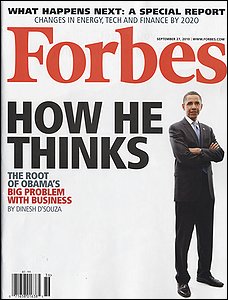
This is the perennial cry of the outraged reader and the wronged article subject. The latest party to raise the fact-checking howl is the White House, which yesterday went public with its discontent over Forbes’ ludicrously poisonous new cover story.

The article depicts President Obama as a deranged anti-colonialist whose ideology of business-hatred was somehow implanted, Manchurian Candidate-style, by the estranged father who abandoned him when he was two. (Imagine, if you will, a leftist critique of George W. Bush that attributed his torture policies to secret indoctrination in his father’s CIA dungeons. I know, I remember reading that cover story too…)

I’ll let others do the actual point-by-point refutations of the Forbes article. I want to come at this story from two other angles.

First, that question about fact-checking: four times out of five, the answer to it is “no, they don’t.” Much of the public still believes that “fact-checking” is actually a routine part of news journalism, and most journalists aren’t in any rush to bust the myth, but myth it is.

There are two types of “fact-checking”: One is a formal procedure of the news work-flow, where somebody with the title of “fact checker” actually attempts to verify every single fact in a piece. This is the sort of thing the New Yorker is famous for. It used to be the norm at glossy magazines, but the norm is decaying in this era of media-business meltdown. I did fact-checking work at the start of my career, as many journalists did, and it’s a good discipline, but an increasingly rare one.

The other sort of fact-checking is the more informal spot-checking that has always taken place in daily newsrooms and today is common in the better online operations. This is fact-checking by sniff-test, for the most part — story editors and copy editors (where they still exist) backstopping beat reporters, looking up stuff that sounds wrong or that’s in some sensitive area. Informal spot-checking is vital but necessarily spotty. Stuff slips through. That’s why we have corrections. (We need more.)

The fact-checking picture is further muddied by the divide between reporting and analysis or commentary, a theological line that many editors still believe it’s both possible and necessary to draw. This gives some old-school editors heart in today’s overheated partisan landscape. The news reporting is where they’ll continue to fight the battle for fact; the opinion stuff can sell the product with fact-mauling innuendo.

Readers don’t care about this line. If you put the story on your cover, it’s your publication’s reputation that’s at stake. And Forbes’ has taken a serious hit.

Forbes’ defense of its work has been a classic circle-the-wagons move. Here’s the magazine’s statement in its entirety:

Dinesh D’Souza’s cover story was presented as an analysis of how the president thinks. No facts are in contention. Forbes stands by the story.

In fact, the statement “no facts are in contention” is itself counter-factual. You can’t say “no facts are in contention” when the staid Columbia Journalism Review has described your article as “a fact-twisting, error-laden piece of paranoia.”

The second point I want to make is about the changing cast of characters in this media drama. The Forbes piece is written by Dinesh D’Souza; it’s a trailer for a new book. (Books are another media type that’s far less “fact-checked” than most readers understand. That’s ironic, since magazine fact-checkers treat books as authoritative sources.) D’Souza’s career was hatched in right-wing think tanks and funded by conservative foundations. That in itself is nothing new; today, for instance, the Wall Street Journal’s op-ed pages serve as a full-employment act for Heritage Foundation and American Enterprise Institute hacks.

But if you read just five paragraphs into Howard Kurtz’s piece on the Forbes flap, you notice this line: “The magazine would not make Editor in Chief Steve Forbes, who sought the Republican presidential nomination in 1996 and 2000, available for comment.” That’s right: In case you forgot, Forbes is edited by a, pardon me, politician — a conservative GOP presidential candidate.

Perhaps this has some bearing on its willingness to launch brazenly absurd and inaccurate assaults on a Democratic president. Ya think?

So we’ve moved beyond putting the commentariat on the partisan payroll. Now, more and more of your political commentary, particularly on cable, is being delivered by actual politicians. Not people who might someday consider a career in politics, but rather, people who — like Sarah Palin — are presumed active candidates. This phenomenon cuts across parties (now we’ve got New York’s former Democratic governor hosting on CNN), but plainly it’s the Republicans who have made the most of this new revolving door. Fox News has become their shadow-cabinet government. And the pols are laughing all the way to the bank: used to be, the broadcasters got their footage for free, but now, they’re collecting checks.

In this new world, the public is forced to look at news coverage with the same jaundiced eye it has long turned on stump speeches and candidate debates. Forbes’ cover story isn’t journalism; it’s essentially a campaign attack ad. Its technique is to introduce outrageous lies into the discourse so that public figures can parrot them and spread the misinformation before the truth squad can arrive on the scene.

We shouldn’t be surprised. But neither should we expect the practitioners of this dark art to care when we wonder why they’re abandoning journalistic norms.

I do feel sorry for those self-respecting journalists laboring on Forbes’ payroll who have to carry this albatross around their professional necks. Or those employees of the Web operation who landed at Forbes when it recently acquired the blogging network True/Slant. Their predicament is likely to be one that more and more journalists face over the next couple of years.

UPDATE: CJR’s Ryan Chittum did a second, more detailed takedown of the errors and misrepresentations in D’Souza’s piece.