Ecco in the cloud with Amazon

Late last night — because late night is the time to tinker with software! — I decided to test drive Dave Winer’s recent crib sheet on setting up an Amazon Web Services cloud-based server. Dave called it “EC2 for Poets” (EC2 is the name of Amazon’s service), and I’ve always been a fan of “Physics for Poets”-style course offerings, so — though I do not write poetry — he lured me in.

For the uninitiated, Amazon has set up a relatively simple way for anyone to purchase and operate a “virtual server” — a software-based computer system running in their datacenter that you access across the Net. It’s like your own Windows or Linux box except there’s no box, just code running at Amazon. If you’ve ever run one of those arcade video-game emulators on your home computer, you get the idea: it’s a machine-within-a-machine, like that, only it’s running somewhere else across the ether.

Dave provided crystal clear step-by-step instructions for setting up and running one of these virtual servers. (Writing instructions for nonprogrammers is, as they say in software-land, non-trivial. So a little applause here.) The how-to worked hitch-free; the whole thing took about a half-hour, and by far the longest part was waiting for Amazon to launch the server, which took a few minutes.

But what should one do with such a thing? Dave’s sample installation runs a version of his OPML editor, an outlining tool. That gave me an idea.

Regular readers here know of my dependence on and infatuation with an ancient application called Ecco Pro. It’s the outliner I have used to run my life and write my books for years now. It has been an orphaned program since 1997 but it still runs beautifully on any Win-32 platform; it’s bulletproof and it’s fast. My one problem is that it doesn’t share or synchronize well across the Net (you need to do Windows networking to share it between machines, and I just don’t do that, it’s never made sense to me, as a one-man shop with no IT crew).

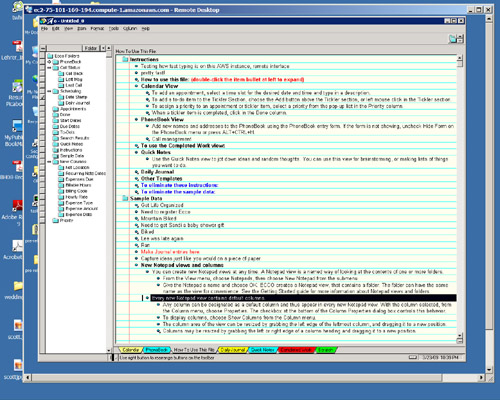
But what if I were running Ecco on an Amazon-based server? Then I could access the same Ecco document from any desktop anywhere — Macs too. So I downloaded the Ecco installer (using a browser running on the Amazon-server desktop, which you access via the standard Windows Remote Desktop Connection tool), ran it, and — poof! — there it was, a 12-year-old software dinosaur rearing its ancient head into the new Web clouds:
eccoincloud

What you see here in the innermost window is Ecco itself (displaying some of the sample data it installs with). Around that is the window framing the remote desktop — everything in there represents Windows running in the cloud. The outermost frame is just my own Windows desktop.

This remains very much in Rube-Goldberg-land at this point. Accessing this remote server still requires a few more steps than you’d want to go through for frequent everyday use. (To me it felt like it was about at the level that setting up your own website was in 1994 when I followed similar cribsheets to accomplish that task.) And the current cost of running the Amazon server — which seems to be about 12.5 cents per hour, or $3 a day, or over $1000 a year — makes it prohibitive to actually keep this thing running all the time for everyday needs.

On the other hand, you have to figure that the cost will keep dropping, and the complexity will get ironed out. And then we can see one of many possible future uses for this sort of technology: this is where we’ll be able to run all sorts of outdated and legacy programs when we need to access data in different old formats. Yesterday’s machines will virtualize themselves into cloud-borne phantoms, helping us keep our digital memories intact.


What’s in a middle initial?

One of the first things I learned as a rookie reporter was to ask everyone I interviewed how to spell their names and what their middle initials were. Who cared about the middle initial? Mostly, nobody. But obtaining it, the reasoning went, was a sign — to both the interviewee and, later on, your readers — that you cared about the details and could be trusted to get them right.

I still care about details and aim to spell names right. Mostly, I don’t bother with middle initials any more. Still, I take note when I see a Web writer who does. So I perked up while I was reading a breezy but lengthy piece titled “Die, Newspaper, Die” by
Mark Morford, a columnist at SFGate, the Web site of the foundering SF Chronicle. In his piece, Morford attempts to sum up the latest round in the Web’s discussion of post-newspaper journalism. He comes down on all sides at once, but with a definite leaning towards the value of the old pros, the sort of reporters who still bother to ask for middle initials:

In the howling absence of all the essential, unglamorous work newspapers now do — the fact-checking, interviewing, researching, all by experienced pros who know how to sift the human maelstrom better than anyone, and all hitched to 100+ years of hard-fought newsbrand credibility — what’s the new yardstick for integrity?

Alas, if including middle initials, and getting them right, is one of those yardsticks, Morford comes up short. For some reason, in referring to Steven Johnson — the widely known writer, founder of the pioneering Feed magazine and more recently Outside.in, and author of a currently much-discussed post on the new journalism ecosystem — Morford calls him “Steven P. Johnson.”

Now, getting a middle initial wrong could happen to anyone. But in Steven’s case, the man’s URL — at stevenberlinjohnson.com — includes his middle name. Morford even links to it.

A tiny thing, no doubt. But in a column whose title is “Notes and Errata,” it really made me wonder how much of that “100+ years of hard-fought newsbrand credibility” is left to salvage.

This morning I am in New York

nyposthed

Berkeley J-School’s Chronicle panel: The horse-and-buggy set’s lament

[Warning -- long post ahead! This happens when one has a transcontinental flight during which to blog.]

A panel at the UC Berkeley School of Journalism that I attended yesterday evening was titled “The SF Chronicle in Transition.” “Transition,” here, is plainly a euphemism; the title ought to have been “The Chronicle In Extremis,” and the mood was that of a wake.

There is plenty of cause for communal handwringing in the face of the wrenching cutbacks and shutdowns that are plaguing newspapers across the U.S. and that most recently have threatened the survival of our major Bay Area daily, which has reportedly been losing its owner, the Hearst Corporation, $50 million a year, and looks likely to cut its staff by half if owners and unions reach an agreement. If not, Hearst has threatened to shut the paper down, leaving this city without a major daily newspaper. (It’s hard to believe that Hearst would simply write off its huge investments in the Chron, however; the threat sounds more like a negotiating tactic than a serious option.)

The panel offered a by now familiar litany, a mixture of wrongheaded cliches with legitimate fears. Heard, for instance, was the old canard that giving up newspapers for the Web means we won’t ever stumble on things we didn’t know we were interested in. (In fact, hugely popular sites like Boing Boing or Kottke.org have professionalized the generation of serendipity, and our Twitter friends feed us as varied a diet of links as we choose to feast on.) Here was the routine complaint about rudeness and “uninformed shouting” in comments forums. (A brief shouting match between one member of the crowd at the Berkeley event and the editor and publisher of the Berkeley Daily Planet — from what I could hear, about whether a writer had been censored — was as rude and off-topic as anything I’ve seen in a newspaper comments section.)

Beyond the usual Web-bashing lay some realistic worries about how we’ll get our local news and who will perform the public-interest watchdog role if newspapers vanish. “We’re in for a real dangerous period where there’s no one watching the store,” Lowell Bergman, the veteran investigative reporter, predicted.

[Read more...]

“Stealing MySpace” review in Washington Post

It’s been about a decade since I did my last book review for the Washington Post, of a Marshall McLuhan biography, so it was time for a return engagement, I guess! Yesterday’s Post featured my review of Wall Street Journal reporter Julia Angwin’s new book on the story of MySpace. (Here’s the book’s site.)

The book is very thorough, dogged business reporting, worth reading if you want to know about MySpace’s origins in the murk of the Web’s direct-marketing demimonde or if you’re interested in the corporate maneuvering around Rupert Murdoch’s 2005 acquisition of the company. It offers only some brief glimpses of the culture of MySpace, though, and I think MySpace is more interesting for the vast panorama of human behavior it provides than for its limited innovations as a Web company or for the ups and downs of its market value. Here’s the review’s conclusion:

Angwin tries to cast MySpace as “The first Hollywood Internet company” — freewheeling, glitzy, “where crazy creative people run the show” — in contrast to what I guess we’d have to call the Internet Internet companies, like Silicon Valley-based Facebook, where programmers rule the roost. But that’s a bit of a false distinction: Programmers can be crazily creative people, too, and plenty of creative types have learned to master technology. (See, for example, Pixar.)

You can’t help getting the impression from “Stealing MySpace” that MySpace’s founders, however smart and dogged they may have been, were also opportunists who simply got lucky. That leaves us wondering about the wisdom of Murdoch’s acquisition. Facebook surpassed MySpace long ago in innovation, buzz and, more recently, actual traffic, according to some tallies. It has thereby stolen MySpace’s claim to being “most popular” and rendered Angwin’s subtitle obsolete.

Sic transit gloria Webby. Was Murdoch’s purchase of MySpace a savvy coup or just a panicked act of desperation, like Time Warner’s far more costly AOL mistake? It will take at least a few more years before we know for sure. By then, no doubt, both MySpace and Facebook will have been elbowed aside by some newcomer nobody has heard of today.

Shirky sets the wayback machine to 1500

Clay Shirky has a new post up titled “Newspapers and Thinking the Unthinkable” that is really about as cogent a summary of the state of affairs in the land of dying newspapers as you’re likely to find. Here are a couple of brief excerpts, but I highly recommend reading the whole thing:

When someone demands to be told how we can replace newspapers, they are really demanding to be told that we are not living through a revolution. They are demanding to be told that old systems won’t break before new systems are in place. They are demanding to be told that ancient social bargains aren’t in peril, that core institutions will be spared, that new methods of spreading information will improve previous practice rather than upending it. They are demanding to be lied to.

There are fewer and fewer people who can convincingly tell such a lie….

Print media does much of society’s heavy journalistic lifting, from flooding the zone — covering every angle of a huge story — to the daily grind of attending the City Council meeting, just in case. This coverage creates benefits even for people who aren’t newspaper readers, because the work of print journalists is used by everyone from politicians to talk radio hosts to bloggers. The newspaper people often note that newspapers benefit society as a whole. This is true, but irrelevant to the problem at hand; “You’re gonna miss us when we’re gone!” has never been much of a business model. So who covers all that news if some significant fraction of the currently employed newspaper people lose their jobs?

I don’t know. Nobody knows. We’re collectively living through 1500, when it’s easier to see what’s broken than what will replace it. The internet turns 40 this fall. Access by the general public is less than half that age. Web use, as a normal part of life for a majority of the developed world, is less than half that age. We just got here. Even the revolutionaries can’t predict what will happen.

J-schools: from phone and typewriter to Web

There’s a great back-and-forth in the comments on my post below about new media skills and journalism schools.

As my former colleague Damien Cave says, journalism schools ought to be teaching students to ask, “What’s the best way to tell this story?” and to become adept at finding, and executing, an answer.

Plainly some students want more of a new-media focus than they’re getting. There’s an interesting contrast between what some of the recent Columbia grads posting are saying (in essence, that the school isn’t really keeping up) with what faculty member Paula Span says (they’re working like crazy to keep up). Maybe the incoming students today are getting a different experience from their recent predecessors. Schools don’t change as fast as the Web does.

“Cranky” asked me, “Universities are not vocational schools. Where did you learn your Web skills, Scott? On the job, right? Just the way it should be.” It’s sort of a moot question in my case, since the Web didn’t exist when I was in school. But I didn’t expect the university to teach me to type, either, so point well taken.

I agree with those (including, I guess, Lemann himself) who say that a journalism school shouldn’t be in the business of teaching technical skills. But I would always have expected any professor teaching me about writing to be familiar with the experience of typing, and understand how the process of typing affects the form and function of producing journalism. Similarly, you would expect someone teaching reporting, then and now, to understand the telephone and its role in putting a story together. You didn’t need to know the technical underpinnings of the phone system then, any more than you need to know how to program Flash now. But you needed to understand how to make a call, and how the phone fit into your journalist’s job of story-finding-and-communicating, just as you now need to understand how different forms of Web communication fit into that same job today.

We do not expect journalism professors to be programmers. But I think we have a right to expect them to be conversant in the media universe in which their students will be working. To teach journalism and still be ignorant of today’s Web would be like teaching journalism 30 years ago while being ignorant of the typewriter and the telephone. You still might have some wisdom to impart to your students, but you’d be operating at a significant remove from the real world in which the craft is practiced.
