Flashback 9/11

I’ve been spending a lot of time digging through the blogospheric record of 9/11. And it’s brought back some of my memories of those tense days and weeks — less tense in San Francisco, certainly, than in New York, but jittery nonetheless.

And I can’t help thinking, again, as I have before — on the one-year anniversary of the attacks, and again at the five-year milestone — how miserably the U.S. has fared in pursuing its interests since the towers fell. President Bush had a good first couple weeks (after a bad first couple of days), followed by an awful rest of the decade.

In the days after 9/11, we didn’t know whether there were more attacks in line. There was anthrax in the mail and fear in the air.

But we also had a measure of political unity, unthinkable now; an outpouring of good will from around the world; and a national resolve to bring the 9/11 perpetrators to justice.

If you could somehow send a messenger from today back to that packed joint session of Congress that Bush addressed on Sept. 20, 2001, Joe Future would have to say something like this:

“I’m sorry to tell you that, nearly seven years later, you won’t have captured Osama bin Laden. You’re going to have a big scare about anthrax-tainted letters, but you’ll never find out who sent them. You’re going to depose the Taliban only to let them survive and prosper. You’re going to invade Iraq, commit America to a disastrous open-ended occupation, and give the Islamists a whole new banner to recruit under. You’re going to bankrupt the Treasury, trample the Constitution, and drag the name of the U.S. through the mud.”

Such a prospect would, of course, have been unfathomable.

UPDATE: I didn’t even realize when I posted this last night that today is the fifth anniversary of Bush’s hubris-laden “Mission Accomplished” stage show. Thanks to Amos in the comments for pointing out.

 

Everything connects

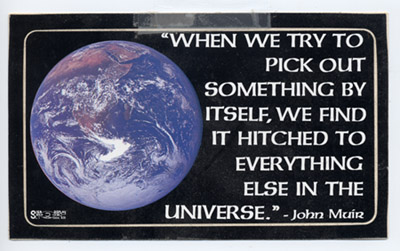
For something like 25 years I have had a postcard (now tattered and brown-edged) taped near wherever I write:

John Muir quote

One reason I became a writer is that I love the sensation of finding connections. It can stun me, make me laugh, or help me feel that I understand the universe just a little bit better.

I’ve spent the last few months researching my next book. I’m nowhere near done (and will continue!). I could conceivably, and profitably, devote whole additional years to further research.

But I’ve also reached a point in my labors that I now recognize from previous large writing projects. My brain feels like it’s overflowing. And everywhere I look, whatever I’m looking at seems to connect to what I’m writing about. Everything is hitched to everything else.

That means it’s time to start writing.

The exhilarating and painful work of trying to preserve that apprehension of interconnectedness on the page always involved some amount of disappointment, at least for me; where the apprehension is oceanic, the written end-product is finite.

But a completed book has one advantage over a vague sensation: it can be shared. So here goes!


Checked out for a bit

We’ve been on vacation this week — springtime on the Pacific coast! — so no posts about Hillary vs. Obama, the transformation of the WSJ by Rupert Murdoch (the original Mediogre) or anything much else.

LATE CLARIFICATION: There was no seal massacre! These mothers and pups are just taking a little break (as we were).


Obama’s fundraiser, Mayhill Fowler, and the “supporter/reporter” question

Here’s a fascinating story from Jay Rosen about the Off the Bus blogger who first reported on Obama’s “bitter in Pennsylvania” comments.

It turns out, as so many important stories do, to be far more complex and nuanced than anything you’re likely to have heard on TV or in the papers, which mostly preferred not to name the story’s source: Mayhill Fowler, an Obama supporter who has been blogging for Off the Bus (a collaboration between Huffington Post and Rosen’s NewAssignment, for which I have served as an adviser in the past).

Fowler attended Obama’s San Francisco fundraiser. Traditionally, the press has not reported on what candidates say at private fundraisers. Fowler seemed blur the roles of “supporter” and “reporter” well enough that she got access to the event without ever being asked not to cover it.

Rosen talks about how “uncharted” the campaign terrain is today, with no clear boundaries separating those participating in the campaign from those covering the campaign. In the New York Times, Katherine Seelye asks, “Is it possible to straddle the line between reporter and supporter?”

Fowler’s story answers that question pretty definitively. Of course it’s possible. The fixed roles of the old campaign drama are dissolving. Everyone’s improvising. The bad news is that a lot of people are confused. The good news is that a lot more people can participate — and hear what’s said behind previously closed doors.

If you are a politician speaking to a crowd — any crowd — you should pretty much assume that everything you say can and will be broadcast to the world. That’s the lesson that George Allen learned, and it’s one Obama should know, too.

Apparently some Obama supporters feel that bloggers should be understood to be “activists” not “journalists,” and that Fowler betrayed their cause:

Bloggers are viewed as activists, not journalists. It’ s why some campaigns have blogger conference calls and press conference calls. The blogger calls are to pump up the base. The press calls are to do spin and answer arguably tough questions. She was admitted to the private San Francisco fund-raiser as an activist blogger and then functioned as a journalist.

This strikes me as one of those distinctions that is untenable. Some bloggers are activists, some are journalists; some are diarists, some are businesspeople. Saying you’re “a blogger” doesn’t make you an activist or a journalist or anything else; all it means is that you’re someone who posts stuff on the Web. Since the Web is public, this practice has a natural slope, a gravitational pull; things roll naturally from the private to the public.

So, yes, on the Web the “line between supporter and reporter” has been smudged out. One result, this week, is that Obama’s campaign has suffered a setback — and as an Obama supporter, I might be mildly disappointed. But, far more importantly, as a journalist I’m happy to see more and more of the previously curtained elements of our election process brought forth into view. Ultimately, it’s better for everyone to know what Obama said at his fundraiser.

But now we’ve only heard from one of three candidates. Next, let’s turn on the mikes in the rooms where Hillary Clinton is talking to her backers. And let’s listen in on John McCain wooing those wary evangelicals!


Times/Journal convergence

As long as I can remember I’ve read the New York Times (I grew up in NYC). Since the mid 90s — when I moved from being a newspaper critic to the Web universe, both covering it and participating in it — I’ve also read the Wall Street Journal daily. The Journal, despite its paleolithic editorial page, had a whole different slice of material than the Times: more in-depth coverage of tech business, lengthy investigative features, those quirky column-three features on the front page. The two papers were complementary.

Now, under Murdoch, the Journal is getting more — there’s no other word for it — redundant. The front page has more news headlines and fewer unique features. Increasingly, I find myself saying, “I’ve already read this.”

I don’t get why Murdoch is pushing the Journal to be more generic. The stuff the Journal does that nobody else does is the only reason to buy the paper (or read it online). Breaking news and color photos are commodities today.

Maybe Murdoch sees himself moving into some sort of old-fashioned newspaper war with the Times. But from where I sit, he’s just pushing me closer to the point where I say, “Why do I need two newspapers?”


Links for April 9th: Fresh Air, Firefox, business models…

  • Firefox 3 Memory Usage — pavlov.net: I met Stuart Parmenter, a/k/a Pavlov, during his time at OSAF. Here he offers an in-depth explanation why Firefox 3.0 no longer leaks memory the way the older version did (meaning that if you kept a jillion tabs open for a long time, the way I do, the browser would gradually eat up your computer’s available memory). This is heavy technical sledding, but a fascinating document of just how much painstaking, drudgery-filled detective work goes into the fine-tuning of a software application.
  • Newspapers and the Net: Where’ the Business Model, People? – Britannica Blog: Jay Rosen’s contribution to a big old round-robin at the Britannica site on the future of newspapers. There’s a quote from me at the end — thanks! — but this is the part that I want to clip:

    At many a conference I have attended on new media and journalism, some old pro whose subsidy is fast disappearing will (mentally) place hands on hips and say about the Internet as a whole, “Well, that’s all very nice, very Web 2.0, but where’s the business model, people?” As if that were some kind of contribution. I can’t tell you how disconcerting — and weird -– I find some of these performances.

    The funny thing is, those guys have been doing that as long as the Web has been around — pointing this lack of prospective revenues out as if it were not their problem but someone else’s.


Why the Web-only life is not worth examining

Today’s Journal features a Portals column by Vauhini Vara that represents yet another attempt to gauge how far Web apps have come by attempting to “live on the Web,” forsaking all desktop-based software. (Others — like James Fallows in 2006 in Technology Review, whose effort I wrote about back then — have done this before.)

The trouble with this approach is that it’s a total straw man. No one would ever do this except to provide column fodder. The shifts in our software habits are incremental; we don’t “change state” 100 percent, we just drift in one direction. And the drift today is overwhelmingly towards the Web.

Of course Vara finds the trouble spots exactly where you’d expect: If you’re tied in to a corporate email system, giving up Outlook for a Web interface is still painful. Spreadsheets and PDFs are harder to work with. Web-based writing tools are pretty good but so far they haven’t provided a good replacement for Word’s clumsy but essential “track changes” feature.

OK. In the meantime, those of us who aren’t locked in to Outlook long ago went with Gmail or some other Web-based email system. We keep and share our calendars on the Web, and increasingly we use Web-based tools to coordinate small work groups. No one is holding a gun to our heads, so we happily mix Web apps and desktop apps. Why not?

If you’re starting a small business today, are you going to invest in Outlook or are you just going to piggyback on some Web service? When the business begins to grow, are you going to pay the big Outlook tax or stick with what’s working? As developers devise new useful tools for communication and coordination, are they introduced on the desktop or on the Web — or in both places?

These are the trends that matter. “All or nothing” is beside the point.