
Wordyard

Hand-forged posts since 2002

Archives

About

Greatest hits

Apple vs. the press

April 11, 2005 by Scott Rosenberg

As long as I’ve written about blogs I’ve made the point that blogging and journalism are separate activities that may or may not overlap. Since this debate has now entered the legal realm, let’s restate this with mathematical precision: Bloggers can be journalists; journalists can be bloggers. Neither state — I Am A Journalist, and I Am A Blogger — excludes the other, but neither guarantees the other. There is an axis of blogger to not-blogger, and an axis of journalist to not-journalist. The two axes are orthogonal, not parallel.

The legal matter that forces us to contemplate such a graph is Apple Computer’s suit against three online journalists in an attempt to get them to reveal the sources they used to publish some advance scoops about forthcoming Apple products.

We’re fortunate to be at a moment in history when changes in technology, begun a decade ago by the rise of the Web and accelerated by the introduction of anyone-can-publish software, mean that the spectrum of journalism has been broadened in ways that were previously unimaginable. The danger in the Apple suit lies in the possibility that a bad court decision — like one a lower court has already delivered in this case — might careless and foolishly decide that in order to be a journalist one has to receive a salary from some operation that some legal authority has defined as a journalistic entity.

That such a definition would be not only wrongheaded but actively harmful to the vibrant and lively democratic free-for-all on today’s Internet is the point of an amicus curiae brief filed today by Stanford Law School’s Center for Internet and Society. I’m proud to be among the signers of this document, which was written by Lauren Gelman of the Stanford center. (Here’s a full list of the amici, with links.) The brief argues that, when the courts need to determine who receives the various legal protections available in some circumstances to working journalists, it should decide who is a journalist by looking at what putative journalists actually do, not who pays their salary or what membership cards they carry or what degrees they hold:


Amici come together to urge this court to hold that Internet publishers, including webloggers who are engaged in the reporting and dissemination functions a journalist performs, may invoke the protection of the journalists’ privilege on equal footing with traditional reporters and news organizations….

The applicability of the newsgatherers’ privilege is determined not by the reporter’s formal status as a ‘professional journalist,’ but rather by the reporter’s functional conduct in gathering information with the purpose of disseminating widely to the public.

If you take the time to read the somewhat confused state court decision that is now under appeal, you’ll see that the judge’s initial ruling, in favor of Apple and against the Web sites, declares that it doesn’t really matter whether you consider the Apple news sites to be conducting journalism or not, because, the judge seems to be saying, journalists have no business publishing trade secrets anyway.

I’m not enough of a lawyer to try to predict where that argument is headed; it seems of a piece with a variety of assaults taking place today on the rights of journalists to protect their sources. (The parallel amicus brief presented by the AP, a long list of California newspapers and the Reporters’ Committee for the Freedom of the Press tackles this issue.)

What I do know is that, if the New York Times or Time magazine published a scoop from an anonymous source about a forthcoming Apple product, the company wouldn’t be suing the press. So it’s important here for people who do journalism at all points along the spectrum from “pro” to “citizens” to step forward and say: If you ask questions with intent to publish, and you publish information someone considers news, you’re a journalist, and should be treated as one by the courts.

Filed Under: Blogging, Media, Personal, Technology

Interesting reading

April 4, 2005 by Scott Rosenberg

## Peter Drucker looks at the big picture of the world economy today — really four economies, he says: information, money, multinationals and mercantile exchange.

  For thirty years after World War II, the U.S. economy dominated practically without serious competition. For another twenty years it was clearly the world’s foremost economy and especially the undisputed leader in technology and innovation. Though the United States today still dominates the world economy of information, it is only one major player in the three other world economies of money, multinationals and trade. And it is facing rivals that, either singly or in combination, could
conceivably make America Number Two.

## Cynthia Ozick reviews Joseph Lelyveld’s memoir. I haven’t read the book, but the former N.Y. Times editor apparently did a vast amount of legwork researching his own childhood. This is Ozick’s discussion of the limitations of Lelyveld’s approach:

  …There is no all-pervading Proustian madeleine in Lelyveld’s workaday prose. Yet salted through this short work is the smarting of an unpretentious lamentation: ”If this were a novel,” ”If I were using these events in a novel,” and so on. Flickeringly, the writer appears to see what is missing; and what is missing is the intuitive, the metaphoric, the uncertain, the introspective with its untethered vagaries: in brief, the not-nailed-down. Consequently Lelyveld’s memory loop becomes a memory hole, through which everything that is not factually retrievable escapes. Memory, at bottom, is an act of imaginative re-creation, not of archival legwork. ”Yes, I was finding, it was possible to do a reporting job on your childhood,” Lelyveld insists. Yes? Perhaps no. The memoirist has this in common with the novelist: he is like the watchful spider alert to every quiver on its lines. Sensation, not research.

Well put. I think one of the reasons I chose, as a young writer, a career as a critic rather than as a reporter was that I could not see devoting my life to writing that was all “nailed-down.” Reporting is a necessary and valuable skill, and I have deep respect for those who do it well; it’s hard, hard work, too. But it will typically miss that dimension of “the intuitive, the metaphoric, the uncertain, the introspective.” In American journalism as it is conventionally defined by those who carve out the job descriptions, a critic’s portfolio is broader, and it’s possible, under the right alignment of stars, to feel as well as to record — or rather, to record what one has felt along with what one has witnessed.

## Apparently there’s a movement afoot in the world of writing about games to be less “nailed-down.” It’s called the “New Games Journalism” — “a narrative, experiential approach that acknowledges the effect of the game on the player.” I’ll need to read up. This was sort of what I had in mind 15 years ago when I began to move my attention from the world of theater to the digital realm, and thought, hey, why not try writing more ambitious reviews of videogames? I’d just turned 30, though, and was already feeling that the gaming world was one I would be less and less able to keep up with as the decades advanced. (So right!) So I wrote one opus — an “experiential” discourse on the world of Super Mario — and moved on to broader terrain.

Filed Under: Business, Food for Thought, Personal, Technology

Robot combat

March 28, 2005 by Scott Rosenberg


Ouch

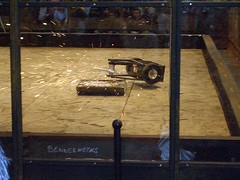
What could be a better diversion for two robot-besotted five-year-old boys than San Francisco’s annual Robolympics? We went Saturday, spent about an hour watching the “two bots enter, one bot leaves” arena combat in the gym at SF State, then wandered over to the more peaceful confines across the way where swarms of Aibos wandered the stage.

This was Matthew and Jack’s favorite. No wonder: The sword lights up, the bot does Mifune moves — this snapshot doesn’t really do justice.

Filed Under: Personal, Technology

Long time no blog

March 28, 2005 by Scott Rosenberg

Apologies — I’ve been digging into the work of actually writing some chapters of my book, and something had to give. Since the kids still expect to be tended and entertained, the blog had to be left neglected and bored. I could hear its whimpers from the corner, but I had to harden my heart. (The kids scream louder, anyway.)

Conveniently, I no longer need to explain the deep psychological reasons behind my choice not to blog a whole lot of the work of my book, because Steven Johnson has said it all. Johnson has a new book coming out next month, Everything Bad is Good For You, a defense of pop culture that I am looking forward to reading as a reward to myself once I finally finish the half-dozen books on software disasters I am working my way through.

Filed Under: Dreaming in Code, Personal

Dosed

March 1, 2005 by Scott Rosenberg

Here’s a little tale of life in the 21st century.

As I suffered through a bout of the usual seasonal cold last week, I found that my supply of my remedy of choice — a generic over-the-counter combo antihistamine and pseudoephedrine (Sudafed) — was running low. As I ran errands, I searched for this variety on the shelves of local drug stores, but to no avail. Finally, this morning, at a Walgreen’s in downtown San Francisco, I found the precise medication, so I thought, gee, better stock up.

But when I plopped three boxes of “Walfinate D” on the counter, the checkout lady said, “There’s a limit of two on those.” She couldn’t tell me exactly why, but since all she wanted to do was ring box number three up separately, I didn’t pursue it.

Back at my desk, I decided to look for answers. I couldn’t remember how to spell “pseudoephedrine” so I just Googled “sudafed controls” and found this page, which pretty much answered my question: Pseudoephedrine is apparently a key raw material for the proprietors of meth labs, so the government wants to limit bulk sales.

First I was irritated that my need for cold relief was being made more inconvenient by the chemistry demands of speed freaks. Then I was delighted at how simple a matter it was, in these Google-powered times, to discover exactly why my cold medicine was considered a suspect substance.

My inconvenience was hardly severe. But if they try to ban my Sudafed, as the commentator on the above page proposes, they’ll have to pry it from my germy, sneezed-into hands!

Filed Under: Business, Personal, Science

Personal publishing

February 22, 2005 by Scott Rosenberg

Jason Kottke, a Web veteran and longtime blogger whose work I’ve always respected and enjoyed, has quit his job to blog full time, and rather than go the advertising route, he’s passing a patronage hat. I kicked in a wee bit and encourage you to do so as well if you are one of Kottke’s readers, or if you become one.

Making blogging pay is not easy; making any kind of online publishing pay, when you’re hand-producing content, is hard, I can safely say, after a decade of trying. Sponsorships and advertising raise the same sorts of ethical concerns in blogs as they do anywhere else; even when you’re ethically alert, you can’t help facing tough calls pitting your duty to your readers against the demands of your advertisers. (J.D. Lasica’s recent piece in the Online Journalism Review thoroughly explores this ground.)

Some high-profile political bloggers (e.g. Sullivan, Marshall) have made a go of it as independent blogger/publishers outside of any institutional framework. But the passions of partisanship help open people’s pocketbooks; it’s brave of Kottke to try this from a perch largely outside the political fray.

Personal publishing is a grand dream. Exactly ten years ago, in February 1995, I posted the first (and only) issue of my own Web magazine (warning: ancient HTML alert! Prehistoric navigation scheme ahead!). It’s what I thought I’d end up doing, and if Salon hadn’t come along, I probably would have given it my all. Today the tools are better, and our understanding of the power of the network is stronger and subtler, and if folks like Jason Kottke can make a go of it, we’re all going to feel a little more free.

Filed Under: Blogging, Personal

David Talbot moves on

February 10, 2005 by Scott Rosenberg

In 1994, the Internet grabbed me by the lapels and said, “Come here, kid.” I learned all about HTML and TCP/IP but I knew nothing about raising money or starting a company. It was David Talbot who had the totally unshakeable belief that it would be possible, not only creatively but financially, to start an independent Web site where he and a group of writers and editors from the San Francisco Examiner, including me, could try to do their best work.

Since the news of his stepping down as editor of Salon broke today, it seems the right time to tip my hat to his ingenuity and tenacity and guts over the years of starting Salon, shaping it, and keeping it afloat in high tides and low ebbs.

I’m getting asked a bit about what the transitions at Salon mean for me, so I’ll mention what I’ve said in this space before: I’m thrilled to be working on my book, but I would never have felt right about taking a break from Salon in the first place if I didn’t have deep trust and confidence in the people who are now in charge. Joan Walsh and Betsy Hambrecht are smart and energetic and creative, and they will, I’m sure, keep Salon moving in good directions. I’ll be continuing to enjoy my new status as a reader of the site who doesn’t know everything that’s going to be published beforehand. And when my own project is done I hope to return to Salon and contribute to its next chapters.

Filed Under: Media, Personal, Salon

This thing still on?

February 4, 2005 by Scott Rosenberg

For a variety of boring reasons I spent some time today upgrading my old Windows 2000 box to WinXP. I believe that Radio has survived the transition, but this is a test post to make sure…

Filed Under: Personal

Yearend notes

December 31, 2004 by Scott Rosenberg

I’ve been off-blog for a time here as I tend to family during the holidays — normal posting will resume next week.

In the meantime, best wishes for the new year to all of you who keep up with my small effort in the blogosphere here. We celebrated, as is often the case here at our home, with good beer and spicy Szechuan meat sauce noodles — noodles being, as I understand it, symbolic, in the Chinese culture, of long life. Also tasty.

And of course it’s not possible this year to celebrate without thinking of the thousands lost and the thousands still coping with the sorrows and privations of the Indian Ocean tsunami. Living here as we do on the Hayward and San Andreas faults, we can only acknowledge our collective vulnerability, and offer whatever help we’re able.

It’s good to see that our government is finally reacting to the enormity of this disaster with a more appropriate level of assistance than first announced.

But not everyone sees the humanitarian value in such decisions: Our friends at the Ayn Rand Institute argue that the U.S. government shouldn’t offer any humanitarian aid at all. After all, the government has no money of its own except what it raises by taxation — and taxation is, you know, like, theft. “Every dollar the government hands out as foreign aid has to be extorted from an American taxpayer first” — so let’s stand on that principle while thousands die!

This ludicrous argument has no virtue other than consistency with the rest of the rad-lib[ertarian] “starve the beast” mentality that, alas, has achieved more influence in the Beltway than anyone would have imagined possible a decade ago. It’s a perspective that’s not far removed from those of proponents of Social Security pseudo-reform, who are really eager to scuttle the program so that the government is no longer involved in securing a safety net for the elderly.

In the end, these people see no role for the government in taking care of anyone, ever. We’ve gone way beyond the days of complaining about welfare queens and the nanny state. We now face determined ideologues who honestly believe that government should let people die of starvation before taxing citizens a cent. Surely the best retort to their extremist idiocy is a simple demonstration of the effectiveness of both public and private aid in the face of nature’s implacable havoc. May such help be there, for them as for all of us, should it ever be needed.

Filed Under: Personal, Politics

Bonfire of the C-90s

December 13, 2004 by Scott Rosenberg

Over the years I have accumulated a large collection of cassette tapes. Typically, I’d own LPs (later, CDs) but I’d transfer them to cassette to listen to them in the car. You could fit two LPs on one C-90, so it was efficient, and everyone knows that music and driving go together like, say, cinnamon and sugar. (Convenience of this sort is, of course, on the wane as the world of “digital rights management” tries to lock down everything it can.)

This was my mode for many years; I still remember debating whether it was worth dubbing my multi-LP set of Laurie Anderson’s “United States” to listen to during the cross-country drive in 1986 as I moved my life from Boston to San Francisco. I knew I’d made the right choice somewhere on I-80 on the long, slow climb up from the plains on the Nebraska/Wyoming border. Anderson’s voice intoned its futuristic alienations and fragile hopes as I hung suspended between two coasts and two lives, and the wind began roaring down from the mountains, buffeting my old car back toward the past. (I also listened to a lot of Buddy Holly — alienation only gets you so far.)

I’ll keep those tapes, and a handful of others. But I’ve got hundreds more that just duplicate music I have in other, better formats. So what does one do with several hundred old cassette tapes? They were once reasonably high quality blanks; it seems criminal to toss them in landfill. I’d welcome any ideas.

Filed Under: Culture, Music, Personal, Technology

« Previous Page
Next Page »