
Wordyard

Hand-forged posts since 2002

Archives

About

Greatest hits

A tale of two book covers

January 1, 2007 by Scott Rosenberg

My book Dreaming in Code — which I first conceived in 2002, started researching and proposal-writing in 2003, got a contract for in 2004, wrote mostly in 2005, and saw through the editing and production process in 2006 — will arrive in bookstores in about two weeks. I am torn between elation and exhaustion. Mostly, I’m deeply happy that — in a world where writers’ work is too often run through a gantlet of crass attitudes, careless handling and fickle judgments — I got the opportunity to write exactly the book I wanted to.

For the next several weeks, this blog will become heavily focused on Dreaming in Code, its reception and surrounding events. Ideally, that will interest you; if not, apologies, but you’ve been warned.

Let’s start with the saga of the book’s jacket. When my editor at Crown, Rachel Klayman, and I first discussed the cover, we agreed that it might be fun to aim for a classical design, one that ran counter to some cliches of the tech-books field (no mouse on the cover, please!) and that signaled, in a light-hearted way, one theme of the book — the aspiration toward elegance shared by the software developers at the story’s center.
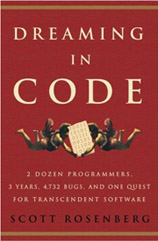
Old cover for Dreaming in CodeSo the wizard designer at Crown came up with this, and we were pretty happy with it. This cover actually went out to the first readers of the book, appeared in early catalog pages, and was transmitted seemingly instantaneously onto Amazon’s page for the book, which first appeared online scarily soon after I’d completed the manuscript.

My agent, however, got concerned, raised some questions, and got the rest of the book’s team equally concerned. For one thing, given that the book tells a story about computer programming, mightn’t it be a good idea for that to be, er, a little more evident from the cover? And then there was the slight problem that some other book that had sold a few copies and also, coincidentally, features the word “Code” prominently in its title uses a similar crimson-and-gold color scheme.
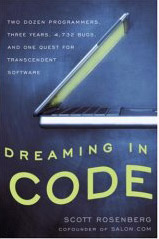
Dreaming in Code, final coverSo it was back to the drawing board for our designer, and we wound up with the splendid cover you see here — its embossed electric-green title mysteriously undulating in a blue-black void.

What I learned from this process is that my own default preference for being subtle and ironic is probably not the best guide for selecting a jacket design. After all, people really do judge a book by its cover. There may only be a nanosecond’s chance to catch someone’s eye. In that instant, you might as well take the direct approach.
[tags]dreaming in code, publishing[/tags]

Filed Under: Dreaming in Code

Good reads: Danner on Iraq, Wolf on the new atheism

December 27, 2006 by Scott Rosenberg

Things have been quiet here lately as we prepare for January, which will be a big month at the Wordyard, what with Dreaming in Code arriving. More anon — as soon as we get through the holidays and I shake off my traditional solstitial cold virus.

In the meantime, a couple of odds and ends of valuable reading — links to curl up with next to the fire when you’ve got some time:

  • If you don’t have time to read the full texts of books like Ron Suskind’s The One Percent Doctrine and Bob Woodward’s State of Denial, you owe it to yourself to read Mark Danner’s New York Review of Books piece, “Iraq: The War of the Imagination,” which summarizes them and puts them — and the disastrous war they chronicle — in a grimly coherent context:

    Nearly four years into the Iraq war, as we enter the Time of Proposed Solutions, the consequences of those early decisions define the bloody landscape. By dismissing and humiliating the soldiers and officers of the Iraqi army our leaders, in effect, did much to recruit the insurgency. By bringing far too few troops to secure Saddam’s enormous arms depots they armed it. By bringing too few to keep order they presided over the looting and overwhelming violence and social disintegration that provided the insurgency such fertile soil. By blithely purging tens of thousands of the country’s Baathist elite, whatever their deeds, and by establishing a muscle-bound and inept American occupation without an “Iraqi face,” they created an increasing resentment among Iraqis that fostered the insurgency and encouraged people to shelter it. And by providing too few troops to secure Iraq’s borders they helped supply its forces with an unending number of Sunni Islamic extremists from neighboring states. It was the foreign Islamists’ strategy above all to promote their jihadist cause by provoking a sectarian civil war in Iraq; by failing to prevent their attacks and to protect the Shia who became their targets, the US leaders have allowed them to succeed.

    …Saddam Hussein and the autocracy he ruled were the product of a dysfunctional politics, not the cause of it. Reform of such a politics was always going to be a task of incalculable complexity. Faced with such complexity, and determined to have their war and their democratic revolution, the President and his counselors looked away. Confronted with great difficulties, their answer was to blind themselves to them and put their faith in ideology and hope—in the dream of a welcoming landscape, magically transformed. The evangelical vision may have made the sense of threat after September 11 easier to bear but it did not change the risks and the reality on the ground. The result is that the wave of change the President and his officials were so determined to set in course by unleashing American military power may well turn out to be precisely the wave of Islamic radicalism that they had hoped to prevent.

  • And over in Wired, don’t miss Gary Wolf‘s excellent discussion of the new evangelical atheism, “The Crusade Against Religion”. Here’s its rousing peroration, in a direct line of descent from Mill’s On Liberty:

    The irony of the New Atheism — this prophetic attack on prophecy, this extremism in opposition to extremism — is too much for me. The New Atheists have castigated fundamentalism and branded even the mildest religious liberals as enablers of a vengeful mob. Everybody who does not join them is an ally of the Taliban. But, so far, their provocation has failed to take hold. Given all the religious trauma in the world, I take this as good news. Even those of us who sympathize intellectually have good reasons to wish that the New Atheists continue to seem absurd. If we reject their polemics, if we continue to have respectful conversations even about things we find ridiculous, this doesn’t necessarily mean we’ve lost our convictions or our sanity. It simply reflects our deepest, democratic values. Or, you might say, our bedrock faith: the faith that no matter how confident we are in our beliefs, there’s always a chance we could turn out to be wrong.

[tags]atheism, iraq, mark danner, gary wolf[/tags]

Filed Under: Culture, Media, Politics

Why this year’s Time “Person of the Year” should be the last

December 18, 2006 by Scott Rosenberg

So Time magazine went and decided that — 2006 being the Year of User-Generated Content ™, aka the Year of YouTube Being Acquired By Google, and also the year that big corporate media companies began to see the rot in their financial foundations — its person of the year is “you.”

Dan Gillmor points out that the very nature of this choice presupposes a rapidly obsolescing notion that the magazine’s own editors are still on the other side of the barricades from the teeming content-generating masses. Jeff Jarvis asks what the fuss is all about, “this is nothing new.” Dave Winer says that Time is still too focused on the value created in the “wisdom of the crowd” aggregation of a multitude of voices, when the really important value lies with each individual voice.

I would add that, if Time’s editors put real stock in their choice and believed in the notion they are now promoting, then, having chosen “You” as the “Person of the Year,” they would announce that this is the very last time they will meet in solemn conclave to anoint a Person of the Year. Gatekeeper, retire thyself! No more bogus end-of-year popularity contests!

Except they do seem very effective at sparking conversations online.
[tags]time magazine, person of the year, youtube, dave winer, jeff jarvis, dan gillmor[/tags]

Filed Under: Blogging, Media, Technology

Good reads: Journal interview with Thomas Lee

December 13, 2006 by Scott Rosenberg

Lee Gomes interviewed Stanford engineering professor Thomas Lee in the Wall Street Journal yesterday; the subject was the history of microchips — but Lee uses that material to offer some trenchant observations on the nature of creativity.

For instance, he says, the transistor was invented in the 1940s by a group led by William Shockley — but not in cliched “eureka!” fashion. Instead, it was “something they stumbled on while they were trying to diagnose their earlier failures to invent a transistor.”

Gomes asks Lee how we got from transistors to integrated circuits:

Because of a somewhat bored and nervous new hire at Texas Instruments, a young kid named Jack Kilby, who eventually won the Nobel Prize. He had been hired in the summer of 1958 and given a project that left him unenthusiastic. He was hired just before the entire company went on a two-week vacation. Rather than just goofing off for the two weeks, he decided to come up with an alternative to his assigned project, so he wouldn’t be seen as just a complainer. So during those two weeks, he invented the integrated-circuit concept.

Failures, accidents, things stumbled upon, stuff people do on the side: that’s how the world moves forward.

Lee’s moral? “You shouldn’t feel bad about being in a state of ignorance; if you are an enlightened person, you should be in a perpetual state of ignorance. And be very suspicious of linear histories, because it means either that the author had an ax to grind, or he hasn’t done his homework, and there are lots of side stories left to be uncovered.”

Read the whole interview.
[tags]wall street journal, transistors, microchips, integrated circuits, history, creativity, thomas lee, lee gomes[/tags]

Filed Under: Food for Thought, Media, Technology

“Victory” in Iraq equals reality detachment syndrome

December 12, 2006 by Scott Rosenberg

It seems the Baker report’s dire portrait of the state of the war effort in Iraq — and lukewarm compromise proposals for how to wind down the U.S.’s disastrous commitment there — upset the diehards (dare we call them “dead-enders”?) on the right who led the charge to invade.

A New York Times Sunday piece collected their comments. Lame-duck Sen. Rick Santorum: “A prescription for surrender.” Richard Perle: “Absurd.” And, of course, mad Rush Limbaugh: “There’s nothing in this about winning, there’s nothing in this about victory. There isn’t anything in this about moving forward in a positive way. This is cut and run, surrender without the words.”

The few neocons still standing are supporting Sen. John McCain’s call for escalation. McCain wants to send 20,000 more American troops to Iraq — as though we had them to spare, and as though such a relatively small force boost could turn the tide. But here’s what William Kristol thinks: “In the real world, the Baker report is now the vehicle for those Republicans who want to extricate themselves from Iraq, while McCain is articulating the strategy for victory in Iraq.”

All this talk of “victory”! I keep hearing the voice of Robert Duvall’s surfing-mad U.S. Colonel Kilgore from “Apocalypse Now,” loving the smell of napalm in the morning, rhapsodizing that it “smells like…victory.”

Our conservative friends, desperate as their entire movement circles a drain of corruption and defeat, are as detached from reality as Duvall’s commander. There is no victory in Iraq. The war has been lost. Past tense. Invading was the greatest strategic mistake the U.S. has made in our lifetime. We will be paying the price, and cleaning up the mess, for a generation.

“Moving forward in a positive way” today means accepting this reality and figuring out what to do next. Pretending that “victory” is still possible is insane. There is no sense in throwing more money and lives down the hole that President Bush dug for the country. The only question is how many more U.S. soldiers must die so that Bush and his dwindling cadre of diehard supporters don’t have to admit defeat.
[tags]iraq war, neoconservatives[/tags]

Filed Under: Politics

Code Reads #6: Mitch Kapor’s Software Design Manifesto

December 8, 2006 by Scott Rosenberg

Code ReadsThis is the sixth edition of Code Reads, an aspiring-to-weekly discussion of some of the central essays, documents and texts in the history of software. You can go straight to the comments and post something if you like. Here’s thefull Code Reads archive.

Mitch Kapor first presented his Software Design Manifesto at PC Forum in 1990. It got published in Dr. Dobbs’ Journal in 1991, and later appeared as the first chapter of Terry Winograd’s book Bringing Design to Software (much of the book is available in online form now). At a point roughly midway between the start of the personal-computing revolution in the mid-’70s and the present, Kapor threw down a gauntlet: Computers were too hard to work with. “Everyone I know (including me) feels the urge to throw that infuriating machine through the window at least once a week,” Kapor wrote.

The PC revolution’s promises of “personal empowerment” remained unfulfilled because the software that drove the miraculous new machines was simply not well-enough shaped. The people who made it weren’t thinking clearly enough about how their products would be used. Somebody had to do that work; Kapor argued that programmers probably weren’t the best people to take it on, and proposed the creation of a new discipline of “Software Designer” to wear this mantle.
[Read more…]

Filed Under: Code Reads, Dreaming in Code, Software

Burying the Kirkpatrick Doctrine

December 8, 2006 by Scott Rosenberg

Jeane Kirkpatrick, President Reagan’s U.N. ambassador, died today.

In this era when American foreign policy has once again been driven into a ditch by neoconservatives, her name is a reminder of another time when the U.S. made colossal errors based on fallacious theories.

Kirkpatrick’s Big Idea, known eventually as the Kirkpatrick Doctrine, was that it was OK for the U.S. to support repressive dictatorships because “authoritarian regimes” (like Chile’s Augusto Pinochet or, for that matter, Iraq’s strongman Saddam Hussein) were capable of evolving peacefully toward democracy, whereas “totalitarian states” — evil entities like the Soviet Union, Nicaragua or Cuba — were incapable of such change. We could talk to right-wing dictators; we could only fight the Commies to the death.

It’s hard to think of another case where a public intellectual has had his or her ideas so swiftly and definitively repudiated by the march of events. Within less than a decade of Kirkpatrick’s formulation of her doctrine, the Soviet Union and its satellite states had peacefully thrown off their Communist leadership. Subsequent events there have hardly been without problems and dangers. But no one could take Kirkpatrick’s idea seriously after the fall of the Berlin Wall.

In its own era, the Kirkpatrick Doctrine looked like a nakedly obvious fig-leaf for the ideological preferences of the Reagan team, who could relate easily enough to the Pinochets and Saddams of the world but who’d spent their lives winning elections by thundering against the Reds. Today, Kirkpatrick’s legacy is a sad reminder to take all grand theoretical frameworks of global policy with multiple handfuls of salt.
[tags]jeane kirkpatrick, kirkpatrick doctrine, foreign policy[/tags]

Filed Under: Politics

A Democrat joins the escalation crowd

December 5, 2006 by Scott Rosenberg

Remember that election we just had, where the country voted overwhelmingly against President Bush’s Iraq war and the party that made it happen?

Forget vox populi, because it looks like, rather than beginning to wind down American involvement in Iraq, we are headed for escalation. That’s why Robert Gates is out there saying we “aren’t winning” the war. That’s what John McCain has been urging for some time. That’s what President Bush will welcome, as a way of making sure that the war drags its miserableness out long enough for him to pass the buck to his successor. And now it seems the escalation crowd has some Democratic support, in the person of the new chairman of the House Intelligence Committee, Silvestre Reyes.

Reyes is saying he supports sending an additional 20,000 to 30,000 troops to Iraq because he wants to “take out the militias.” I think he needs to go back and look at the intelligence again, because, as far as I’ve been able to tell, those “militias” pretty much are the current Iraqi government. Bush recently welcomed the de facto leader of one of the largest of the Shiite militia factions to the White House.

The presence of 140,000 U.S. troops in Iraq for close to four years now has done little to curtail the power and influence of these militias. Why would Reyes or anyone else think that adding 20-30,000 more would make any difference at this late stage of the game? You might be able to talk about “taking out the militias” if you were willing to, say, consider doubling the size of the American force in Iraq — a purely theoretical exercise, since we don’t have the troops. But modest increases in troop commitment are all about domestic U.S. politics; they’re not going to change the course of events.

Reyes seems to be engaging in the same sort of dangerous combination of wishful thinking and strategic confusion that got us into the Iraq mess in the first place. We thought we’d voted for change a month ago, but who’d have guessed Washington would interpret “change” to mean “send in more troops”?
[tags]iraq, militias, silvestre reyes[/tags]

Filed Under: Politics

Yahoo reorg: “audience” over here, “publishers” over there

December 5, 2006 by Scott Rosenberg

Interesting. Yahoo announces a corporate reorganization with the following explanation:

Yahoo! Inc. (Nasdaq:YHOO), a leading global Internet company, today announced a reorganization of its structure and management to align its operations with its key customer segments — audiences, advertisers and publishers.

Nothing unusual there. Sounds like your good old-fashioned off-line media company. Except, hold on a minute: Hasn’t Yahoo spent the last few years repositioning itself as the big Internet media company which understands that its “audience” and “publishers” are the same people?

This is the message I have heard in conference talks by Yahoo exec Bradley Horowitz; it’s the message Yahoo gave by acquiring Flickr and Del.icio.us; it’s the message of the great success of Yahoo’s “Hack Day” events, which deliberately blurred the line between the corporate “us” and “them” in the developer community. Google may have more PhDs and keener algorithms, this vision of Yahoo had it, but Yahoo understood the social dynamics of the new, user-driven Web far better than the competition. Or so it seemed.

So either (a) the message never really made it to the top of the company; (b) it did, but now it’s being jettisoned, which would be too bad; or (c) the reorg will need another reorg real soon.
[tags]yahoo, yahoo reorg[/tags]

Filed Under: Business, Media, Technology

Rumsfeld’s “not working” memo: betrayal takes two

December 3, 2006 by Scott Rosenberg

So now we have news from the New York Times that, right before he was fired, secretary of defense Donald Rumsfeld (not former yet!) wrote a terse memo to the president that basically said, “Oops, this war isn’t working out, let’s look at our escape hatch options.”

It’s hard to imagine that this leak came from anywhere else but Rumsfeld’s camp, who presumably felt it would demonstrate either (a) that Rummy isn’t such an idiot after all, and has some awareness of how badly the Iraq adventure has gone awry, or, (b) that Rummy got fired precisely for suggesting that “stay the course” was no longer an idea that anyone but a moron could embrace.

Of course, if Rummy really wanted to prove that he’s no dummy he’d have to dial up the Wayback Machine and find a copy of such a memo a year or two further in the past. No such memo exists; Rumsfeld remained a loyal stay-the-courser — indeed, he was the primary architect of the course-to-be-stayed — till the last possible moment, by which time the gesture was far too little, far too late. Yet even that gesture, it appears, was too much for the blinkered, bunkered man in the Oval Office, who read his defense secretary’s grim prognosis and promptly decided to hang the messenger.

These men belong to an administration that wove a golden-hued myth of loyalty around itself. But it seems that, in fact, each of them found a way to double cross the other — Rumsfeld by belatedly telling the president the truth about the war; Bush responding with a “Now you tell me? Off with your head!”; and now Rumsfeld returning fire with this knife-twisting leak. These guys truly deserve each other, though the nation deserves better.

Our household recently watched The Fog of War, Errol Morris’s amazing documentary about Robert McNamara, and it offers some instructive parallels. (The entire film, in fact, is eye-opening today, and worth watching again even if you saw it back in late 2003 when it came out; the echoes that were only ominous then are deafening in light of the downward spiral of events in Iraq.) McNamara, who in many though not all ways was Lyndon Johnson’s Rumsfeld, offered Johnson a similar memo in fall of 1967, telling his president that it was time to “cut and run” from the Vietnam debacle. Johnson promptly gave him the axe.

The nation was blessed by better timing in that conflict; primary elections were only months away, and the voters delivered such a resounding thumbs down to Johnson’s war that the president stunned the nation with an announcement that he wouldn’t run for reelection. Today we’ve got 15 months before the primaries. That’s a long time to weather the collapse of a government we’re propping up and a murderous civil war our irresponsibility helped start.

I wrote earlier this week about the prospect of a Bush/Cheney resignation, and I realize that remains the unlikeliest of scenarios. But consider how unlikely Johnson’s choice was: He’d won in 1964 in a colossal landslide (a victory on a scale that puts Bush’s two ostensibly “mandate”-delivering squeakers into perspective); he’d engineered passage of some of the most important civil rights and social-welfare legislation in American history; he presided over an era of expansive, if unsettled, prosperity. The idea that he could be essentially forced from office must have seemed absurd.

There’s probably no force that can dislodge Bush from the White House between now and 2008. But consider: we will soon experience a flood of revelations from Congressional investigations into administration corruption and law-breaking. We may well see a revolt in the Republican ranks by party leaders and voters who see how badly Bush’s blind policies can cripple their future. The Beltway media’s slavish willingness to look the other way at the administration’s lies and stupidities appears to be eroding (though at a surprisingly slow pace!).

Right now Bush looks like he’s resuming the policy, if not the rhetoric, of “stay the course”: The Gates choice for defense actually supports that view, as Thomas Powers argued, and the president’s statements are becoming more and more petulantly defiant, as with his declaration that talk of a “graceful exit” displayed “no realism at all”. But if, in the face of the opposition that is beginning to assemble, Bush keeps his heels dug in, the damage will be extraordinary: not only to the GOP but to the office of the president, the U.S.’s international position, and, finally, to the one legacy Bush apparently believes he’s building — his own place in history. If things get to that point, it’s not impossible to imagine someone picking up the phone and telling the president what he must do for the good of the country. I don’t know exactly who that would be — Henry Kissinger? James Baker? Billy Graham? dad? all of the above?

It’s a way long shot, to be sure. But, as Frank Rich writes today, Bush is “slipping into the same zone as Woodrow Wilson did when refusing to face the rejection of the League of Nations, as a sleepless L.B.J. did when micromanaging bombing missions in Vietnam, as Ronald Reagan did when checking out during Iran-Contra.” The president, in other words, is entering a “Final Days”-like phase of utter detachment not only from reality but also from the forces that have hitherto insulated him. That’s dangerous for us all, certainly; but it could be the beginning of the end of the nightmare, too.
[tags]bush administration, iraq, rumsfeld memo[/tags]

Filed Under: Politics

« Previous Page
Next Page »