
Wordyard

Hand-forged posts since 2002

Archives

About

Greatest hits

Links: IndieWeb optimism; Ouellette’s self analysis; native advertising’s scam

June 6, 2014 by Scott Rosenberg

raygun gothic rocketship

  • How we’re on the verge of an amazing new open web: Ben Werdmuller of WithKnown lays out the IndieWeb argument:

    The social web was a proof of concept. We needed a space to experiment…. We’ve learned a lot about social behavior. We understand how to create a great user experience that people find comfortable to use; we understand how to make it easy to share and to publish. Those things didn’t come easily, but we have them, and the learning was made easier by creating simpler architectures: centralized systems where user activity could be observed.

    It’s time for the next step.

    Open follows closed. We know that we need to open our platforms, and that mass surveillance by governments around the world is a problem. It’s even fair to say that it’s a problem that’s been enabled by creating these centralized proofs of concept. Luckily, the next evolution of the web is taking place.

    The idea is simple: instead of everyone giving all their information to a site like Facebook, they keep it themselves, but still get to communicate easily using all of the great user experience discoveries we’ve made. You can still share selfies, make friends, listen to music together and share links, but now you do it in a space that’s really yours, and that you get to have more control over.

    The IndieWeb movement will be a key thread of what I’m covering here at Wordyard.

  • Jennifer Ouellette is interviewed about her new book on the science of self, Me, Myself, and Why, on public radio’s Science Friday (this bit is at the 23′ mark):

    Q: These days the self is online…. Do you think that social media has changed our selves in a fundamental way? In other words, now that we have the avatar, Facebook self, Twitter self, have we given away a part of the self? Do we need that now, because everybody else does it, to be a fully whole self?

    A: I don’t really see it as something new or dangerous. Believe it or not, I think that what we’re doing is pretty much the same thing we’ve always done when it comes to how we manage our public self. It’s just that there’s now a new realm into which we’ve extended it. One of the most amazing things about the self, and how the brain processes and constructs the self, is that it’s so flexible — it can expand and contract and adapt. And that public face, your avatar or your Twitter handle or that thing that goes out into public to represent you, is an extension of you. And we’ve always done that, whether it’s through magazines, or books, or cameras taking photographs. I think it’s always natural to assume every time there’s a new technology, that something is being lost. But it’s just a different realm, and the brain is doing what it’s always done.

    Q: As [your twitter handle and Second Life avatar] JenLucPiquant, do you think that’s allowed you to do things you wouldn’t do in normal life?

    A: She’s a fun thing, because she sometimes is my mouthpiece if there’s something kind of snarky that I don’t really want to say, I can put it in her mouth, and she can say it, and it gives me a little bit of distance. But only a little, because more and more it’s starting to become an extension of me.

  • Copyranter: BuzzFeed’s Native Advertising Is Nothing But A Confidence Game: [via Andrew Sullivan] There’s nothing new about camouflaging ads as editorial matter; it’s been going on as long as there’ve been ads and publications. (It was known as “advertorial” when I was a wee lad.) All that’s different today is the pattern on the camouflage. What’s constant is the pressure from the advertisers to blur the differentiation between the ad and the not-ad.

    This post offers an arresting take on today’s “native-ad” mania, refreshingly from the perspective of an ad guy — Mark “Copyranter” Duffy, who wrote ad reviews for Buzzfeed till he was let go.

    Duffy explains why “native ads” will fail: They serve neither the advertiser nor the reader, though at the moment they are filling Buzzfeed’s coffers and filling the “flavor of the month” niche of the Web ad business.

    Looking at BuzzFeed’s daily layout, it’s obvious that they’re praying to God you don’t notice that their ads are in fact yucky ads. It is purposely deceptive….

    The kicker is: BuzzFeed’s native advertising is really—ultimately—terrible for brands. But it’s great for BuzzFeed. And this giddy circle jerk underway between media sites desperate for revenue and misguided advertisers desperate to feel instant gratification, continues….

    …I would have asked [Buzzfeed VP Jonathan] Perelman this question: “What percentage of people who click BuzzFeed’s ad posts remember who the advertiser was?” Their data slicksters probably don’t put that number up on the wall, because I guarantee you it’s a very low one.

  • Today’s song speaks for itself: Graham Parker’s “Passion is No Ordinary Word” — this live version is from 1979.

Filed Under: Links, annotated, Project, Uncategorized

Top 10 reasons Huffington Post decided to give Facebook its comments

June 4, 2014 by Scott Rosenberg

The botnet did it.

The botnet did it.

The Huffington Post has announced that it is handing over its entire comments system to those crazy social-graph-heads at Facebook. (The editors made the news public over this last weekend, which tells you something about how much they wanted it to get around.)

This is noteworthy since HuffPo (now owned by AOL) has always talked a proud line about the value and importance of its community. It has invested considerable effort and resources into moderating the flood of reader comments on its high-traffic pages, and has long been a poster-child for the success of that kind of moderation. As you might expect, the site’s devoted user base simply loved the change, haha, JK.

So what gives? Herewith, some speculation, idle rumor, and pure fabrication.

HuffPo is moving its comments to Facebook because…

  • (10) …AOL CEO Tim Armstrong wants Facebook to buy the whole operation, and he’s making nice to Clan Zuckerberg.
  • (9) …HuffPo leadership understands that before much longer, 100 percent of news-site traffic will come as Facebook referrals, so why fight the future?
  • (8) …It’s all a big mistake! Someons in HuffPo operations got phished, lost control of the site’s Facebook account to a botnet in Belarus, and before the editors knew what happened, the switch got flipped.
  • (7) …No, actually, it happened while all the HuffPo honchos were taking naps.
  • (6) …Arianna Huffington woke from a nap and realized that the whole frenzied business of user comments ran counter to her Third Metric ethos of work-life balance.
  • (5) …HuffPo editors were suddenly seized with the epiphany that all the users who post angry diatribes for/against gun control/pot legalization want all their Facebook friends to see every single carefully weighed word.
  • (4) …Obviously, AOL is just protecting its dialup business, the way it always has. (OK, I don’t understand what that might have to do with the commenting platform, and neither do they. It just is.)
  • (3) …The NSA discovered that the entire corpus of 6,472,835,119 comments in HuffPo’s database actually contain an encrypted representation of the Snowden files, set to decode in the event of the whistleblower’s demise. AOL’s lawyers didn’t want any of that.
  • (2) …The Obama birth-certificate forgers who run the Democrat-loving site couldn’t handle the EXPLODING BARRELS OF TRUTH that patriot commenters were smuggling into their socialist, abortionist, homosexual-coddling pages! But they will fail! Even Facebook can’t keep the voices of freedom down!!!!!! !!!
  • (1) …As CTO Otto Toth explained in the Saturday announcement, “At The Huffington Post, we are always thinking of ways to better engage our worldwide audience and create a meaningful community for our readership.”

    But, you know, on second thought, we’ve decided it’s a hell of a lot easier to let another company do the thinking and creating for us.

Filed Under: Features, Project, Uncategorized

Apple: Leave room for “the crazy ones, the misfits, the rebels,” wouldja?

June 3, 2014 by Scott Rosenberg

Yosemite

Yesterday my feeds were full of chatter about translucency. Apple’s big announcement day included some major overhauls to the Mac operating system in its new Yosemite release. The edges of windows, henceforth, will be see-through! Some font will change. Icons, too. Big stuff afoot.

Apple’s marketing act is so well-choreographed at this point that it commands the tech world’s attention — whether there is real news or just the sort of stuff that, long ago, might have been relegated to a technical white paper.

When you are the company that produces most of the devices members of the tech press use every day, that’s understandable. But I’ve learned that every batch of Apple announcements contains some that end up making a difference and others that turn out to be duds — and the calls made by the pundits in the first 24 hours often don’t pan out.

So, as we chew on the incremental improvements and competitive feints that constitute Apple’s seasonal burping up of announcements, there’s a larger story whose thread I hope we don’t lose: As Apple continues to meld iOS (for the iPhone and iPad) with OSX (for the Mac), how will its choices expand or confine users’ creative options?

Apple has always served two crowds: The everyday non-technical user who wanted things to “just work,” and the creative professional who needed the integrated features that only Apple offered. At its very best — with extraordinary products in both ancient times (HyperCard) and the modern era (GarageBand) — Apple found ways to bridge these two worlds. It created simple tools that led users magically toward complexity without ever cramping their style.

In the world of user experience research this sort of thing is called “end-user programming.” That’s when people who can’t write code themselves are given enough power to push a creative tool in new directions — and to share their work.

Because end-user programming mobilizes the innovative energy of a much larger population with more diverse needs than the software-developer crowd, it drives unexpected sea-changes in technology. It is what sparked the adoption of spreadsheets in the ’80s, which turned out to be the early personal-computing business’s first “killer app.” It also catalyzed the initial success of the Web itself: HTML was easy to learn and write yourself; URLs were a simple, universal way to point to other people’s stuff you liked; and “view source” let you see exactly how they did it and try it out yourself.

There are still pockets of this sort of empowered creativity in the world of the Mac. There is precious little of it in the consumption-happy world of iOS. As Apple goes about merging its two universes, it needs to keep that space for “end-user programming” open — not just because advanced users want it, but because it’s where unpredictable innovations grow.

One small indication of Apple’s direction here is the way the new OSX will hide full URLs in Safari’s address bar. This isn’t the end of the world for webheads — a click will reveal the full address path — but it indicates what we can assume is Apple’s aesthetic prejudice: Code is ugly; hide it wherever possible.

On the one hand, sure! (Just let me check a preferences box that turns the full URL back on, please.) On the other, if this is a first step toward deprecating the very idea of a user-accessible Web address, well, that would be bad — not only for those of us who love the Web, but for Apple.

That’s because this prejudice against “http://” is oddly retro; it makes Apple look curmudgeonly. URLs may offend the technophobic among us, but this isn’t the ’90s. We’ve lived with them for a long time. People have grown up with them. Objecting to them is sort of like being pissed off that Interstate highways have numbers instead of names.

Today, the “URLs are gobbledygook” argument is, I think, in the same category as the “people don’t want to scroll” argument or the “people want to own their music on physical media” argument — a vestige of generational prejudice that the march of time will erode. Put them behind a scrim if you must. But leave it translucent!

Filed Under: Features, Project, Uncategorized

Forgot to forget to remember: Google’s identity court

June 2, 2014 by Scott Rosenberg

forgetGoogle shaped today’s Internet for good and ill — first by showing us how links could create authority; then by commercializing those links, which eroded their informational value but generated hefty profits. The company has always been smart about links and code and data but a little uncomfortable around people. From its earliest days, when you couldn’t find any contact information on its pristine site, it preferred algorithms to conversations.

“Put a human face on it,” the social-media gurus tell us today. “No way!” was Google’s answer.

Of course Google evolved. Engineers stepped forward to connect with their peers; other businesspeople were hired to communicate with the outside world. But Google has remained largely impersonal in its self-presentation. (The home-page’s playful Google doodles are an exception that proves the rule.) The company is ill-at-ease with the more ambiguous dimensions of human behavior: It may not be fair to call Google anti-social, but asocial? For sure.

This awkward wallflower is the organization now tasked by the European Union with a most delicate and socially demanding effort: to adjudicate a flood of requests from individuals who will be asserting their “right to be forgotten,” asking to have information scrubbed from Google’s index. On this ill-defined new legal turf — where the human quest for privacy and self-definition runs afoul of the Internet’s relentless connecting of people and information — Google is about to start making a whole lot of close calls in tough-to-figure cases. It’s as if a chess prodigy has been asked to pinch-hit for a social worker.

The “right to be forgotten” has emerged from Europe’s legal and social tradition, which is far more sympathetic to individual autonomy and far less friendly to the privileges of corporations and the media than U.S. norms. That’s unsurprising: Europe is more crowded, has a much longer history, and lacks the American instinct for reinvention-by-moving-west.

How’d we get here? A Spanish businessman, Mario Costeja González, irked by Google’s elevation of an old report of his bankruptcy proceeding, brought suit in the EU to get Google to scrub the link, and won. (And, oopsie, now the whole world is talking about his financial past.) Isn’t this a matter of public record? Sure. Should this guy be able to tell Google not to represent accurate public information about his past? The EU says “yes.”

At first it seems the “right to be forgotten” concept simply pits advocates of press freedom and the virtues of “publicy” (the positive good that comes from openness, transparency and sharing) against believers in privacy. Interestingly, the EU isn’t asking to censor the Spanish newspaper that posted the notice of González’s woes — instead, it has targeted Google’s index. The “right to be forgotten” doesn’t seem to be about deleting the past but about making specific personal information less discoverable.

Such “personal takedown requests” have been with us almost as long as we’ve had a Web. If you’ve been publishing long enough online you have probably already been in Google’s shoes, adjudicating someone’s wish that you somehow tinker with your archives — not to fix an error but to bury some indiscretion or problematic revelation. At Salon we found ourselves regularly in this position from the moment of Google’s ascent at the turn of the millennium, as the search engine resurfaced signatures on recklessly confessional letters to the editor whose authors now had second thoughts. (Paul Ford reports a similar experience from his time working on the Harper’s website.)

These are never simple cases. They offer anything but clearcut choices, and there is no set of consensus practices for dealing with them. (The DMCA takedown request, covering copyright infringement, is a different bird: There, the standard legal drill is, unpublish first and ask questions later.) You must grapple with all sorts of issues. There’s verification: Was the published information accurate? How about what the petitioner is telling you today? There’s motive: Why does the person want to bury the information? Is he or she a public figure or not? Who will benefit? Will anyone be harmed? There’s fairness and empathy: How would you feel if you were in the other person’s position? What’s right here? And what’s kind?

(Mostly, at Salon we were reluctant to tinker with our “back issues” but chose to honor requests from people who persuaded us that leaving their letters up might harm them professionally, emotionally, or even physically. In those cases we “anonymized” the letters, usually by converting their full signatures to initials. That generally did the trick. At Harper’s, they chose to put a “go away” notice on the page for the Googlebot so it wouldn’t index it.)

Now it’s Google’s turn to try to answer these questions. The “publicy” camp would argue that it shouldn’t have to: Surely, González could just go out there and seed the Web with more positive info about himself and bury that unwanted link. (Or hire someone to do that for him.) The EU instead said: It’s not on the individual to fix this, it’s on Google.

I wish I had more confidence in how Google will fare here — not because I fear its motives, but because I doubt its capacity and judgment. The record isn’t great. Back in 2009 Eric Schmidt, Google’s then CEO and now its chairman, set off a news-bomb with this answer to TV interviewer Maria Bartiromo’s privacy question: “If you have something that you don’t want anyone to know, maybe you shouldn’t be doing it in the first place.” The predictable outrage centered on his cavalier arrogance (plus the note of hypocrisy, since Schmidt had been fighting his own privacy battles).

But the real problem with Schmidt’s line was its innocence — its technocratic assumption that human behavior is an equation with inputs and outputs. As if people bent on doing things that are risky or hurtful or shameful or just frowned on by polite society might simply step back and, surveying the incentives, decide “not to do it in the first place.” Problem solved!

Schmidt’s statement presents a binary, “if this then that” way of looking at life. It reeks of a kind of adolescent absolutism. There is no room in it for impulse, vulnerability, or regret. If Google is to deal responsibly with the challenge of the EU’s “right to be forgotten,” it’s going to have to shed this innocence and wade into the deeper waters of grownup life.

Here’s one sign of hope: The company took its own risky step of self-revelation recently in publishing its employee diversity numbers — which, as with so many Silicon Valley icons, turned out to be pretty bad. Unsurprisingly, Google tilts male and white (and to a lesser extent Asian). Good for the folks at Google who went ahead and shared the data. Now they will have to do something about it.

The “right to be forgotten” affair gives Google one more strong reason to diversify its workforce. Thanks to the EU, it’s going to be making decisions about people’s lives and identities — about convictions and bankruptcies, divorces and affairs, claims and counter-claims, rumors and lies.

In this circumstance, as in assembling a jury, the Googlers are really going to want decision-makers with the widest possible range of backgrounds. If they’re going to make good calls, they need to draw on a broad spectrum of experiences — including that one where you stare into your own past and flinch. If the people in Google’s room don’t recognize that feeling, the “right to be forgotten” is going to baffle them, and they will bungle their response.


Other takes

  • Jeff Jarvis thinks it’s an outrage; Paul Ford says, c’mon, just deal.

    Jarvis:

The court has trampled the free-speech rights not only of Google but of the sites — and speakers — to which it links. The court has undertaken to control knowledge — to erase what is already known — which in concept is offensive to an open and modern society and in history is a device used by tyrannies…

    Ford:

We have collectively ceded to Google the right to define our public personas, but it’s a consumer product, not a public trust. By granting the right to be forgotten to its citizens, the EU will allow them to shape their own personas.

  • The always-valuable Danny Sullivan has tons of details on how Google has begun to comply with the EU ruling.
  • “Forgot to forget to remember” is the Mekons’ ingenious reworking (in their song “Amnesia,” from the 1986 album “Rock ‘n’ Roll”) of the title of the old country song popularized by Elvis Presley; their version laments and lampoons popular music’s unwillingness to examine its own past — something it shares with Silicon Valley.

Filed Under: Features, Project

Links: Fake readers, real rep; Paltrow, Bowie and more

May 30, 2014 by Scott Rosenberg

3661636220_de9ecf6b93_m

I’ve got a huge backlog of interesting stuff to share, so some of these date back a little ways.

  • The Secret About Online Ad Traffic: One-Third Is Bogus – WSJ.com: When fake readers click on fake sites, they generate real ad revenue. According to this report, one out of every three ad impressions today is bogus (generated by botnets). And that’s just conventional Web ads. Wait till the bots get to work inside an ever-more-commercialized Facebook and Twitter. (The link is behind the Journal paywall; Business Insider, of course, has the free summary.)
  • Hello, Illinois? Rep. Tim Johnson Is on the Line – NYTimes.com: This story’s from 2012, but worth revisiting:
  • Representative Tim Johnson, Republican of Illinois, perpetually paces the Capitol hallways, a cellphone pressed to his ear as he talks to constituents, whom he calls all day long, one by one, just to say hello….Mr. Johnson said his calling habits grew out of his many years in the Illinois state legislature. “I came to the conclusion that the problem with government is that they were too out of touch with people and had very little individual relationships,” he said.

  • The era of Facebook is an anomaly | The Verge: Any interview with danah boyd is worth reading in full, but this part in particular spoke to the post-social me:
  • The era of Facebook is an anomaly. The idea of everybody going to one site is just weird. Give me one other part of history where everybody shows up to the same social space. Fragmentation is a more natural state of being. Is your social dynamic interest-driven or is it friendship-driven? Are you going there because there’s this place where other folks are really into anime, or is this the place you’re going because it’s where your pals from school are hanging out? That first [question] is a driving function.

  • Chief of British Conglomerate Calls 2013 Results ‘Disastrous’ – NYTimes.com – NYTimes.com: Business-speak is the locus classicus of inauthenticity, so I love it when, everyone now and then, some CEO decides to abandon euphemisms and admits to shareholders, colleagues, board members and the media: It’s true! We had a terrible year!
  • Don’t Worry, Get Botox – NYTimes.com: This study inverts our model of the emotions: apparently, frown-prohibiting botox injections can make people feel less depressed. We think feelings originate within and are represented on our faces; but perhaps we’re not a species of method actors after all.
  • The Botox studies, by contrast, suggest a circuit between the brain and the muscles of facial expression in which the brain monitors the emotional valence of the face and responds by generating the appropriate feeling. (Obviously, information flows in both directions, as you can think yourself into practically any emotional state and then have the face to match it.)

  • Farhad Manjoo, the Man Behind Tech’s Most Captivating Tweets:
  • This is hard to say without sound like some kind of tech dope. But in some way I think the person I am on Twitter is the real me. Twitter is the online service that replicates my brain most faithfully. For good and bad! As Sam will tell you. Let me get deeper into this: Obviously saying my Twitter is “the real me” is a loaded thing. We all have shades of personality expressed in different ways. But if (for some crazy reason) you wanted to get a glimpse of how I think, or the things I’m reading that influence how I think, I don’t think you can get closer than reading my tweets. (I don’t know if this is true just of me. Often I meet people I know on Twitter and they’re totally different in real life. And I wonder which one is the more authentic version of that person. For me, the answer is my Twitter version, because in real life, especially with new people, I am not quite myself.)

  • Blackness ever blackening: my lifetime of depression | Mosaic (Jenny Diski):
  • We all have a more or less deep sense of ‘what we really are’, which is buffeted and put at risk temporarily or permanently by moods, as a boat is by the turmoil of the Bay of Biscay or the dying of the winds in the doldrums. I’ve been on both of those boats and know the power the swell or stillness has over the conveyance, that sense of being a small object in the storm or the lull as it progresses. It is possible, though, that the essential self we perceive is a mirage. It might be no more fundamental, no more unitary, than the moods we want to say affect ‘us’ and change our feelings at any moment. What if our moods are our lives, if our selves are the flicker-book: that what we really are is a continuous fluxing of emotional shades created and conditioned by our biological and experiential environments – body, mind, world – and there is no more a single self, impinged on by fleeting moods, than there is that single mood my parents defined as interrupting my real self?

  • Gwyneth Paltrow Talks About Goop, Celebrity, Trolls at Code Conference | Re/code:
  • On creating an authentic self safe from online vitriol: The part that grows impervious to negativity from a stranger is the part that has the right value, the value that you are just you. And nothing is going to change that. And the more you you can be, the more you deepen in your authenticity, no matter what anyone says. It’s no accident that as the Internet grows and all the voices grow softer and softer because there are just so many of them, we’re drawn to authenticity.”

  • David Bowie on Stardust | Blank on Blank | PBS Digital Studios – YouTube: [via Andrew Sullivan]
  • I had no problem writing something for Iggy Pop or working with Lou Reed or writing for Mott the Hoople. I could get into their mood and what they want to do. But I find it extremely hard to write for me. So I found it quite easy to write for the artists that I would create. I did find it much easier, having created Ziggy, to then write for him. Even though it’s me doing it.

Filed Under: Links, annotated, Project

Wordyard Project nuts and bolts: what I’ll do and how I’ll support it

May 29, 2014 by Scott Rosenberg

249819770_33377bc736_o

For the last couple of days I’ve laid out in broad strokes the areas I intend to write about — the map of my new beat, being ourselves in the post-social world, which falls into two main areas: Life after Facebook, and personal authenticity, online.

But what exactly am I going to do? How will I organize and support this project? Today, I need to get a little meta.

First, the structure:

  • I will post — reported pieces, interviews, essays and commentaries, and annotated links — regularly and frequently here, at least once a (week)day. So a blog, yes, but a focused and structured one.
  • Less frequently — maybe once a month, maybe more — I will produce something longer-form.
  • I will most likely crosspost some of this stuff on other sites and see what works. (The IndieWeb movement’s “POSSE” concept — post on your own site, syndicate elsewhere — makes a lot of sense to me.) I may be singing the “post-social” song, but social networks are how people find stuff to read today. A paradox, perhaps, but I’m not going to let that paralyze me.
  • I want to choose what I write about by combining my own instincts and hunches with what I hear back from you. I’ll experiment with different ways of opening the blog monologue into a discussion. I’ve got some fun ideas in mind.
  • I want to highlight the important work other people, publishers and organizations are doing in the areas I’m covering, and to spotlight the people, events and projects that have inspired what I’m doing here.

I am not suggesting that any of this is earth-shatteringly innovative, but it’s good to lay it out up front.

The “how do I support this” part is more interesting, more complex, and much more a work in progress. Here are my starting points:

  • I intend to work independently. I am not trying to grow a big enterprise. I am not building something to sell. I do not want to “scale up” (except in the broadest way, if my experiments prove useful to others). I have no exit strategy.

    I have had the fantastic experience of building a startup, riding the hockey-stick growth curve, and helping take the whole thing public in an IPO. I have also had the less fantastic experience of riding the other side of that curve, fighting for survival, and succeeding. I learned plenty from both experiences; I have no need to relive either.

  • Instead, I want to see how fully today’s technology and services can support what, for me, was the promise of the Web when I first encountered it in the mid-‘90s: an independent voice, embedded in a broader conversation but not beholden to any single sponsor, funder, or boss. “Freelance” is a great word, and I’ve done that, but freelance means you’re a knight for hire. My model is more the self-directed professional: I think of it as being a writer in private practice.
  • I aim to connect as directly as I can with my readers/users/audience/friends/followers, given the tools and conventions available to online publishers in the mid 2010s. Too much of publishing is still about treating readers as numbers, objects, and targets; we say we want to “know” them but what we really mean is we want to know about them so we can sell them stuff. Can we entirely remove targeting from the picture and make the whole thing as real as feasible, as natural as meeting over a beer? Can we set out, not to know about readers, but actually to know them? (Right, it doesn’t scale. I know!)

    In how many different places and ways can we meet “the people formerly known as the audience” and make the encounter honest and valuable? I’m channel-agnostic, but with a bias toward putting stuff out there without someone else’s ads or terms of service slapped on it.

Today’s publishing environment pushes us in one of two directions: You can play in the big mad game of eyeball monetization, where you set out to gather a huge crowd and then pelt it with ads; or you can content yourself with reaching a few friends and family on your blog (where you’re in charge but people’s attention is hard to dragoon) or in your social network (where your readers are congregating today but where you are at the mercy of fickle platform owners).

I believe there’s room in between — an unexplored opening between the aggressively commercial and the ambitionlessly casual. I want to test the viability of this middle ground. Is there a space to work between the frenzy of the Chartbeat addict and the dependency of the social-media sharecropper? I hope so. I think so. I’m going to find out.

Money, obviously, will be crucial, as it always is.

How to support this work? Where does the revenue come from? This question haunts every online publishing effort, large or small. I don’t have a sure answer at this point, but I have some strong feelings.

Advertising is the most common approach, and the one I have the most experience with over two decades of work in online journalism. And I have to say: it sucks. It still sucks. It’s as bad today — as invasive, as inefficient, and as widely resented — as it was when HotWired unveiled the first 468-pixel banner ad. Worse, in many ways.

Advertising pushes publishers in the direction of page-views above everything. It gets in the way of delivering a good experience to users. It forces site operators to implement technologies that cause engineers to cry out in pain. It introduces enormous overhead costs for both publisher and network. Directly or indirectly, it is responsible for nearly all of the things about the Web that irritate people — the page-view whoring, the attention-hijacking, the eyeball-hoarding, the endless tracking and privacy invasion and data appropriation.

Above all, advertising turns the simple two-way relationship between writer and reader, or publisher and user, into a treacherous triangle trade. Publishers have to pretend that the user is your customer, but everybody knows you’re actually under contract to capture those users and deliver them to the advertiser who is paying your bills.

I am not saying that all advertising-based publishing is evil. Plenty of publishers I admire — including influential sites like TPM, Slate, the Atlantic, Wired and BoingBoing, and blogging pros like Kottke and Gruber and Dooce, and tons of important local-news outlets — depend on ads. I have worked long and hard for businesses (like Salon) and nonprofits (like Grist) that relied on advertising and, who knows, I might do so again before my career is over.

So it’s not that ads are evil. But digital advertising today remains broken. It introduces endless complexity and compromise and it pushes us down roads I know too well. Right now, trying something different looks a lot more interesting.

At Salon I got the grand tour of internet-publishing business models. We tried them all, sometimes more than once: Advertising. Sponsorships. Custom content (now known as “native advertising”). Partial paywall. Full paywall. “Affinity-group”/membership program. Premium membership. IPO money. Foundation money. Desperate letters from our editor pleading for money.

One of these approaches, or some combination of them, might work — indeed, is working today — for some publishers. But none of them makes a lot of sense for what I want to do with Wordyard.

What I have in mind — in an indistinct, still-germinating way — is a simple, direct transaction: I will do this work, and if enough people like it enough to kick in a few bucks, I will be able to keep doing it. I’m not thinking “tip jar” or donations, exactly. (I’m not incorporating as a nonprofit.) I’m imagining something more like paying a small annual fee for a premium-grade Web service that you like and wish to keep around. (What the enticement might be at the higher service level — or whether there even needs to be one at all — I don’t know yet.)

Those of you who have been following this topic for a long time will recognize that this approach draws on some of Kevin Kelly’s “thousand true fans” concept (except I think of anyone reading this as a peer, not a fan) and some of Andrew Sullivan’s “Dish model.” I find both of these concepts inspiring.

Yes, this needs a lot more thinking through. It’s far too early to ask for support or money, anyway. I just want to be open about where I see this going — and also to forestall the inevitable shouts of “BUT WHERE’S THE BUSINESS MODEL?????”

Whatever course I choose, I’ll tell the story in real time here and share as much as I can of the data, the thinking behind my choices, and the outcomes. by chronicling the effort, I hope others can benefit from any success I have — and learn from all the mistakes I know I’ll make.


When I published my first independent website (my god, this coming January will mark the 20-year anniversary for that), in gloriously crude hand-hewn HTML, I had the romantic notion that this amazing new platform would allow me to strike out on my own as a one-person-does-it-all writer/editor/publisher. But I didn’t really know how to make that work in 1995 (and the good ship Salon — then, hah, Salon1999.com! — looked a lot more inviting).

I never fully shook that dream, though, and now I think I’m ready to try again.

So this whole project about “being ourselves” is also — in a roundabout, recursive way — my own attempt to be myself, right here. Since you’ve read this far: Thanks for joining me. I’m going to do my damnedest to make it worth your while.

Filed Under: Meta, Project

Self-invention! Or: We do tech — tech doesn’t do us

May 28, 2014 by Scott Rosenberg

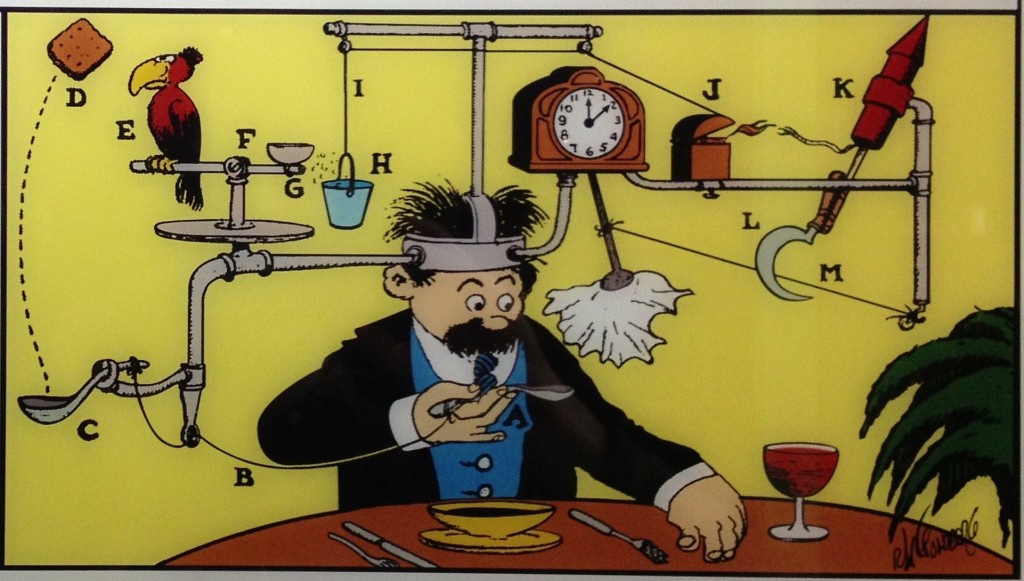
Rube Goldberg

Yesterday, I introduced my new project here, along with my new beat — being ourselves in the post-social world — and I talked about what I mean by that “post-social” thing.

Today, I’m going to talk about the “being ourselves” part.

I know it sounds a little…squishy. Identity is a gigantic topic — at one end, you’ve got big questions like “Who am I?”; and at the other, you’ve got the everyday nuisance of authenticating yourself to your bank or your email provider.

I started paying attention to this subject a few years ago during my research on the history of blogs. I noticed that there was a contradiction at the root of blogging ideology — one that has only intensified in the social media age. On the one hand, digital platforms for the self, from blogs to Facebook, promise a direct shortcut to each user’s authentic being. Accept no imitations — here’s the Real Me! On the other, these same tools offer us boundless opportunities to experiment with alternative identities, to try on different “me”s for size and reinvent ourselves. As Marshall McLuhan used to say: “Don’t like those ideas? I got others.”

It seems obvious to me that both of these conceptions of How to Be Yourself are legitimate and valuable — and that technology has made both of them more available and more tantalizing, making it easier for each of us to find direct unmediated connections with others and also to play with alternative identities and self-reinvention.

Yet, mostly, the public debate on digital identity is stuck in a polarized argument. Advocates of transparency and single identity maintain that a one-person, one-name, one-identity world creates trust and holds us accountable to one another. Believers in anonymity and multiple identities argue that masks and veils can free our voices, liberate us to be playful and vulnerable, and let us speak truth to power.

Both camps urge us to “be ourselves.” But they arrive at opposite conclusions.

Any useful analysis of the nature of identity online needs to acknowledge that neither of these modes is natural or somehow baked into the technology independent of how we use it. Our digital platforms don’t include any inherent bias toward either end of this spectrum; if they push us in one direction or the other, it’s because someone built them that way — and someone else found that useful or attractive.

In other words: The Internet didn’t make me do it! The Internet doesn’t make anyone do anything. We made the Internet ourselves, and we remake it with every click and post and line of code.

Of course different technologies have different characteristics, and those traits fascinatingly affect our experience of those technologies. But they’re not innate, immutable, or inevitable; they’re there because we put them there, and they evolved through an intimate back-and-forth between the technology and the people who make and use it. We need to resist the most common fallacy we fall into in trying to understand communications technology — the assumption that the medium itself has some native will or force that imposes itself on us. This way of thinking turns us into passive receptors of technological imperatives; it denies us our freedom to act.

All “medium is the message” arguments aside, talking about technology’s “impacts” and “effects” is, as Claude Fischer wrote (in his magisterial history of the adoption of the telephone), the “wrong language, a mechanical language that implies that human actions are impelled by external forces when they are really the outcomes of actors making purposeful choices under constraints.”

“Actors making purposeful choices under constraints” — that’s you and me, out here on the net, putting on shows for one another, looking for truth and trying to be ourselves in a rich, perilous, disorienting landscape that has become our home. (For those of you who know that I spent the first, pre-Internet part of my career as a theater critic: Yes, these dots do connect.)

That’s what I’m gonna be writing about a lot here. More tomorrow about exactly what and how.


If this stuff intrigues you, here is a five-minute Ignite talk I gave at NewsFoo 2012 about it:

Filed Under: Meta, Project

The Wordyard Project: Being ourselves in a post-social world

May 27, 2014 by Scott Rosenberg

86515663_28c967bd2a_o

After leaving my full-time job at Grist a few weeks ago, I’ve been weighing my next act, and I’ve decided what I want to write about:

Being ourselves in a post-social world.

This is my new project, here. It falls into three parts: a tech-industry beat I will cover; a cultural investigation and conversation I will undertake; and a personal-publishing venture I am kicking off now.

So let me begin to lay all this out — starting, today, with the tech-industry part.

First thing you’re thinking is, what is this “post-social world” he speaks of?

There’s a lot to say here, but at heart, what I mean is: life after Facebook.

No, I don’t think Facebook is going anywhere. It will continue to dominate much of the digital landscape for some time. But I also think peak Facebook is now behind us.

Every era-defining tech company in recent history — Microsoft, Google, and now Facebook — has seized a moment in the industry’s evolution with a single idea. And for a brief period, that idea proves so powerful that it sucks everything else into its orbit. It seems to be the only game in town, and the only possible future. It also propels utopian visions, and the people responsible for it become filled with a sense of omnipotence — a belief that their magnificent technology can and will solve every imaginable human problem as readily as it has made them rich.

This is where the innovation that originally fed the company’s growth mutates into some world-changing ambition that proves tough to square with the practical demands of quarterly reports and margin-seeking investors. Microsoft’s operating system and office tools became “a computer on every desk and in every home”; Google’s efficient, streamlined search box became “organizing the world’s information”; Facebook’s friend-connecting toolkit turned into its current mission, which is to “give people the power to share and make the world more open and connected.”

But here’s what happens: The moment of corporate omnipotence passes. Always! Microsoft’s computers are still on plenty of desks and in many offices — but they are not in our pockets, where we now use digital technology the most. Google’s search model remains essential, but turns out not to be the only means by which we want to access the world’s information — sorry, Larry and Sergey. Similarly, today’s Facebook has introduced the world to the allure of friend networks and feeds, but it cannot possibly fulfill all of its ambitions or replace email, messaging, news, advertising, entertainment and everything else with its single closed “social graph” universe. The human environment and experience is far too vast to be encompassed by any one company’s data.

Just as the era of Microsoft’s leadership ended with the dotcom crash and the era of Google’s leadership ended with the financial meltdown of 2007-8, so Facebook’s mindshare dominance will end when the current tech bubble deflates. With it will end our mistaken assumption that social networking is the single paradigm that will rule the entire gamut of our Internet-borne behavior.

What comes after that? We don’t know yet. That keeps things interesting! But we have some clues, some sense of which way the pendulums are going to swing:


From the group back to the individual:

    The blogging movement celebrated individual voices. The social-media era’s customs, submerging the individual in a networked environment, privilege the group. We are overdue for a correction.

From centralized platforms to peer networks:

    Some systems concentrate power in one or more hubs. Others move power to the edge. Today’s Internet relies on both approaches, varying depending on which layer of the communications cake you’re talking about; but what defines it, historically and philosophically, is that it is a distributed network.

    Right now we’re experiencing a moment of maximum centralization. We have one company with a near lock on our online identities. Another with the keys to our access to information. Another with a huge chunk of the retail market. In the U.S., the network itself is coming to be dominated by a single provider.

    None of this bodes well. But none of it is irreversible. Technology is anything but static, and its movements and disruptions allow for regular resets of bad patterns and ingrown problems — particularly if we learn from our mistakes and nudge it. 
Fortunately, the Internet itself has created conditions that make it possible for us to do just that.


From “take my data” to “let me take my data”:

    The online publishing and marketing business today depends on our willingness to give up rights to our data. It’s been difficult to get the public too worked up — at least in the U.S. — as long as this has simply meant exploiting the tracks we leave in our digital clickstream.

    But increasingly, people are understanding that “my data” means everything from my medical information to my financial records to my physical travels. In the post-Snowden universe we’re more likely to question standard-issue “just relax” assurances from industry or government. Contrary to conventional-columnist wisdom, the younger cohorts of today’s Internet users take privacy more seriously, not less, than their elders. I think we’re going to spend much of the next decade rebuilding the technical, legal, and financial guts of our connected online world around a more secure, consensual approach to personal data. It will be messy and complex and fascinating.

So yes, “post-social” means “Life After Facebook,” but it’s a lot more than that. Laid out from a high altitude like this, it may sound a little abstract. Don’t worry; a lot of what I want to do here at Wordyard involves talking with people in the trenches, looking at specific ideas and projects. There are individuals and organizations and companies that are already busy trying to imagine and build this post-social world — to fix the mistakes of the past decade and figure out where we should go in the next one.

All of this is being covered in detail and in patches and shreds by the ambitious and lively tech press that has grown up with the Web. But I haven’t seen anyone out there try to put it all together.

That’s my new work! Or at least, the first part of it. Next, I’ll post at greater length about the second part — this business of “being ourselves.”

Filed Under: Meta, Project

« Previous Page