Wordyard

Hand-forged posts since 2002

Archives

About

Greatest hits

New York vs. Northern California

December 20, 2008 by Scott Rosenberg

This is the time of year when I realize anew why I am here. I’m not having a spiritual experience. “Here” is the Bay Area, and as we approach the shortest day of the year and face some of the coldest days as well, I renew my delight in my home for the past two decades and more.

Over on Twitter Anil Dash wrote the following yesterday:

As we landed at JFK, the woman in front of me offered, “Northern California is nice, but there’s no sense of urgency. It’s nice to be home.

I can’t tell from the Twitter-speed typing, which annihilates niceties of punctuation, whether the “it’s nice to be home” was overheard, or Anil’s own sentiment. Either way, I share the feeling, but in the opposite direction, each time I return home from an East Coast trip.

When I left my native New York in the 1980s for San Francisco, people told me similar things. “You’ll never really work hard again.” “Enjoy your long vacation.” I never saw or experienced this ostensible Northern Californian slack. I feel plenty of “urgency” here, but it is a pressure I have chosen myself. I worked harder than ever before in my life once I moved here, and continue to, partly because I’m inspired to do so, partly because I do not spend five months of the year in a state of physical misery and mental dejection brought on by extreme cold, light deprivation and aggressively desiccating indoor heating.

Having grown up in Queens and spent the first two decades of my life in the five boroughs, I have certain aspects of New York imprinted in my genes or upon my neurons, including a contempt for wimpy bagels, a disdain for outlandish pizza toppings and a fairly complete knowledge of the subway system rendered only slightly archaic by service changes (c’mon, what’s with this “Z” and “V” lines?). I *heart* NY as much as anyone. But, perhaps because it’s where I spent my youth, I’ve never felt a personal need to prove myself by taking it on as a challenge. I will be perfectly content without ever making it to Page Six (or even Gawker), and the city, of course, will do just fine without me.

One of my chief reasons for not regretting a move away from New York was my sense, in the mid-1980s, that it was a city where money loomed too large as a motivator, a totem and a measure of human value. I was hoping to plant myself in an environment that left at least the possibility of seeing my own life through other lenses. In the ’80s I thought that the ambient greed of New York might be merely a Reagan-era aberration. But subsequent years and decades only accentuated this aspect of the city’s place in the world. New York had long ago stopped making much of anything except money, but it thrived as the epicenter for America’s financial-engineering prowess.

2008 put a definitive end to that. With the collapse of Wall Street’s investment banks, the implosion of the markets and now the revelation of outright fraud on almost inconceivable levels ($50 billion? isn’t that more like a state budget than an investment portfolio?), it seems that New York’s run as the world’s financial capital is at an end. For the foreseeable future, it appears that Washington will be calling the shots in the U.S. economy.

However inconsistent with capitalist doctrine this change may be, it’s hard to complain, given how poorly the New York financiers managed things. But it makes me wonder: what will New York focus on next? There’s too much brains, energy and determination in the city for it to sit on its hands. I think that, now that the dollar is no longer so almighty, a lot of people are going to need to find something else to drive their lives.
Filed Under: Personal

Appearances elsewhere (NOOP.nl, Fray)

December 17, 2008 by Scott Rosenberg

Item one: Jurgen Appelo was kind enough to include Dreaming in Code earlier this year in his Top 100 Best Software Engineering Books Ever. (Top 100 and best ever! Yow!) When he came back to me and asked me to do one of his “Five Easy Questions For…” interviews, how could I refuse?

Here is the result, in which I talk about, among other things, my early days as a freelancer, what inspires me to keep writing, and what is more interesting than software development.

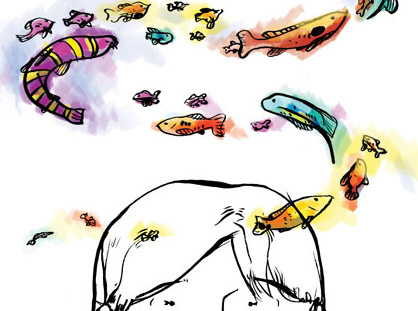
Item two: Earlier this year, while I was deeply immersed in work on the new book, Derek Powazek asked if I’d contribute to Fray, his labor-of-love magazine — yes, a paper magazine, it’s a thing of beauty. The sensible thing to do would have been to beg off, and I was going to. But the topic of the issue was going to be “Geek: True Stories of People Taking Things Too Seriously,” and as I plowed through my book work I found my mind drifting back to my youth, and a time when I was a true geek, not for software or Tolkien or theater or politics or any of the other things I have geeked out on over the years, but for tropical fish — which was, for me, the ur-geekly pursuit.

So I wrote a little piece, titled Memories of a Fickle God, about those times. It’s online here, along with a bunch of far more captivating pieces.

But really, if you’re interested in this stuff, the thing to do is to buy the magazine (or subscribe), because it’s full of great stories and beautiful art. This is the future of the print magazine: once the profits have all migrated elsewhere, people will still publish on paper. But they’ll do it for their own damn reasons.

aquaristsmall

Filed Under: Dreaming in Code, Personal

Friends’ books: Laura Miller, Mike Sragow tomes

December 16, 2008 by Scott Rosenberg

I want to note new books released by two friends and former colleagues, both of which are just out, neither of which I have yet read, both of which I am fully expecting to delight in.

Readers of Salon and the New York Times Book Review know Laura Miller’s critical writing by its wisdom, range, power and clarity. Her new book, The Magician’s Book: A Skeptic’s Adventures in Narnia, is her first (she also edited Salon’s Reader’s Guide to Contemporary Authors). It’s an unusual combination of personal memoir and literary criticism that is about, among other things, Narnia, childhood imagination, memory and the power of stories. I was always more of a Tolkien guy than a Narnian; I think by the time I got to Lewis’s books their Christian subtexts did not look “sub” at all to me, and I found the whole thing an exercise in crude allegory. But if anyone can make me understand their power, I imagine it will be Laura. If you read this excerpt from the book recently posted at Salon, you’ll see why. (Here’s Laura’s website for the book.)

My professional path has crossed multiple times with Mike Sragow’s: He’s now the movie critic for the Baltimore Sun. When I met him he was the movie critic and editor for the Boston Phoenix, where he encouraged me to write about movies (I’d limited myself to theater and books). Then we worked together at the SF Examiner, and again at Salon. For me, he has always been the best kind of mentor; for his readers, he has always been an incisive, insightful and deeply knowledgeable critic.

Mike’s new book, his first (he also edited a couple of anthologies for the National Society of Film Critics), is Victor Fleming: An American Movie Master — a biography of the director of Gone With the Wind and The Wizard of Oz, whose reputation and swashbuckling life story have long been neglected. Here’s a Wall Street Journal review by Peter Bogdanovich, who calls the book “evocative, layered, engaged, graceful and compelling”; here’s another review of it from today’s N.Y. Times.

I can’t wait to read both of these books — soon as I’m done poring over edits on my own…

Filed Under: Culture, Media, People, Personal

Milestone accomplished

December 11, 2008 by Scott Rosenberg

On Tuesday I turned in the first draft of my book, the culmination of over a year’s work, with about seven months of nearly straight writing. So I’m relieved and happy.

I’m still doing some research and filling in some blanks, and we’ve got a ton of editing ahead of us over the next couple of months. But the hardest part is done.

Dave Winer compares bootstrapping a software project to the way suspension bridges get built, beginning with one thin cable stretched from dry land at one end to dry land at the other. When you’re writing a book, the equivalent of that first cable is probably creating the first outline — that’s the first time you can see the whole text from its opening to its conclusion, and get an overview of how the pieces fit together.

The first draft is something different: I don’t know if there’s an equivalent in the world of bridges. This is now my second time through it, and all I can say is that its completion brings a feeling of enormous relief, tinged by a little regret. The relief comes from the knowledge that this vague notion you once had in your mind has now become something real that other people can share. There were no disasters along the way. The thing worked! The regret comes from realizing that, of that vague original notion, only some fraction has survived the transfer from brain to page.

The title is Say Everything: How Blogging Began, What It’s Becoming, and Why It Matters. It is in Crown’s Summer 2009 catalog, with an expected publication date of early July. You will be hearing much more about it here from now on, along with much more of everything, as I return to a more regular posting schedule. To those of you who have stuck with me here through the lean months, I’m grateful for your continued attention.

Filed Under: Personal, Say Everything

The Gift keeps on giving

November 30, 2008 by Scott Rosenberg

I read the recent New York Times magazine profile of Lewis Hyde with some interest. As it happened, I wrote a review of Hyde’s 1983 book The Gift just about 25 years ago as one of my early assignments at the Boston Phoenix. My editor at the time, Kit Rachlis, thought I might find Hyde’s uncategorizable mixture of literary criticism, sociology and anthropology intriguing, and he was right. (As the profession of editing moves into eclipse, let’s not forget that this matching of writer and subject is one of the subtle arts that we do not yet know how to automate.)

At the time, Hyde’s effort to establish a language of value separate from the financial marketplace spoke hauntingly to me — as a disaffected young liberal stunned by the Reaganite rise of free-market, anti-government ideology. The book’s themes feel somehow timely again today, at the end of the arc of history that began a quarter-century ago, as we scrabble through the ruins that said ideology has left of our economy and try to imagine rebuilding along different lines.

I was fascinated to learn from the Times piece that in the years since, The Gift has become a volume of almost totemic stature to writers like David Foster Wallace, Jonathan Lethem and others whom I admire. I’d written that Hyde’s book would “probably be most read and appreciated by those who already grasp its lessons, the visionary writers and artists from whom Hyde draws so many examples.” It appears I was right. But I’m glad to know that the book has had such perennial success — and that Hyde, now a fellow at the Berkman center, has moved on to studying the concept of the “commons,” newly relevant in the Web era. I’ll look forward to his work on that topic.

In the meantime, if you want to read more, I’ve reposted that 1983 review of The Gift, which holds up pretty well, I think (though today I’d write a less involuted lead!).

Filed Under: Books, Business, Culture, Personal

In conversation with Leo and friends

October 13, 2008 by Scott Rosenberg

I had a good time yesterday afternoon chatting with Leo Laporte, Harry McCracken (formerly of PC World and now a free-agent blogger at Technologizer), and Tom Merritt of CNET’s Buzz Out Loud on Laporte’s “This Week in Technology” podcast. We talked about Apple’s forthcoming notebook announcements, Sarah Palin’s email accounts, whether Google should be feared, whether the NSA’s eavesdropping should be feared, whether Google’s Android phone should be cheered, whether charging for SMS text messages at both ends will kill off the technology, and a lot more.

I am a mere amateur when it comes to Apple geekery and cellphone connoisseurship, and what I know about SMS text messaging could be communicated via SMS text messaging, so the invitation to hobnob with the experts was a gracious one — thanks, Leo! And we did talk a little about my book and the story of blogging.

You can listen to the whole thing here.

Filed Under: Personal, Technology

Review of Randall Stross’s Google book

October 9, 2008 by Scott Rosenberg

I will poke my head up ever so briefly from my labors to note that I have a book review up at Salon today of Randall Stross’s new “Planet Google.”

Here’s a couple passages:

“Planet Google” further reinforces the picture we now have of Google as the Mr. Spock of Internet companies: intellectually supreme, agile and engaged with the world, but prone to respond to the unpredictable behavior of its customers by cocking an eyebrow and exclaiming, “Highly irrational!”

Is there a Bones McCoy anywhere in the company who can provide a humanist counterweight to all that calculation? Maybe — but you’re not likely to learn who it is from Stross’ research. “Planet Google” is solid and informative, and Stross, refreshingly, avoids the frothier sort of Google hype sometimes heard from the tech-punditry choir. But the book is hardly the insider’s-eye view of Google that it has been painted to be.

Also:

If Google is going to falter over the coming decade, it is likely to be the result of avidly pursuing its “organize the world’s information” goal even as the evidence mounts that its Spock-like principles and engineering-first culture may not get the company to its destination. Stross’ account provides several case studies — including accounts of the oddly neglected Orkut social networking site and the ill-fated Google Answers service — in which innovative Google ventures foundered because of the company’s clumsiness at managing human interaction.

Filed Under: Business, Personal, Salon, Technology

Mediashift’s Simon Owens reports on my blog book

September 23, 2008 by Scott Rosenberg

Earlier this summer, Simon Owens asked me if I’d give him an interview for his blog about the book I’ve been working on. I was happy to oblige. Then it turned out he took the piece to the PBS Media Shift blog, which he contributes to, and there it is, today — a little introduction to the project, a couple of interesting tidbits I’ve dug up, and a little perspective from Rebecca Blood to boot.

Here’s a bit:

Speaking with Rosenberg about his book, I felt like we were discussing evolutionary biology. Rosenberg’s research goes beyond highlighting the earliest blogs, and slowly pieces its way through the primordial ooze of the Internet, tracing a line of websites in the early 1990s that first began taking on blog-like characteristics.

“Most of the people I’ve talked to, I’ve asked who had inspired them,” he said. “Who were you reading when you decided to start blogging? To a certain point that becomes a harder and harder thing the further back you go. For instance, Justin Hall started his site in January 1994, before most of us had heard of the web. I asked him, ‘Well, you’re one of the first bloggers, was there anyone out there who you were getting inspiration from?’ And he pointed me to this other guy named Ranjit Bhatnagar who was keeping a site at moonmilk.com in 1993. And, sure enough, it was a reverse chronological list of stuff he found on the web.”

Thanks to Simon for the piece. I’ve now got rough drafts of more than half of my chapters, and am racing frantically to meet my deadline, which is before the end of the year. If I’m scarce round these parts, you know why.

Oh yeah, I also see that I’d better update my author photo when I get the chance!

Filed Under: Blogging, Personal, Say Everything

Clearly not self-promotional enough

August 19, 2008 by Scott Rosenberg

On the recommendation of BoingBoing, I hied myself over to check out Polymeme, a new news-aggregator site that collects top stories based on clusters of links from expert blogs. (From what I can see it appears to be kin to Techmeme and Memeorandum.)

Polymeme looks interesting. The funny thing is, the first thing my eye landed on on the home page tonight was a headline that read: “Self-Promotion Becomes a Prerequisite for Online Journos.” Hmmm, that sounds similar to that post I wrote a few days ago about rustling up readers. Then I read the text under the headline and realized, wait a minute, this is that post I wrote a few days ago about rustling up readers. I made Polymeme before I even knew it existed. I’ve got this self-promotion stuff down!

Only, on second look, wait a sec: there’s no link to my blog, and no attribution of my words. How’d that happen? The link is actually to a post Dan Gillmor wrote at PBS. Dan quoted a paragraph from me; that graph is featured on Polymeme. (I imagine the Polymeme front page will change at some point soon, but here’s a permalink page with the same excerpt and more links.)

Well, the main thing is, the ideas in my prose are now out there. Glad to see my little contribution propagating. But I guess I could still use a little work on the self-promotion angle…

Filed Under: Blogging, Media, Personal

Open Salon launches

August 10, 2008 by Scott Rosenberg

Not one but two big developments (coincidentally simultaneous) in projects that are intertwined with my life! The first, noted below, was Chandler 1.0. The second is the unveiling — for what is being labeled a public beta — of something called Open Salon.

While the news is not live on the Salon site yet, it’s already on Techmeme, so I’m going to go ahead and note it.

Open Salon is the present incarnation of a project I proposed a long time ago at Salon as we tried to figure out a future for the old Salon Blogs program, which had been built on Radio Userland, a program that had fallen by the wayside.

When Dreaming in Code was done I returned to Salon and started to work on it. A year and a half later, we had some neat prototypes, but we were still awfully far from launching, I got excited about a new book idea, and it was time for me to move on.

The Open Salon that opens its doors today — it’s been in private beta for a while — is an outgrowth of the work I did back then, but of course over the past year the project has evolved much further. I’ve been concentrating too assiduously on my book deadline to do more than cheer the present effort from afar, and I can take little credit for much of anything about Open Salon in its present form. It’s the work of Kerry Lauerman and his team — and, now that the participants are using it, it’s in the hands of Salon’s readers the people formerly known as Salon’s readers, to make of it something new and exciting.

The one thing I’ll claim is to say, proudly, that from day one at Salon I was the editor pushing the publication hardest toward opening out to the Web and experimenting with ways of using it to bridge the ancient divide between writer and reader. I’m delighted to see Salon taking this next step. Congratulations to everyone there who helped make it happen.

There’s a post by Matthew Ingram up already. Also one at CNet (“Salon launches blogger ‘tipping’ system”) that, I think, may put far too much emphasis on one small feature of the project — the “tip jar.” I have no inside information but it seems inevitable to me that Salon will want to experiment with the whole idea of reward mechanisms, and I would be really surprised if the “tip jar” was the only effort made in that direction.

UPDATE: Joan Walsh’s official announcement about Open Salon is now up.

Filed Under: Blogging, Media, Personal, Salon

« Previous Page
Next Page »