
- Visual design guru Edward Tufte’s new book, Visual Evidence, is out. I haven’t read it yet, but if it is anything like its three predecessors it will not only be eye-opening but will embody the principles it espouses. I wrote at length about Tufte almost a decade ago in Salon, in March ’97.
- “What happens when you take everything in your house and make one giant chain of dominos?” Some people in Japan find out. It’s on YouTube. I saw it because Doc Searls linked to it back when only 250,000 people had viewed it, and now over 500,000 have, and we should really be shooting for >1,000,000, so I’m doing my part.
- Who knew there was a They Might Be Giants tribute album with covers by the Wrens, Frank Black, and the Long Winters? (The latter two also each have new discs out or on the way.)
Outliners then and now
I am addicted to outlining as a means of organizing my work and life. (And no, the outliner in MSWord does not count, it’s a clumsy, kludgy horror that has probably turned off millions to the value of outlining.) I still use Ecco Pro — a long-orphaned Windows outliner — every day. (This old post has links to some of my writing on the topic.) I used Ecco to compile the research for my book, and I use it, GTD-style, to keep the spheres of my life moving in harmony.
Ecco is a fascinating hybrid of the pure outliner that Dave Winer pioneered in the 1980s and the free-form personal database exemplified by Mitch Kapor’s Lotus Agenda, which let you recategorize and invent new categories for your information on the fly. (Today’s tagging phenomenon is a latter-day version of the idea.) Chandler, the product whose development my book Dreaming in Code chronicles, started with the ambition of bringing some of these ideas into the present, though it has since evolved in different directions.
I was reminded of this complex software genealogy recently as I read a page that Winer recently linked to — a detailed chronicle, written in 1988, of how his once-popular outliners (ThinkTank and More) came to be developed. (I found it because Winer linked to it from another page about thinking about the Internet as an idea processor — which is also food for thought.)
I’ve never understood why outliners never found wider adoption. Is it just the curse of Word (once Microsoft “included” outlining in Word, however poorly, the market evaporated)? Is it that people associate outlining with boring work they had to do in high school composition class? Is it that the number of people who like to organize their thoughts in collapsible hierarchies is just not very high? But the alternative model of idea-organization tools, which provides you with more of a 2D or 3D space to place and link words and concepts (cf. The Brain and other “mind-mappers“) has never caught on in a big way, either. Maybe the vast majority of people are still too busy figuring out how to wrestle their computers into submission to concern themselves with trying to use them as (in Howard Rheingold’s phrase) “brain amplifiers.”
Many contemporary outliners (like Shadowplan) feel more like checklist organizers than tools for organizing large amounts of text. With the more sophisticated programs, one problem I have (I’m thinking here of tools like Zoot and InfoSelect) is that they are built like e-mail clients with separate panes — a pane on the left where you expand and collapse nodes, and then a pane on the right where you read the text associated with the node that’s highlighted at the left. This separates the “thing itself” from the “relationships between things.” That’s not the way my mind works: I want to see the things and their relationships — all at once!
In Ecco, as in More, you’ve got the full text of each node right in front of you, in place in the outline hierarchy. This allows you to use the tool — as I understand Dave Winer does — as a primary writing environment; it also allows you to dump huge amounts of information into the outline efficiently, move big pieces around easily, and swoop quickly from a top-level overview to the finer details.
Today Mac users can adopt OmniOutliner, which has a feature called “inline notes” that begins to move it toward the model I prefer. If I were using a Mac every day I’d also check out Eastgate’s Tinderbox, Circus Ponies Notebook and VoodooPad. Windows users can still get Ecco for free. In the new world of web-based apps, there’s not a lot of activity yet — though there is a rudimentary AJAX-based outliner called Sproutliner. 37 Signals, the “small is beautiful” web app company, has a lightweight listmaker called Tada List, along with another product that’s sort of a free-form personal info manager called Backpack. And then of course we come full circle back to Dave Winer, who has created the Web-based outline format OPML (the OPML editor is here) for constructing and sharing Web-based outlines.
I don’t know if outlining software will ever take off, but to me it feels like a natural way to use a computer. I will keep using Ecco until they invent a version of Windows that won’t run it, and I suspect I will outline until the day I die.
POSTSCRIPT: Doc Searls’ technography from Bloggercon IV is a good example of outlining in action. He wrote about it here.
[tags]outliners, pims[/tags]
Meat space
This incredibly short little [tag]science fiction[/tag] tale will take you only a couple minutes to read. BoingBoing pointed it out a while back and I just stumbled upon it again. It’s a thing of brilliance. Also funny.
The title is: “They’re Made Out of Meat.” The author is Terry Bisson. Read it.
There is also a well-made little film on YouTube but I prefer the text.
Newassignment.net: new-model journalism
Jay Rosen has posted a detailed sketch of a new, non-profit venture in the “citizens’ media” (or “networked media”) realm that he is calling NewAssignment.Net. The idea is to create an institution online where people can contribute dollars to fund reporting projects they’re interested in. These projects will in turn be pursued by paid reporters and editors working creatively with information and contributions flowing back to them from the Net. Foundation seed money gets the thing off the ground; money from the crowd keeps it going. Old-fashioned editorial processes mesh with newfangled feedback loops and reputation systems to produce something new and unique.
Jay is one of the bright lights in this area, and I’m looking forward to what he comes up with — especially since some of the issues and problems he’s exploring are similar to the ones I’m working on at Salon these days.
Rosen’s description makes it clear that he’s seeking to create an institution where many traditional journalistic values persist and shape the work being done in a novel mode. In particular, there’s the idea that the reporters are going to go out and ask questions and consider all the information flooding back to them from the Net and determine the truth as best as they can — even if that truth is not what the people ponying up the cash wanted to hear.
This, to me, is likely to be a major friction point for NewAssignment — which will doubtless be avowedly nonpartisan but which will not be able to insulate itself from the fierce political divisions that shape so much online discourse today.
At Salon, we don’t make any claims to nonpartisanship but do maintain our own tradition of journalistic pride, and a commitment to fairness and giving the “other side” a say, and a belief in telling the story as you find it, not as your political preferences might dictate it. This has regularly placed us at odds with at least some of the readers who are funding our stories with their subscription dollars. (The relationship is not quite the direct quid pro quo that Rosen envisions, where individual site visitors put their chips on specific stories, but emotionally it seems similar.)
So, for instance, in the wake of stolen-election charges in Ohio in 2004 we had Farhad Manjoo — one of the most talented, hardest-working and open-minded reporters I’ve ever worked with — devote a lot of time to exploring the story. He’d done significant reporting on the topic in the past. His conclusion — as our headline put it, “The system is clearly broken. But there is no evidence that Bush won because of voter fraud” — was well-documented and carefully delineated. But it wasn’t what many of our readers wanted to hear.
Ever since, Salon has had a steady trickle of disgruntled subscribers cancel on us, citing these stories as a factor. It’s never been enough to make any difference to our business, and it certainly won’t stop us from doing further reporting on the subject, and presenting our findings accurately. But it’s disheartening. And I think that NewAssignment may face some similar tensions if it ends up reporting on topics that people have strong feelings about, which it must if it is to matter.
The sample story Rosen walks us through to explain his new idea is one about wild variations in drug prices from one place to another. The assumption is that some people who are upset by what they perceive as unfair, rigged drug pricing might be willing to help fund such an investigation. But what happens if the reporters come back and say, gee, it turns out that the drug companies are innocent here, the fluctuations are actually the result of [some other factor]? (I’m not saying I love drug companies. This is just an example.) Will these citizen-journalism sponsors want their cash back?
UPDATE: Jeff Jarvis’s post about NewAssignment provides some tidbits of interest about the new media venture he’s been dropping hints about for a while, named Daylife. But I wonder about his comment: “We must explore new business models to support coverage of news and this is one of them.” It strikes me that the not-for-profit, institutionally-supported model Rosen has picked — perfectly reasonably — is good for many things, but maybe not so good for exploring new business models. Yes, there are sustainable nonprofit models, and maybe NewAssignment will turn out to be one of them; but it seems to me that Rosen’s plan is more about delivering a proof-of-concept for important new ideas about networked journalism than it is about building a business. If I’m wrong, I’m sure he’ll let me know!
[tags]Jay Rosen, citizens media, newassignment.net, Salon.com[/tags]
Yahoo goes scrum
Buried at the tail end of yet another which-portal’s-on-top? feature in the Times is this interesting tidbit about software development practices at Yahoo:
Meanwhile, Yahoo says it is now trying to emulate Google’s faster method of creating products. Like most big companies, it used to develop software by first creating a comprehensive design that defined how features would be written and tested. Instead, it is now trying what is known as a scrum method, where it will plan, build and test parts of a product every 30 days.
“We may not know how everything fits together,” Mr. Patel said. But by creating partly completed products that can be shown to customers, “We can get insights from users and react to that over a three- or four-month period to put it all together,” he said.
Scrum is a species of agile software development in which the development team, among other things, holds quick daily meetings and delivers new bits of functioning software on very short schedules. It’s all about “moving the ball forward,” scrum expert Ken Schwaber says.
[tags]software, software development, yahoo, google, scrum[/tags]
Dabble launches
Dabble, the new service for sharing Web videos that Mary Hodder has been developing, just launched. Think Flickr for video, but without the hosting of content and a more sophisticated focus on sharing “finds” than Youtube offers. I’m looking forward to experimenting with it.
[tags]dabble, video[/tags]
Paella at Andrew’s
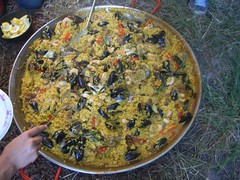
It’s been a decade or so, I think, that I’ve been attending the midsummer backyard bashes that my friend and colleague Andrew Leonard throws for his friends and colleagues to celebrate his birthday each year. These events are extraordinary outpourings of hospitality, good cheer and culinary excess. (Several years ago, a whole pig was buried in the yard and cooked over coals.)
This year the centerpiece was a paella that Max Garrone cooked up in a colossal shallow metal pan that must have been a yard in diameter. I am still savoring its flavor — and I don’t even really like bivalves. Above you’ll see the dish in all its beauty.
[tags]Andrew Leonard, Max Garrone, Salon.com[/tags]
Dean
This link is for Dean! Congratulations to Steven Johnson on the birth of his third boy.
Short attention span theater of war
Today, Lebanon; yesterday, Iraq; the day before, Afghanistan.
There’s no question to me that the Bush administration has a kind of global attention deficit disorder. Any large organization has difficulty keeping its eye on more than one ball, but the Bush White House is a special case. It’s clear that one reason the U.S. project in Afghanistan is now faltering is that the administration stopped paying much attention to it soon after Bin Laden’s escape from Tora Bora. “On to Baghdad!” was the cry then.
Iraq has held White House attention for a good long time — unsurprisingly given the enormous investment of money and blood and credibility in a misbegotten misadventure. But now, as American goals disappear into the mist of implausibility and Iraq sinks into the confusion of a sputtering civil war, Iraq, too, has become yesterday’s problem — displaced on the front burner by the alarming escalation of Israel’s war with Hezbollah and Hamas.
Watch in coming weeks as the diplomatic energies of the Bush team, such as they are, concentrate on Israel and Lebanon. We don’t talk with Syria or Iran so there isn’t that much diplomacy to do right now. But the potential for wider regional war is dangerous, and the White House’s ability to juggle multiple problems isn’t impressive, and to the extent anyone in Washington has any imagination and energy left to try to nudge the world towards peace, for the moment it will be aimed at the Israeli/Arab conflict.
In the past, each time the Iraq situation has seemed to be deteriorating, Bush, Cheney and Rumsfeld have patched together some sort of face-saving event (A turkey for the troops! A government that only took six months to form after the elections!) to maintain an illusion of progress. I think it’s quite likely that Iraq will deteriorate as the Lebanon crisis continues, and I also think this time the U.S. is going to be stuck without a rabbit to pull out of the hat.
[tags]president bush, iraq, lebanon, afghanistan[/tags]
NYT NSFW
Back in 2003 my jaw dropped to find the word “asses” on the New York Times’ front page. Today, it dropped again: There, in Tom Friedman’s column, was the full quotation from President Bush’s now notorious open-mike moment at the summit in Russia in all its barnyard epithet glory. The Times hadn’t published Bush’s “shit” in its news columns, which bowdlerized the president, referring to his choice word as “a vulgarity.” But Friedman boldly seized the four-letter moment in his op-ed column. I assume this is some by-product of the bureaucratic Maginot Line that separates the Times’ news department from its editorial and op-ed pages.
It used to be that the niceties were supposed to be observed in newspapers because of the old “breakfast table” argument and related “protect the children” rationales. In an era when the breakfast table (and the kids) are treated to depressingly regular displays of mangled corpses, grieving relatives and collateral-damage rubble, those niceties simply seem out of touch with reality.
POSTSCRIPT: Lance Knobel points us to this fascinating post by Benjamin Zimmer on the Language Log, chronicling the Times’ publication (in transcript, though not in news columns) of “shit” as used by Nixon on the Watergate tapes. A.M. Rosenthal then made clear that the Gray Lady was not swooning into the gutter, saying “We’ll only take shit from the President.”