
Wordyard

Hand-forged posts since 2002

Archives

About

Greatest hits

A buck-pass too far: “No one could have anticipated sectarian violence”

August 7, 2006 by Scott Rosenberg

From the Sunday Times’ news story on the civil-war-ness of things in Iraq comes this quotation:

“I don’t think we moved too quickly, General [William B.] Caldwell said of putting the Iraqis in charge of Baghdad. “I don’t think anyone could have anticipated the sectarian violence.”

I am no doubt showing my age here, but each time the Bush administration and its related entities (Caldwell is the U.S. military spokesman in Iraq, so technically he’s not part of the administration, but that line is pretty blurry today) trot out this particular line, all I can hear is the mad voice of Monty Python cackling, “No one expects the Spanish Inquisition!”

No one expected the looting in Iraq. No one expected the insurgency. No one expected that we would never find the weapons of mass destruction. No one expected that Iraq would be so hard to rebuild. No one expected the Sunnis and the Shiites to not get along. No one “could have anticipated the sectarian violence.”

It is time for the Bush administration and its people to retire this excuse, which played out so infamously with Hurricane Katrina as well — not simply because it represents a species of buck-passing that ought to be beneath the people who run our government and our military, but also because in every case it is untrue, and, at this late stage in the unfolding Iraq fiasco, it serves as an egregiously self-incriminating lie.

The prospect of Iraq descending into civil war is one that has loomed over Bush’s invasion from well before its start. The “anticipation” of such a conflict has been a constant theme among observers on the scene and armchair commentators alike. For a U.S. general on the ground in Iraq today to claim that nobody anticipated “sectarian violence” is a sign of delusional incompetence — and an indication that reality continues to be alien terrain for the people leading our war effort.
[tags]Iraq[/tags]
Filed Under: Politics

AFB (away from blog)

August 4, 2006 by Scott Rosenberg

…for the next two days, taking the kids camping (their first time), tent and all. But not far from friends and good food.

Filed Under: Personal

Business Week on Digg: Smells like bubble spirit

August 4, 2006 by Scott Rosenberg

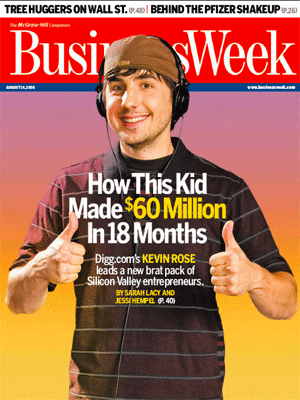
Kevin Rose on Business Week cover

Late last night I clicked on a link to the new Business Week cover story about Digg and its founder, Kevin Rose, and read the cover’s headline: “How this kid made $60 million in 18 months.” Gee, I thought, bleary-eyed, I guess I missed the story about how they sold the company. Good for them.

This morning I started reading the piece, and, after scanning quickly through it hunting for the graph about how Digg had sold out and to whom, realized that the $60 million figure was not the proceeds from a sale, and not even a valuation that a prospective buyer had offered, but an almost entirely fictional number.

Was it something that some irresponsible coverline writer had slapped on the piece, that the responsible writer was horrified to see? I don’t think so. The second paragraph of the article, referring to a recent redesign of the Digg site, reads: “At 29, Rose was on his way either to a cool $60 million or to total failure.”

The $60 million number is never explained in the piece; the only real numbers are contained in this sentence: “So far, Digg is breaking even on an estimated $3 million annually in revenues. Nonetheless, people in the know say Digg is easily worth $200 million.” Elsewhere the article says Rose owns 30 to 40 percent of the company. Hence, $60 million.

There is a word for this kind of business journalism, and it is: awful. The reader has no idea who these “people in the know” are; they could easily be people associated with the company who have an interest in inflating its worth.

There’s no question that Digg is a successful site that might be on its way to building a real business. It might be worth more than $200 million someday. I’m not slighting them in any way; I’ve been visiting the site almost since it started. But plastering imaginary dollar figures on its forehead is not the way to help Rose and his colleagues build a real business. “On paper” means just that. “People in the know” can say whatever they want, but your business, like your house, is only worth what someone is actually willing to pay for it.

The Business Week piece itself acknowledges this in places: “This time around, the entrepreneurs worry that, within a moment, the money — and their projects — could vanish… it’s still only paper wealth, which [Rose] and many others have learned can evaporate.”

Right. So why is Business Week insisting that Rose has made $60 million? If this callow 29-year-old understand that it’s “only paper,” why are the editors of one of our best-known business journals being so stupid about it?

Techdirt calls the article “the ultimate Web 2.0 hype piece,” but I think it’s not even that up to date; it’s the same old dotcom-bubble piece dragged from the attic and retrofitted for today’s Web. It is just as mindless about the nature and meaning of company valuations as the dumbest purchaser of TheGlobe.com IPO shares was.

POSTSCRIPT: Jason Fried of 37Signals comes at Business Week from the perspective of a successful entrepreneur who is also a member of the tech industry’s reality-based community.
[tags]digg, web2.0, bubble[/tags]

Filed Under: Business, Media, Technology

The Technorati dance

August 3, 2006 by Scott Rosenberg

I have been using Technorati since it was running on servers powered by Dave Sifry’s hamsters, and it remains an essential part of my blogging existence. The company recently rolled out a spiffy new design for its service. Hooray.

But: Why are the results still so…unstable? Since I am the perpetrator of a recent blog-address move I’ve been trying to keep an eye on how many, and which, other bloggers have updated the address that they link to me with. (I know it’s a pain; I’ve been guilty of plenty of blogroll-rot myself, though it’s an easier job keeping it up to date now that I’ve outsourced it to Bloglines’ widget.)

What I’m finding is that, depending on the hour of the day, sometimes I will get a list of results from T-rati that’s reasonably up to date and trustworthy, and sometimes I will get a list that’s just wacky — full of results that just don’t seem to have anything to do with my blog, no links evident, no overlapping subject matter, nothing. Furthermore, the results that I get from the T-rati site sometimes differ significantly from those that turn up in the RSS feed that represents that search.

Is this fallout from the monumental war I know Technorati must be waging on the depredations of blog-spammers and spam-blogs? Is it a symptom of some general structural problem with the service’s design, or just side-effects of the company’s constant scaling-up efforts to keep pace with the blogosphere’s exponential growth?

Or is there some deeper logical pattern hidden within the seemingly irrelevant pages T-rati is claiming point to my blog — some guy’s Nirvana playlist; A non-English-language page with a photo of Andrea Bocelli singing “Besame Mucho”; Debby’s World’s list of “34 things worth knowing” — and if only I could decipher that pattern, I could achieve perfect bliss, or at least a more rarefied Technorati ranking?
[tags]technorati, blogging[/tags]

Filed Under: Blogging, Personal, Technology

Standish’s CHAOS Report and the software crisis

August 2, 2006 by Scott Rosenberg

Whenever there is an article about software failure, there is a quotation from the venerable CHAOS Report — a survey by a Massachusetts-based consultancy called the Standish Group, first conducted in 1994 and regularly updated since. The CHAOS Report presented dire statistics about the high failure rate of software projects: 31.1 percent of projects cancelled, 52.7 percent “challenged” (completed only way over budget and/or behind schedule), and only 16.2% deemed a success.

There aren’t a whole lot of other statistics out there on this topic, so the numbers from Standish get big play. I used them myself in my book proposal, and returned to the report as I researched the book, interested in finding out more about the methodology the researchers used — and also curious about what “CHAOS” actually stood for: Combinatorial Heuristic Algorithm for the Observation of Software? Combine Honnete Ober Advancer…?

Nope. As far as I could tell, CHAOS is an acronym for nothing at all. I tried to contact Standish for more information by telephone and e-mail but they never responded. It wasn’t essential to my work — there’s only a handful of sentences on the subject in Dreaming in Code — so I didn’t push hard. I thought, maybe this was the sort of consultancy that was only interested in the paying customers.

In the August issue of Communications of the ACM, Robert Glass has a column about Standish and the CHAOS Report that suggests my failure to get a response from this organization was hardly unique.

Several researchers, interested in pursuing the origins of this key data, have contacted Standish and asked for a description of their research process, a summary of their latest findings, and in general a scholarly discussion of the validity of the findings. They raise those issues because most research studies conducted by academic and industry researchers arrive at data largely inconsistent with the Standish findings….
Repeatedly, those researchers who have queried Standish have been rebuffed in their quest….

Glass is a widely known and respected authority on the software development process (I read, and can recommend, his book Facts and Fallacies of Software Engineering as part of my book research), and the Communications of the ACM is the centerpiece journal of the computing field’s main professional organization. So maybe the Standish group will respond to the plea with which Glass closes his column:

it is important to note that all attempts to contact Standish about this issue, to get to the heart of this critical matter, have been unsuccessful. Here, in this column, I would like to renew that line of inquiry. Standish, please tell us whether the data we have all been quoting for more than a decade really means what some have been saying it means. It is too important a topic to have such a high degree of uncertainty associated with it.

Indeed. The Standish numbers are precisely the sort of statistic that journalists in need of background “facts” — and scholars, too, for that matter — will quote in an endless loop of repetition, like Newsweek’s infamous stats showing that thirtysomething women were more likely to be killed by terrorists than to find husbands. The loop keeps repeating until someone provides a definitive debunking — and even then it doesn’t always stop.

So it’s ironic but hardly surprising to find the same magazine that contains Glass’s complaint also featuring a cover story on “The Changing Software Engineering Paradigm” that parrots the Standish numbers for the umpteenth time.
[tags]dreaming in code, software development, software failures, chaos report[/tags]

Filed Under: Dreaming in Code, Software, Technology

Cloudy Vista

August 1, 2006 by Scott Rosenberg

Windows Vista may not be ready on time after all, says one knowledgeable observer (and another agrees).

But then, it may not matter, because who is going to buy this thing while the bugs are still being squashed? Not I, said the CTO. Not I, said the home user.
[tags]microsoft, vista[/tags]

Filed Under: Software, Technology

All Web 2.0, all the time

August 1, 2006 by Scott Rosenberg

Over at Technology Review, in “Homo Conexus,” James Fallows reports the results of a two-week experiment in which he cast off desktop software and cast his lot with a collection of Web-based (“Web 2.0”) applications.

He finds that the new world is best for stuff that’s natural to share: calendars (Google Calendar) and photos (Flickr). The Achilles heel is connectivity: For instance, he uses Writely to compose the article itself and, inevitably, his Net connection drops in the middle, forcing him to reconstruct his work from local backups that he’d cautiously been keeping.

Fallows also senses a “tragic” potential in the essentially trusting (and, he argues, perhaps overly idealistic) framework of the new Web:

Every bit of the Web enterprise operates on trust. Web-based commerce has gone as far as it has because of the surprisingly low level of fraud and error…. all this depends on the basic trust that messages will go through undistorted, unintercepted, and in general unimpeded.

If problems like privacy breaches or indentity theft cause that trust to break down, he suggests, the Web 2.0 era may lose its innocence, along with the trust that keeps so many of its wheels turning.

If you live and breathe this stuff — if you religiously read TechCrunch and store your bookmarks in del.icio.us — then you’re unlikely to learn much new here, or to find Fallows’ sympathetic skepticism very congenial. But for the rest of us, the article is a useful reality check — a reminder that a lot of what early adopters get excited about isn’t yet ready to cause a mainstream stir.
[tags]web2.0, james fallows[/tags]

Filed Under: Software, Technology

Outliners, trees and meshes

July 31, 2006 by Scott Rosenberg

Thanks to Julian Bond for his response to last Thursday’s Outliners post, which pointed me to his essay from 2004 on outlining, “Outliners Considered Harmful.” (The title, I should point out for those of you who are not steeped in programming lore, is a nod to a tradition in that literature dating back to software pioneer Edsger Dijsktra’s 1968 paper “Goto Statement Considered Harmful.”)

When you use a tool that encourages you to think in terms of hierarchies, everything looks like a hierarchy. Unfortunately the world is much much messier than that. Almost everything is actually a mesh not a hierarchy. And when hierachies do exist in the data, it’s very likely that you will find 2 or more inherent hierarchies that are orthogonal and in most real world situations it’s more like 10…. I suspect that the move towards anarchic tagging in systems like del.cio.us and Flickr are driven by this tension between mesh and hierarchy as well though I haven’t seen it expressed like this. Tag driven systems look horribly uncontrolled to hierarchy people. But they actually reflect the real world much better than hierarchies….So in a nutshell, Outliners are harmful because they lead to hierarchy thinking. And hierarchy thinking is harmful because it leads to political hierarchies. And all of this is harmful because the world is actually mess(h)y and not structured into elegant trees.

I’m reasonably familiar with this argument. For one thing, it’s part of a discussion I closely followed while researching my book at OSAF. During some of the early work on Chandler, its designer, Mimi Yin, inspired by Christopher Alexander’s celebrated essay “A City Is Not A Tree,” tried to figure out a structure for personal-information management software that privileged “semi-lattices” (what Bond calls “meshes”) over hierarchies and trees. (Clay Shirky’s 2004 post on the Alexander essay is worth rereading.)

I’m also familiar with it because it is a theme that David Weinberger has been pursuing over the last several years — a pursuit that is culminating in the publication next year of his book, Everything is Miscellaneous, which, he tells us, he has recently completed, and which I’m eagerly awaiting.

The thing is, I’m not actually a particularly hierarchical thinker. My love of outlining is less a matter of obsession with rank and structure than an appreciation of flexibility. I don’t especially care that outlines are built around parent and child nodes neatly arrayed in tree structures; what matters is that outlines give me easy handles to move chunks of loosely structured information around, and they let me quickly zoom from a low-altitude view to a high-altitude overview and back.

All of which may explain why I still love Ecco Pro so much. For one thing, Ecco doesn’t force you to follow the outline structure rigidly; you can drag nodes pretty much anywhere you want. Even more important, each Ecco outline can also be fitted with “columns” — really, versatile tags or categories (they can be free text or checkbox or dropdown or date) that provide exactly the sort of cross-meshing or semi-latticing that Bond rightly reminds us we need. You get the best of two worlds — outlining structure and free-form mesh-i-ness. And it’s very easy to adapt to the David Allen “Getting Things Done” method for those who’ve been bitten by that bug.

I’ll stop raving now: Ecco is old, unsupported and probably has no future. Still, it’s rock-solid, and free, and it continues to serve me better than anything else I’ve found. As for the “Outliners make your brain too hierarchical” line, it might hold for some of the simpler outlining tools out there, but I really don’t think it applies to a program this versatile and fluid.
[tags]outliners, pims[/tags]

Filed Under: Dreaming in Code, Software

Rosen on NewAssignment.net: It’s made of editors

July 28, 2006 by Scott Rosenberg

In his second Q&A about his new venture in collaborative journalism online, Jay Rosen responds cogently to my suggestion here that when readers become sponsors of investigative journalism they sometimes end up unhappy with the outcome:

Guidelines at New Assignment will make it clear what is and is not kosher in accepting donations. But mostly it would be common sense. If you take money from someone who knows what the story is—before the reporting—and who only wants validation… expect problems….

For New Assignment to work, donors can’t have an editorial say greater than anyone else’s. They explicitly sign it away as a condition of giving the money. Those who expect outsized influence will be disappointed after one experience. Would they return for more? Besides, management has a policy: no refunds.

I think Jay has a pretty good grasp of what he’s after here when he talks about “good editors” being the heart of the answer to the problem. And I agree. But note that in this new world being a “good editor” involves some significantly greater political leadership, by which I don’t mean “involvement in parties and elections” but the more generic, abstract kind of politics — the mustering and deployment of power through the creation of consensus among competing interests and diverse people. Jay quotes one of his correspondents, Daniel Conover:

In a system like what Jay proposes, a NewAssignment editor would be in constant communication with the participants. Rather than being neutered by an opaque hierarchy, this editor would be empowered by the broad base of integrity-seeking NewAssignment participants. How are those participants going to react if the editor reports a pressuring phone call from a wealthy donor?

The trick is, for the editor to draw power from that base, the editor has to stay in constant contact with its interests. Assuming that the larger NewAssignment community will often be in various levels of conflict and competition, we’re talking about some very heady relationships, being acted out in the Great Wide Open.

In other words, the editor’s job at NewAssignment is going to be as much about managing online community as about assigning stories, editing copy and mentoring reporters. That’s a demanding, but certainly not impossible, pile of responsibilities. Rosen cites the formidable example of Josh Marshall’s work at Talking Points Memo as a sign that it can indeed be done.

Filed Under: Blogging, Media

Quote of the day: Microsoft’s Long March

July 28, 2006 by Scott Rosenberg

From an interview with Steve Ballmer in this morning’s Journal:

You can’t replace Bill Gates, but I think the future of the company is brighter looking forward even than looking back. You never can go through the teenage years of being a company again in the sense of growing from nothing to something, but I think we can go from something very good to something great.

When did China get great? China didn’t get great under Mao Zedong. China got great under — in the recent years — probably got great under Deng Xiaoping.

And you thought Apple was the personal-computing revolutionary! If BillG was wearing the Mao jacket, then did that make Paul Allen Lin Biao? If Steve = Deng, does that make Ray Ozzie Hu Yaobang — and is he in danger of being purged?

What was Ballmer thinking?
[tags]Microsoft[/tags]

Filed Under: Business, Technology

« Previous Page
Next Page »