Wordyard

Hand-forged posts since 2002

Archives

About

Greatest hits

Open endings

March 18, 2007 by Scott Rosenberg

One of the more common criticisms of Dreaming in Code is that some people are disappointed the book ends without a clear resolution to the Chandler story (which was still unfolding at the beginning of 2006, as I wrapped up my work on the book, and is still unfolding today). So my ears perked up last week as I listened to NPR’s Weekend Edition and heard its film critic, Elvis Mitchell, defending the David Fincher movie Zodiac (which I haven’t seen and have no opinion about) from Scott Simon’s complaint that it lacked a satisfying wrap-up. Mitchell argued that the whole movie is an homage to the ’70s indie-film aesthetic and that a willingness to tell stories without providing a traditional ends-tying conclusion was a hallmark of that era’s directors.

Here’s the passage:

SIMON: The film doesn’t tie anything together with a pretty — or in this case, since you’re talking about a murder, an ugly — series of bows. I know it’s real life, I know there was no way of avoiding it; but I found tht dramatically unsatisfying — to go through this long movie, and not have that at the end.

MITCHELL: It’s so funny you say that, Scott, because that’s a ’70s movie ethic — they’d say, basically, you can’t say that things are tied up anymore, these aren’t John Wayne movies, these aren’t Jimmy Stewart movies, these aren’t Henry Fonda movies. The real act of creative bravery in Zodiac is to follow with that, and to say that this is what these movies were, these movies that influenced me as a filmmaker, and I’m going to use that here, in a case where people really want that kind of closure, and not give it to them.

I can’t claim that my choice to conclude Dreaming in Code the way I did was any sort of statement of allegiance to authors or auteurs past. More, it was just a belief that, in non-fiction, you’d better let the shape of the story be dictated by reality and not wishful thinking.


Filed Under: Culture, Dreaming in Code, Media

A palpable hit

March 16, 2007 by Scott Rosenberg

I am proud to announce that Dreaming in Code is now in its third printing.

No, it’s not on any bestseller lists. (That I know of!) As a hit, it is of the slow-burn kind. But it’s selling well enough to give me a gentle feeling of vindication towards those observers who, at various stages of the project, doubted that a detailed chronicle of a software project with no world-changing heroic outcome or billion-dollar payoff could attract many more readers than you could count on the fingers of one RSI-addled hand.

Like any introspective and at least marginally neurotic writer, I of course had a voice in my own head saying similar things. So it gives me some calm satisfaction to note the book’s success and to continue to read the generous flow of comments, kudos and criticisms flowing back at me from the blogosphere and the media.

In recent coverage, Glenn Fleishman (in the Seattle Times) said that — since I ended up “adrift with an intrepid crew, a host of dogs and an ample food supply” yet found that “After three years, no land was in sight” — I should be humming the Gilligan’s Island theme. (Okay, but only in one of the punk cover versions!)

In the Chicago Tribune, Mark Coatney said that “Rosenberg clearly knows what he’s talking about and knows how to tell a story.”

Still, my favorite pro-media review to date appeared in the Irish Times (alas, behind a pay wall) — perhaps because, despite the mainstream venue, the author is the estimable geekographer Danny O’Brien, creator of the NTK newsletter, progenitor of the Life Hacks movement and (I think) currently a staffer at the EFF. Here’s a bit of the review:

Books like Rosenberg’s do a great job at allowing us to step away from the keyboard and see our foibles as others might see them. His skill in portrayal lies not just in explaining the tribulations of the software project to the layman, it also lies in explaining them afresh to the seasoned — and therefore oblivious — hacker.

His mastery in picking just the right metaphor to pull an obscure coding controversy into the common world is unparalleled: I’ve never seen the difference between software’s “back-end” and “front-end” portrayed better than in Rosenberg’s analogy between the incomprehensible R2D2 and its fey, deferential interpreter, C3PO.

But even more impressive (at least, to me) is his ability to uncover anecdotes and connections that even the most oversurfing geek would not have heard. Even for me, an obsessive follower of the trivia of tech culture, there were genuine surprises in every chapter…

…It’s perhaps forgivable that such great literature on programming should happen so rarely: the mix of tech skills, explanatory abilities, and sheer determination to trail and document what from the outside looks as exciting as an accountant’s meditation retreat, is rare among writers of Rosenberg’s calibre. But we badly need those books to be written.

Filed Under: Dreaming in Code, Personal

Viacom vs. YouTube: Misreading history

March 14, 2007 by Scott Rosenberg

I’m reading the otherwise perfectly reasonable New York Times piece on the Viacom/Youtube lawsuit and I encounter this bizarre misrepresentation of recent history:

“In the early 1990s music companies let Web companies build business models on the back of their copyright,” said Michael Nathanson, an analyst at Sanford C. Bernstein & Company. “I think the video industry is being more aggressive for the right reasons, to protect the future value of those assets.”

It’s hard to imagine how one could find more ways to be wrong on this topic.

First, there were no “Web companies” in the early 1990s; the first Web companies emerged in 1994-5 — and aside from some unusual efforts, like Michael Goldberg’s Addicted to Noise zine, there was not a lot of music happening on the Web. The MP3 revolution didn’t begin to roll until late 1997 or early 1998 (here is Andrew Leonard’s early report on the MP3 scene, which I edited).

More important, Mr. Nathanson has the history here precisely inverted. What happened in the Napster era was that music companies refused to allow Web companies to build business models on the back of their copyright. They decided that MP3s were all about piracy and they sued Napster out of existence. They refused to do deals with companies that wanted to distribute their music online, and in fact they failed to offer their music online in any way palatable to consumers until Steve Jobs whacked them on the side of the head — and even then they saddled his whole iTunes enterprise with a cumbersome “digital rights management” scheme that even he is now disowning.

The Viacom suit against YouTube does not represent a break with the way the music industry dealt with its rocky transition to the digital age; it is an instance of history repeating itself. The RIAA strategy of “sue your customers” may have succeeded in driving file-sharing underground, but it didn’t do anything to protect the profits of the music industry, which have been in a tailspin ever since. If the Viacom suit is an indication that the owners of TV shows and movies are going to pursue a similar strategy of I’d-rather-sue-than-deal, they may find themselves in a similar downward spiral.

Google has a pretty good case based on the 1996 Telecommunications Act safe harbor provision. If Viacom fails to win against its corporate opponent, will it start suing all the Jon Stewart fans (and, possibly, the show’s own staff) who are uploading clips to YouTube?

If the TV and film industries look carefully at the music industry’s story, they will see that their danger lies not in being too soft on copyright infringers but rather in missing the tidal wave of a platform shift.
[tags]youtube, google, viacom, napster, drm[/tags]

Filed Under: Business, Culture, Technology

Dreaming in Code on KQED Forum, Tuesday

March 12, 2007 by Scott Rosenberg

I should be on KQED Forum tomorrow (Tuesday) at 10 AM Pacific time, if all goes as planned, talking about Dreaming in Code. Tune in — or call in!

I’ve now concluded my two week stint in the Well’s Inkwell conference — a slow-motion interview about the book that goes a little deeper in various ways than some of the other conversations I’ve had about the book. (Unlike most stuff on the Well, this is “world-readable” — no membership required.)

Filed Under: Dreaming in Code, Media

Denise Caruso’s “Intervention”: What we don’t know can hurt us

March 11, 2007 by Scott Rosenberg

Biotech is not a field I’ve immersed myself in, and I have been — like, perhaps, many of you — content to place a simple boundary on my worries about its impact, on the assumption that smart and dedicated people were already deeply engaged in assessing and managing the risks we are taking in that area.

Then I read Denise Caruso’s eye-opening new book, Intervention, and realized that such complacency is a very bad bet. Intervention is a passionately argued, carefully documented critique of our society’s narrow approach to defining, and dismissing, the potential risks of biotech products.

I worked with Caruso many years ago at the San Francisco Examiner, and since then have followed her career as a technology pundit and more recently a nonprofit think-tank founder with admiration, mostly from afar. When I heard that she’d self-published her book after a publishing-house deal fell through, I set up an interview with her. It’s now live on Salon. Here’s a brief excerpt:

You spent years writing about the technology industry. How did this book come about?

It was sheerly out of reaction to meeting [molecular biologist] Roger Brent. He laughs when I say this, and I say it with all the love in my heart, but he’s one of the most macho scientists I’ve ever met in my life. His lineage — in academics, that means who your Ph.D. advisor was — is a guy named Mark Ptashne, whose Ph.D. advisor was James Watson. When I met Roger, his attitude was: What’s a nice girl like you doing being afraid of eating genetically modified food? Don’t you know that you could eat 10 kilos of Bt potatoes [Bacillus thuringiensis is used to modify crops transgenically for insect resistance], and nothing would happen to you?

I didn’t know that much about biology. But when he said that, I said, “I don’t think you actually know that to be true. I don’t know how you could know that to be true.” And we went back and forth on it, and he finally conceded — which I was really surprised about. He said, “So how do we protect the public, but not stop science from progressing at the same time?”

Filed Under: Books, Science, Technology

Goats galore

March 9, 2007 by Scott Rosenberg

I originally got hooked on the music of the Mountain Goats by listening to the first four tracks of the album “We Shall All Be Healed,” late one February night three years ago. The riffage of these low-tech rock songs reminded me of the Velvet Underground songs I grew up with, and formed memorable frames for the mysterious lyrics of John Darnielle — evocative, in songs like “Palmcorder Yajna” and “Letter From Belgium,” of sacred rituals, ancient science fiction plots, and David Lynch movies. (It was only later that I figured out that the whole album is a kind of memorial to doomed meth addicts Darnielle had hung with in his youth.)

As I made my way through the Goats’ voluminous back catalog I came to understand that these full-band song arrangements were the exception to Darnielle’s rule of recording mostly with an acoustic guitar, solo into a boombox mike — and touring, most of the time, as a duo, with bassist Peter Hughes.

All of which is by way of preface to a report from the last two evenings that I spent, enraptured, at the Independent (the venue I knew formerly as the Kennel Club), watching the Mountain Goats metamorphose into a rocking band. Yes, friends, the Mountain Goats are now a power trio, with a drummer joining Hughes and Darnielle and the latter trading in his acoustic for a natural-wood Telecaster after the first few songs of the set.

How did it sound? Wonderful. The last time Darnielle swung through San Francisco he gave a subdued show at the Bottom of the Hill; beset, apparently, by the flu, his set leaned heavily on the hushed falsetto of so many of the tunes on his most recent album, “Get Lonely.” (His voice was so shot he essentially turned over the vocal chores on “No Children” to the sing-along crowd — an event preserved in MP3 and celebrated in the blogosphere as an instance of band/audience bonding.) This week, those songs remained part of his set, but they have assumed their rightful place as the slow songs, serving as mood- and pace-changers rather than centerpieces.

The new full-band mode gave the Goats a chance to rearrange much of their catalog. Songs like “Jaipur,” “The Pigs That Ran…”, “The House that Dripped Blood,” “Quito,” “Lions Teeth,” and “See America Right” all emerged with extra-hard edges and careening speeds. Darnielle performed even more unexpected transformations on “Peacocks,” from Tallahassee (the quiet 6 a.m. song got an infusion of mid-tempo energy); and on “Dance Music,” which traded in some of its bop for some bittersweetness; and on “Dilaudid,” a desperate love song given a tougher bite.

Recent articles by All Axess describe how Darnielle is in full-throated form again, moving nimbly from a feather-light whisper to a piercing pleasing bray, never losing grip of the syllables that define each moment of each song as unique. As he bangs away on his electric guitar, jaw dropped open an inch or two to release a goofy “I still can’t believe I’m doing this!” smile, he looks like he has moved through all the pain in his songs, found his own little corner of nirvana and invited us in. (Here’s some good descriptive writing about his performance style.)

John Vanderslice joined the band for the conclusion of both shows, adding to the fun and layering “Palmcorder Yajna,” “Half Dead” and “This Year” with some extra exquisite crunch. Then the young women of Pony Up, the warmup act, trotted out to sing backup on Darnielle’s devotedly straight-faced cover of Thin Lizzy’s ode to vernal rebirth, “The Boys Are Back in Town.”

It’s a great time to see the Mountain Goats. Go if you can. They’re playing again tonight at the Bottom of the Hill. Full tour schedule here.
[tags]mountain goats, john darnielle[/tags]

Filed Under: Culture, Music

Leaking entities

March 8, 2007 by Scott Rosenberg

Today’s software is built up in layers, like sedimentary rock that has been accumulating over many generations. In Dreaming in Code I wrote about how sometimes the lower layers poke up through the surface, like angled strata of rock, disturbing the placid interface surface. (This was merely a metaphoric restatement of Joel Spolsky’s Law of Leaky Abstractions.)

Examples of this are all over the place. This morning, for instance, I went to have a look at the new beta of My Yahoo (here’s the TechCrunch report). And here’s what I saw at the top of the page:

Notice the center button. This is, of course, an HTML code or “entity” representing the “non-breaking space”, and it is rearing its ugly little head onto the shiny new AJAX-y fresh My Yahoo screen.

Presumably some designer or developer entered that data long ago, maybe long before anyone ever thought it would end up labeling a button in this environment. Or maybe it was coded consciously that way with the expectation that the HTML data, including the non-breaking space code, would be transformed by the My Yahoo application in such a way that each layer would understand that it was looking at an HTML entity and handle it properly. However it happened, the bug exposes a layer of the software you were never supposed to see.

It’s a tiny bug, to be sure, on the first day of a public beta. It will probably be gone soon. But such “entity” codes have made their way often enough over the years onto Salon’s home page — so I find it a little reassuring that these things happen even to the experienced and well-staffed team at Yahoo.

Filed Under: Dreaming in Code, Software, Technology

CyberSalon notes

March 5, 2007 by Scott Rosenberg

Last night’s Berkeley CyberSalon panel was great fun — thanks to Eric Allman, Chad Dickerson, Lisa Dusseault and Jaron Lanier for sharing their thoughts, and to everyone else who showed up with their time, their questions and their trenchant comments. (I had not known that both Jaron and Lisa have very recently become parents, and if I had I might not have presumed to ask them on the panel, but I’m very glad I did, and grateful that they put aside their parental duties long enough to participate.)

One of many highlights for me was the moment when Eric hauled some old inch-thick booklets out of his briefcase — one contained the entire set of Internet (then Arpanet) protocols from the late ’70s, bound in a mere single volume; the other was a complete list of the network’s users. My, things have changed.

There’s a downloadable podcast/MP3 file of the whole event if you’re curious.

Filed Under: Dreaming in Code, Events, Personal

Code Reads #8: The Cathedral and the Bazaar

March 3, 2007 by Scott Rosenberg

Code ReadsThis is the eighth edition of Code Reads, a series of discussions of some of the central essays, documents and texts in the history of software. You can go straight to the comments and post something if you like. Here’s the full Code Reads archive.

The Cathedral and the Bazaar, Eric Raymond’s classic essay on open-source software development, is now 10 years old. I first read it soon after its publication. At that time the term “open source” was newly minted, and the movement was in the news chiefly because (a) it seemed to offer a threat to Microsoft, and (b) Netscape, at a late stage of its war with Microsoft, had decided to release its browser code under open-source license. I was editing Salon’s technology section in those days, and one of our central projects was Andrew Leonard’s thorough coverage of the open-source phenomenon. (He interviewed Raymond in early 1998.)

I think it’s fair to say that today CatB (as Raymond and others now call the essay) has proved its importance independent of its place in the long-concluded browser-war saga. I’ve reread it several times over the years since, and each time find something new and valuable.

[Read more…]

Filed Under: Code Reads, Dreaming in Code, Software

Software glitch leads to Dow conundrum

February 27, 2007 by Scott Rosenberg

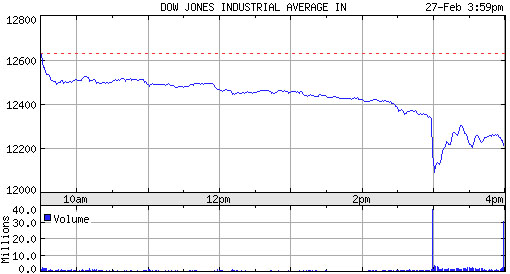
I was sitting in a long news meeting this morning, laptop in front of me, checking every now and then to see how bad a drubbing the stock market was taking. One minute around noon, West Coast time, I saw that the Dow was down around 250; a few minutes later, somehow, it was down 500. I thought, “Whoa, was there another terrorist attack? Did Alan Greenspan say something? What happened?”

It turns out that what happened was some as yet undefined software problem. As this AP story describes it, the New York Stock Exchange’s systems were falling steadily farther behind all day — in other words, the actual drop in the market was already worse than it was being reported when we thought the Dow was down 250. When the market’s managers realized what was going on, they flipped a backup into place, and suddenly, the backlog cleared — leading to that huge plunge at 3 pm Eastern time.

What’s interesting to me if you look at that chart is, once the drop became known to the market — once the backup system was in place and accurately reporting the deeper plummet — the market actually bounced back to where it thought it had been, even though that wasn’t really where it was. I’m not enough of a stock geek to fully understand this, but it’s fascinating, on some level of paradoxical reasoning.

Whoever said markets were perfect information systems?

UPDATE: Based on Wednesday AM coverage it sounds like the problem was specifically with Dow Jones’ systems, not the general stock exchange systems.
[tags]stock market, dow, software, bugs[/tags]

Filed Under: Business, Software, Technology

« Previous Page
Next Page »