
Wordyard

Hand-forged posts since 2002

Archives

About

Greatest hits

Archives for July 2006

Outliners, trees and meshes

July 31, 2006 by Scott Rosenberg

Thanks to Julian Bond for his response to last Thursday’s Outliners post, which pointed me to his essay from 2004 on outlining, “Outliners Considered Harmful.” (The title, I should point out for those of you who are not steeped in programming lore, is a nod to a tradition in that literature dating back to software pioneer Edsger Dijsktra’s 1968 paper “Goto Statement Considered Harmful.”)

When you use a tool that encourages you to think in terms of hierarchies, everything looks like a hierarchy. Unfortunately the world is much much messier than that. Almost everything is actually a mesh not a hierarchy. And when hierachies do exist in the data, it’s very likely that you will find 2 or more inherent hierarchies that are orthogonal and in most real world situations it’s more like 10…. I suspect that the move towards anarchic tagging in systems like del.cio.us and Flickr are driven by this tension between mesh and hierarchy as well though I haven’t seen it expressed like this. Tag driven systems look horribly uncontrolled to hierarchy people. But they actually reflect the real world much better than hierarchies….So in a nutshell, Outliners are harmful because they lead to hierarchy thinking. And hierarchy thinking is harmful because it leads to political hierarchies. And all of this is harmful because the world is actually mess(h)y and not structured into elegant trees.

I’m reasonably familiar with this argument. For one thing, it’s part of a discussion I closely followed while researching my book at OSAF. During some of the early work on Chandler, its designer, Mimi Yin, inspired by Christopher Alexander’s celebrated essay “A City Is Not A Tree,” tried to figure out a structure for personal-information management software that privileged “semi-lattices” (what Bond calls “meshes”) over hierarchies and trees. (Clay Shirky’s 2004 post on the Alexander essay is worth rereading.)

I’m also familiar with it because it is a theme that David Weinberger has been pursuing over the last several years — a pursuit that is culminating in the publication next year of his book, Everything is Miscellaneous, which, he tells us, he has recently completed, and which I’m eagerly awaiting.

The thing is, I’m not actually a particularly hierarchical thinker. My love of outlining is less a matter of obsession with rank and structure than an appreciation of flexibility. I don’t especially care that outlines are built around parent and child nodes neatly arrayed in tree structures; what matters is that outlines give me easy handles to move chunks of loosely structured information around, and they let me quickly zoom from a low-altitude view to a high-altitude overview and back.

All of which may explain why I still love Ecco Pro so much. For one thing, Ecco doesn’t force you to follow the outline structure rigidly; you can drag nodes pretty much anywhere you want. Even more important, each Ecco outline can also be fitted with “columns” — really, versatile tags or categories (they can be free text or checkbox or dropdown or date) that provide exactly the sort of cross-meshing or semi-latticing that Bond rightly reminds us we need. You get the best of two worlds — outlining structure and free-form mesh-i-ness. And it’s very easy to adapt to the David Allen “Getting Things Done” method for those who’ve been bitten by that bug.

I’ll stop raving now: Ecco is old, unsupported and probably has no future. Still, it’s rock-solid, and free, and it continues to serve me better than anything else I’ve found. As for the “Outliners make your brain too hierarchical” line, it might hold for some of the simpler outlining tools out there, but I really don’t think it applies to a program this versatile and fluid.
[tags]outliners, pims[/tags]
Filed Under: Dreaming in Code, Software

Rosen on NewAssignment.net: It’s made of editors

July 28, 2006 by Scott Rosenberg

In his second Q&A about his new venture in collaborative journalism online, Jay Rosen responds cogently to my suggestion here that when readers become sponsors of investigative journalism they sometimes end up unhappy with the outcome:

Guidelines at New Assignment will make it clear what is and is not kosher in accepting donations. But mostly it would be common sense. If you take money from someone who knows what the story is—before the reporting—and who only wants validation… expect problems….

For New Assignment to work, donors can’t have an editorial say greater than anyone else’s. They explicitly sign it away as a condition of giving the money. Those who expect outsized influence will be disappointed after one experience. Would they return for more? Besides, management has a policy: no refunds.

I think Jay has a pretty good grasp of what he’s after here when he talks about “good editors” being the heart of the answer to the problem. And I agree. But note that in this new world being a “good editor” involves some significantly greater political leadership, by which I don’t mean “involvement in parties and elections” but the more generic, abstract kind of politics — the mustering and deployment of power through the creation of consensus among competing interests and diverse people. Jay quotes one of his correspondents, Daniel Conover:

In a system like what Jay proposes, a NewAssignment editor would be in constant communication with the participants. Rather than being neutered by an opaque hierarchy, this editor would be empowered by the broad base of integrity-seeking NewAssignment participants. How are those participants going to react if the editor reports a pressuring phone call from a wealthy donor?

The trick is, for the editor to draw power from that base, the editor has to stay in constant contact with its interests. Assuming that the larger NewAssignment community will often be in various levels of conflict and competition, we’re talking about some very heady relationships, being acted out in the Great Wide Open.

In other words, the editor’s job at NewAssignment is going to be as much about managing online community as about assigning stories, editing copy and mentoring reporters. That’s a demanding, but certainly not impossible, pile of responsibilities. Rosen cites the formidable example of Josh Marshall’s work at Talking Points Memo as a sign that it can indeed be done.

Filed Under: Blogging, Media

Quote of the day: Microsoft’s Long March

July 28, 2006 by Scott Rosenberg

From an interview with Steve Ballmer in this morning’s Journal:

You can’t replace Bill Gates, but I think the future of the company is brighter looking forward even than looking back. You never can go through the teenage years of being a company again in the sense of growing from nothing to something, but I think we can go from something very good to something great.

When did China get great? China didn’t get great under Mao Zedong. China got great under — in the recent years — probably got great under Deng Xiaoping.

And you thought Apple was the personal-computing revolutionary! If BillG was wearing the Mao jacket, then did that make Paul Allen Lin Biao? If Steve = Deng, does that make Ray Ozzie Hu Yaobang — and is he in danger of being purged?

What was Ballmer thinking?
[tags]Microsoft[/tags]

Filed Under: Business, Technology

Random notes

July 27, 2006 by Scott Rosenberg

  • Visual design guru Edward Tufte’s new book, Visual Evidence, is out. I haven’t read it yet, but if it is anything like its three predecessors it will not only be eye-opening but will embody the principles it espouses. I wrote at length about Tufte almost a decade ago in Salon, in March ’97.
  • “What happens when you take everything in your house and make one giant chain of dominos?” Some people in Japan find out. It’s on YouTube. I saw it because Doc Searls linked to it back when only 250,000 people had viewed it, and now over 500,000 have, and we should really be shooting for >1,000,000, so I’m doing my part.
  • Who knew there was a They Might Be Giants tribute album with covers by the Wrens, Frank Black, and the Long Winters? (The latter two also each have new discs out or on the way.)

Filed Under: Culture, Humor, Music

Outliners then and now

July 26, 2006 by Scott Rosenberg

I am addicted to outlining as a means of organizing my work and life. (And no, the outliner in MSWord does not count, it’s a clumsy, kludgy horror that has probably turned off millions to the value of outlining.) I still use Ecco Pro — a long-orphaned Windows outliner — every day. (This old post has links to some of my writing on the topic.) I used Ecco to compile the research for my book, and I use it, GTD-style, to keep the spheres of my life moving in harmony.

Ecco is a fascinating hybrid of the pure outliner that Dave Winer pioneered in the 1980s and the free-form personal database exemplified by Mitch Kapor’s Lotus Agenda, which let you recategorize and invent new categories for your information on the fly. (Today’s tagging phenomenon is a latter-day version of the idea.) Chandler, the product whose development my book Dreaming in Code chronicles, started with the ambition of bringing some of these ideas into the present, though it has since evolved in different directions.

I was reminded of this complex software genealogy recently as I read a page that Winer recently linked to — a detailed chronicle, written in 1988, of how his once-popular outliners (ThinkTank and More) came to be developed. (I found it because Winer linked to it from another page about thinking about the Internet as an idea processor — which is also food for thought.)

I’ve never understood why outliners never found wider adoption. Is it just the curse of Word (once Microsoft “included” outlining in Word, however poorly, the market evaporated)? Is it that people associate outlining with boring work they had to do in high school composition class? Is it that the number of people who like to organize their thoughts in collapsible hierarchies is just not very high? But the alternative model of idea-organization tools, which provides you with more of a 2D or 3D space to place and link words and concepts (cf. The Brain and other “mind-mappers“) has never caught on in a big way, either. Maybe the vast majority of people are still too busy figuring out how to wrestle their computers into submission to concern themselves with trying to use them as (in Howard Rheingold’s phrase) “brain amplifiers.”

Many contemporary outliners (like Shadowplan) feel more like checklist organizers than tools for organizing large amounts of text. With the more sophisticated programs, one problem I have (I’m thinking here of tools like Zoot and InfoSelect) is that they are built like e-mail clients with separate panes — a pane on the left where you expand and collapse nodes, and then a pane on the right where you read the text associated with the node that’s highlighted at the left. This separates the “thing itself” from the “relationships between things.” That’s not the way my mind works: I want to see the things and their relationships — all at once!

In Ecco, as in More, you’ve got the full text of each node right in front of you, in place in the outline hierarchy. This allows you to use the tool — as I understand Dave Winer does — as a primary writing environment; it also allows you to dump huge amounts of information into the outline efficiently, move big pieces around easily, and swoop quickly from a top-level overview to the finer details.

Today Mac users can adopt OmniOutliner, which has a feature called “inline notes” that begins to move it toward the model I prefer. If I were using a Mac every day I’d also check out Eastgate’s Tinderbox, Circus Ponies Notebook and VoodooPad. Windows users can still get Ecco for free. In the new world of web-based apps, there’s not a lot of activity yet — though there is a rudimentary AJAX-based outliner called Sproutliner. 37 Signals, the “small is beautiful” web app company, has a lightweight listmaker called Tada List, along with another product that’s sort of a free-form personal info manager called Backpack. And then of course we come full circle back to Dave Winer, who has created the Web-based outline format OPML (the OPML editor is here) for constructing and sharing Web-based outlines.

I don’t know if outlining software will ever take off, but to me it feels like a natural way to use a computer. I will keep using Ecco until they invent a version of Windows that won’t run it, and I suspect I will outline until the day I die.

POSTSCRIPT: Doc Searls’ technography from Bloggercon IV is a good example of outlining in action. He wrote about it here.
[tags]outliners, pims[/tags]

Filed Under: Dreaming in Code, Food for Thought, Software, Technology

Meat space

July 25, 2006 by Scott Rosenberg

This incredibly short little [tag]science fiction[/tag] tale will take you only a couple minutes to read. BoingBoing pointed it out a while back and I just stumbled upon it again. It’s a thing of brilliance. Also funny.

The title is: “They’re Made Out of Meat.” The author is Terry Bisson. Read it.

There is also a well-made little film on YouTube but I prefer the text.

Filed Under: Culture, Humor

Newassignment.net: new-model journalism

July 25, 2006 by Scott Rosenberg

Jay Rosen has posted a detailed sketch of a new, non-profit venture in the “citizens’ media” (or “networked media”) realm that he is calling NewAssignment.Net. The idea is to create an institution online where people can contribute dollars to fund reporting projects they’re interested in. These projects will in turn be pursued by paid reporters and editors working creatively with information and contributions flowing back to them from the Net. Foundation seed money gets the thing off the ground; money from the crowd keeps it going. Old-fashioned editorial processes mesh with newfangled feedback loops and reputation systems to produce something new and unique.

Jay is one of the bright lights in this area, and I’m looking forward to what he comes up with — especially since some of the issues and problems he’s exploring are similar to the ones I’m working on at Salon these days.

Rosen’s description makes it clear that he’s seeking to create an institution where many traditional journalistic values persist and shape the work being done in a novel mode. In particular, there’s the idea that the reporters are going to go out and ask questions and consider all the information flooding back to them from the Net and determine the truth as best as they can — even if that truth is not what the people ponying up the cash wanted to hear.

This, to me, is likely to be a major friction point for NewAssignment — which will doubtless be avowedly nonpartisan but which will not be able to insulate itself from the fierce political divisions that shape so much online discourse today.

At Salon, we don’t make any claims to nonpartisanship but do maintain our own tradition of journalistic pride, and a commitment to fairness and giving the “other side” a say, and a belief in telling the story as you find it, not as your political preferences might dictate it. This has regularly placed us at odds with at least some of the readers who are funding our stories with their subscription dollars. (The relationship is not quite the direct quid pro quo that Rosen envisions, where individual site visitors put their chips on specific stories, but emotionally it seems similar.)

So, for instance, in the wake of stolen-election charges in Ohio in 2004 we had Farhad Manjoo — one of the most talented, hardest-working and open-minded reporters I’ve ever worked with — devote a lot of time to exploring the story. He’d done significant reporting on the topic in the past. His conclusion — as our headline put it, “The system is clearly broken. But there is no evidence that Bush won because of voter fraud” — was well-documented and carefully delineated. But it wasn’t what many of our readers wanted to hear.

Ever since, Salon has had a steady trickle of disgruntled subscribers cancel on us, citing these stories as a factor. It’s never been enough to make any difference to our business, and it certainly won’t stop us from doing further reporting on the subject, and presenting our findings accurately. But it’s disheartening. And I think that NewAssignment may face some similar tensions if it ends up reporting on topics that people have strong feelings about, which it must if it is to matter.

The sample story Rosen walks us through to explain his new idea is one about wild variations in drug prices from one place to another. The assumption is that some people who are upset by what they perceive as unfair, rigged drug pricing might be willing to help fund such an investigation. But what happens if the reporters come back and say, gee, it turns out that the drug companies are innocent here, the fluctuations are actually the result of [some other factor]? (I’m not saying I love drug companies. This is just an example.) Will these citizen-journalism sponsors want their cash back?

UPDATE: Jeff Jarvis’s post about NewAssignment provides some tidbits of interest about the new media venture he’s been dropping hints about for a while, named Daylife. But I wonder about his comment: “We must explore new business models to support coverage of news and this is one of them.” It strikes me that the not-for-profit, institutionally-supported model Rosen has picked — perfectly reasonably — is good for many things, but maybe not so good for exploring new business models. Yes, there are sustainable nonprofit models, and maybe NewAssignment will turn out to be one of them; but it seems to me that Rosen’s plan is more about delivering a proof-of-concept for important new ideas about networked journalism than it is about building a business. If I’m wrong, I’m sure he’ll let me know!

[tags]Jay Rosen, citizens media, newassignment.net, Salon.com[/tags]

Filed Under: Blogging, Media, Salon, Technology

Yahoo goes scrum

July 24, 2006 by Scott Rosenberg

Buried at the tail end of yet another which-portal’s-on-top? feature in the Times is this interesting tidbit about software development practices at Yahoo:

Meanwhile, Yahoo says it is now trying to emulate Google’s faster method of creating products. Like most big companies, it used to develop software by first creating a comprehensive design that defined how features would be written and tested. Instead, it is now trying what is known as a scrum method, where it will plan, build and test parts of a product every 30 days.

“We may not know how everything fits together,” Mr. Patel said. But by creating partly completed products that can be shown to customers, “We can get insights from users and react to that over a three- or four-month period to put it all together,” he said.

Scrum is a species of agile software development in which the development team, among other things, holds quick daily meetings and delivers new bits of functioning software on very short schedules. It’s all about “moving the ball forward,” scrum expert Ken Schwaber says.

[tags]software, software development, yahoo, google, scrum[/tags]

Filed Under: Dreaming in Code, Software, Technology

Dabble launches

July 24, 2006 by Scott Rosenberg

Dabble, the new service for sharing Web videos that Mary Hodder has been developing, just launched. Think Flickr for video, but without the hosting of content and a more sophisticated focus on sharing “finds” than Youtube offers. I’m looking forward to experimenting with it.

[tags]dabble, video[/tags]

Filed Under: Media, Technology

Paella at Andrew’s

July 23, 2006 by Scott Rosenberg


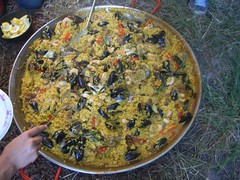
Max’s paella

It’s been a decade or so, I think, that I’ve been attending the midsummer backyard bashes that my friend and colleague Andrew Leonard throws for his friends and colleagues to celebrate his birthday each year. These events are extraordinary outpourings of hospitality, good cheer and culinary excess. (Several years ago, a whole pig was buried in the yard and cooked over coals.)

This year the centerpiece was a paella that Max Garrone cooked up in a colossal shallow metal pan that must have been a yard in diameter. I am still savoring its flavor — and I don’t even really like bivalves. Above you’ll see the dish in all its beauty.

[tags]Andrew Leonard, Max Garrone, Salon.com[/tags]

Filed Under: Personal

Next Page »