Wordyard

Hand-forged posts since 2002

Archives

About

Greatest hits

Dissing Facebook’s like

July 27, 2010 by Scott Rosenberg

At the Hacks and Hackers event last night, two Facebook representatives took the stage and talked about stuff Facebook can do for news organizations and journalists. But the journalists in attendance had only one thing on their minds: Dislike.

You see, Facebook now lets you “like” things you find online. Facebook wants you to like lots of stuff! But if you don’t like something, it asks you to walk on by, without tossing any brickbats. Journalists, based on last night’s crowd, are unhappy with this limitation. They badly want Facebook to let them actively, explicitly “dislike” things, too.

This suggests that we journalists are a negative bunch who dislike a whole lot of things. We wants to tell the world about them, we do. Nassty Facebook won’t let us!

The problem with “Like” and news content, of course, is that a lot of news is heartbreaking, and if you say you “liked” it you come off callous. This was evident from one of the Facebook presentation’s own slides.

It turns out that, on Facebook as everywhere else, people really respond to “touching emotional stories.” Facebook’s Justin Osofsky and Matt Kelly provided an example of such a tale: a headline that read “US Border Patrol shot a 14-year-old at the Mexican border.” Who wants to “like” that? In such instances, Facebook suggests users be given the option of “recommending” or “sharing” the story instead.

That covers the “bad news” case. But there’s also the “articles I disagree with” case, where you’re outraged by something and you want to share that outrage. “Like,” again, won’t do. But neither will “recommend.” This is the case for which “dislike” might make sense. But based on the rote response of the Facebook people to repeated, increasingly agitated questions on the subject, I don’t think Facebook will ever offer this choice.

The conclusion a lot of people drew was that Facebook was afraid of offending advertisers. That’s quite likely. But I also think Facebook is being smart: It’s avoiding torrents of trollery, negativity, and bullying that a “dislike” button would unleash. Some journalists might be happier in a world full of dislikeness, but I think most everyone else would be bummed.

UPDATE: Patrick Beeson points out in a comment, “I find it ironic that journalists want a dislike button, but detest negative comments posted on the websites that publish their stories.”

Chris O’Brien took great notes from the event — if you want the basics on what Facebook recommends this is highly useful.

Filed Under: Media, Net Culture

Breitbart and the story-withdrawal litmus test

July 26, 2010 by Scott Rosenberg

I hesitate to add any more verbiage to the Breitbart/Sherrod post mortem, but there’s one lesson I’m extracting that may be useful.

I do not hold it against Breitbart that he is a partisan. Most of the information I get online about politics today comes from partisans. My problem with Breitbart is that he is a partisan I do not trust, based on his track record with ACORN and other stories.

For me, the Sherrod video reduces Breitbart’s credibility to zero. This is not because he published a story that was later discredited — after all, so did many other media outlets. It is because, in the wake of overwhelming evidence that his original version of the story was inaccurate, misleading and irresponsible, he has done nothing to withdraw or disavow it.

This, to me, is the litmus test for good-faith journalism. Everyone makes mistakes, and every publication seeks scoops and exclusives, and today every news outlet is racing against the clock. Bad decisions are going to be made. If you expect to retain any shred of trust, though, you’d better cop to them and make amends when you mess up.

At Salon we once withdrew a major cover story because we came to realize that the freelance reporter we’d worked with wasn’t leveling with us. (In a later memoir, he confessed to a variety of substance abuse problems, which explained a lot in retrospect.) This was no fun, but our self-respect as journalists demanded that we take the fall.

Breitbart claims that at the time he posted the Sherrod video he didn’t know what was on the rest of it. I find that hard to believe. But if it were true, he would have only one option now that he does: fall on his sword. Withdraw and apologize. Instead, he ran a laughably narrow correction and has continued to make defensive excuses. This is why he has lost all credibility: he lacks the menschlichkeit to clean up his own mess.

One final thought: The most pernicious tactic in Breitbart’s arsenal is his habit of declaring that the little snippet he is posting is the tip of an iceberg, that he’s got way more where that came from. This gambit is straight out of the Sen. Joe McCarthy playbook, and should be called each time it surfaces.

Greg Sargent says all this in a different way:

it’s true that “both sides,” to one degree or another, let their ideological and political preferences dictate some editorial decisions, such as what stories to pursue, how to approach them, who to interview, etc. But what’s underappreciated is the degree to which the Breitbart-Fox axis goes far beyond this, openly employing techniques of political opposition researchers and operatives to drive the media narrative.

This simply has no equivalent on the left. The leading lefty media organizations have teams of reporters who — even if they are to some degree ideologically motivated — work to determine whether their material is accurate, fair, and generally based in reality before sharing it with readers and viewers. They just don’t push info — with no regard to whether it’s true or not — for the sole purpose of having maximum political impact.

Filed Under: Media, Politics

Does the Web remember too much — or too little?

July 26, 2010 by Scott Rosenberg

Jeffrey Rosen’s piece on “The End of Forgetting” was a big disappointment, I felt. He’s taking on important themes — how the nature of personal reputation is evolving in the Internet era, the dangers of a world in which social-network postings can get people fired, and the fuzzier prospect of a Web that prevents people from reinventing themselves or starting new lives.

But I’m afraid this New York Times Magazine cover story hangs from some very thin reeds. It offers few concrete examples of the problems it laments, resorts to vague generalizations and straw men, and lists some truly preposterous proposed remedies.

Rosen presents his premise — that information once posted to the Web is permanent and indelible — as a given. But it’s highly debatable. In the near future, we are, I’d argue, far more likely to find ourselves trying to cope with the opposite problem: the Web “forgets” far too easily.
[Read more…]

Filed Under: Blogging, Culture, Media, Net Culture

Help with a WordPress plugin for published versions

July 23, 2010 by Scott Rosenberg

My “versioning for all news stories!” manifesto inspired lots of feedback. A good amount of it was along the lines of, “What are you talking about? How would this work?” I’ve been pointing people to Wikipedia’s “view history” tabs, which are a great start. (I also notice that the Guardian UK now posts, on each article, a story history, which tells you that the article was modified, but doesn’t actually show you the different versions.)

What I’d like to do now is pursue this at the level of a live demo right here on this blog. So I put out a call on Twitter for help in creating a WordPress plugin that would let me expose every version of each post. I only want to show the versions since publication — a rough draft pre-publication should remain for the author’s (and editor’s, if there is any) eyes only.

Scott Carpenter helpfully pointed me to this existing plugin, which outputs a list of all versions of each post.

This is a great start. All I need now is to add a little code to the plugin that gets it to show only the post-publication versions.

I know just enough about PHP to mess around with templates and cut-and-paste code snippets, but not enough, I think, to do this right. Anyone interested in helping out on this little project?

Someday, when this versioning thing catches on and becomes a universal practice, you’ll be able to say to yourself, with a little smile of satisfaction, “I was there when it all began.”

Filed Under: Blogging, Media, Software

Breitbart fiddles while the MSM refuses to burn him

July 22, 2010 by Scott Rosenberg

If you’re a writer or journalist and you quote someone selectively or out of context so egregiously that you can twist their words to mean the very opposite of what they actually convey when they’re quoted in full or in context, what you have done is not just mischievous or aggressive, it’s outright wrong. If you’re a professional, then you’ve committed an act of professional malfeasance.

And if you get away with this sort of stunt repeatedly, despite being exposed and shamed for it, then you are pulling off a grand heist — stealing the credibility of larger media and government institutions that continue to pay attention to you.

This, in a nutshell, describes the challenge Andrew Breitbart has presented to the world of journalism, first with his ACORN deception and now with his Sherrod stunt. So far, journalism is failing to meet it.

By this point, Breitbart ought to be an object of snorting derision in the journalism profession. He ought to be shunned by respectable news organizations and mocked in public. He deserves the sort of ostracism that until recently was reserved for serial plagiarists.

Yet look at how two post-mortems of the Sherrod affair framed their presentation of his role.

Listen to this lead All Things Considered story on NPR, as Ari Shapiro sums up the meaning of Breitbart’s behavior:

There has been a pattern of conservative activists blurring the line between journalism and advocacy, and doing it with striking success.

This is precisely not the problem with what happened to Shirley Sherrod. What’s wrong with Breitbart’s work has nothing to do with the fact that he is a partisan journalist rather than an “on the one hand, on the other hand” style journalist. The problem with Breitbart is not that he is an activist in journalist clothes, but rather that he is a serial purveyor of deceptions who is somehow still viewed as a legitimate source by some of his colleagues in the media.

Here is how Politico framed its take on Breitbart’s role in the Sherrod story (in a piece that also talked about Tucker Carlson’s stories on the Journolist emails). “The combative Breitbart” caused an “uproar,” but his “revelations proved decidedly less incendiary when the context of the comments was added. And both [Breitbart and Carlson] have been criticized for failing to provide, or even trying to provide, that context.”

No, Politico, Breitbart’s revelations didn’t prove “decidedly less incendiary.” They proved wrong — deliberately counter-factual and embarrassingly misleading. Breitbart is not merely combative and uproarious. He is malicious and dangerous. A handful of journalists have come close to acknowledging this: Later on the same All Things Considered, Jon Alter called him “a notorious smear artist.” And over at Fox News, Shepard Smith describes him as untrustworthy. But mostly, Breitbart gets off with being described as a rambunctious bad boy whose behavior is the result of overly ardent partisanry rather than simple unfairness and lack of decency.

If there is any remaining doubt about how fully Breitbart deserves a full-on shun from the entire media world, just take a look at the laughably inadequate correction notice he has appended to the original report on his site about Sherrod:

While Ms. Sherrod made the remarks captured in the first video featured in this post while she held a federally appointed position, the story she tells refers to actions she took before she held that federal position.

The implication is: “Our story holds up, Sherrod said what we said she said, but we goofed on this little detail of her employment at the time.” Whereas a real correction would read more like “Our original story was wrong. We quoted Sherrod to suggest that she drove an old white couple off their farm because she was a racist. In fact, she helped that couple hold onto their farm and used the tale to argue against racism.”

Really, though, if Breitbart had any self-respect he would withdraw the whole story and apologize to Sherrod. Since he’s never going to do that, why should he have a future as a participant in public discourse?

BONUS LINK: David Frum explains why the conservative media won’t hold Breitbart to account.

MORE LINKS: Not surprisingly, the toughest media voices on Breitbart come from the ranks of those who wear both pro-journalist and blogger hats. Josh Marshall makes a similar point to mine: “For anyone else practicing anything even vaguely resembling journalism, demonstrated recklessness and/or dishonesty on that scale would be a shattering if not necessarily fatal blow to reputation and credibility.”

I’d also point you to the chorus of criticism from the Atlantic’s stellar blogging bench (hat tip to the Atlantic’s Bob Cohn). Josh Green highlights Breitbart’s role as “ringmaster”: “It’s hard for me to see how the media can justify continuing to treat Breitbart as simply a roguish provocateur. He’s something much darker.” And Jim Fallows makes the McCarthyism parallel explicit: “Silver lining: the possibility that for the Breitbart/Fox attack machine this could be the long-awaited ‘Have you no sense of decency?’ moment.”

ALSO: Rogers Cadenhead with some of Breitbart’s backstory: “What good is being a self-employed media mogul if you can’t admit you fucked up and try to make it right?”

And Greg Sargent asks: “Has any news org done a stand-alone story on the damage the Shirley Sherrod mess has done — or should do — to his credibility?”

Filed Under: Media, Politics

Politico, Slate, and story versioning — or: the only Web constant is change

July 21, 2010 by Scott Rosenberg

Last month, the hardworking gang at Politico got into a dustup with critics after an editor made a change in an already-posted story. The story was about the Rolling Stone/General McChrystal affair; the change removed a phrase that described how beat reporting works; the phrase had drawn considerable attention, and so did its disappearance.

I’m not going to add to the volume of commentary on that affair. I’m interested here in the larger issue of the mutability of online content, and how responsible news organizations deal with it.

A story posted at Slate yesterday sheds considerable light on this issue, in the course of making a few stumbles of its own. (The story includes quotes from a recent post I wrote about best practices in online corrections.) It’s remarkable that, after 15 years of Web publishing experience, we haven’t gotten better at handling changes to news published online. Before this post is done, I will offer a straightforward, concrete proposal for doing so.

[Read more…]

Filed Under: Media, Mediabugs

You’re the notorious flamingo smuggler!

July 20, 2010 by Scott Rosenberg

We created what we hope is a fun little video explaining the basic concept behind MediaBugs. All credit to the awesome talents of Kate and Nate at Beep Show — and their stock company of men in shorts.

The Story of MediaBugs from Beep Show on Vimeo.

Filed Under: Mediabugs

Party context of that staggering debt chart

July 19, 2010 by Scott Rosenberg

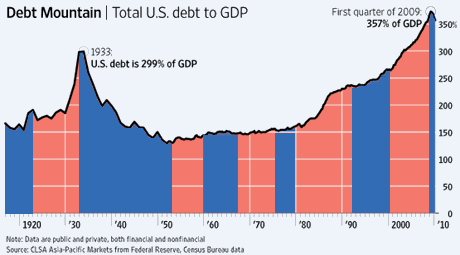
The Journal published one of those jaw-dropping charts about the U.S. national debt last Thursday, and it looked pretty bad:

There are two things to argue about here: One is the economic debate about how dangerous this “debt mountain” really is, and whether deficit-cutting today amid high unemployment would just stall the economic recovery (the famous “mistake of 1936”).

The other is the political debate. We’re in the middle of an election cycle, so charts like this fuel voter anger and “throw the bums out” sentiment.

I’m a timeline-oriented sort of person, and so the first thing I did when I looked at this chart was ask, “OK, let’s plot the presidential administrations by party along the horizontal axis and see what we find.” Since what I found was pretty remarkable, I marked up the chart below. Blue bars are Democratic administrations.

US Debt Chart By Presidential Party

Pretty much speaks for itself, no? The main observation is that the huge runups in the debt that we’ve experienced since 1980 are almost entirely the results of the policies of two Republican presidents, Reagan and Bush Jr. (The elder Bush deserves some credit for a willingness to tackle the debt through a modest tax increase.) Yes, these presidents sometimes had the cooperation of some Democrats in Congress. But the disastrous supply-side-style tax cut policies were authored by these presidents’ administrations, and they are responsible for them.

The truth of the last three decades of American economic history is simple: The GOP has repeatedly pursued a policy of “cut taxes and let our kids pay for it.” Some supported it out of a mistaken belief that tax cuts would always pay for themselves in economic growth. Others supported it out of a Machiavellian belief (“drag it into the bathroom and drown it in the bathtub”) that if you cut taxes enough, you could force the government to scuttle popular government programs that Republicans detest like Medicare and Social Security. Others supported it out of plain old self-interest (tax cuts are always popular).

Whatever their motivations, every Republican politician who rails against the evils of the debt should be shown this chart and asked to explain it.

CORRECTION/UPDATE: As William Sullivan points out in comments, this chart, which I mistook for a graph of public debt only, actually aggregates public and private debt. I’ll poke around for a public-debt-only graph. In the meantime, it’s interesting to think, gee, what does it mean that both public and private debt together surge under our most recent Republican administrations? The positive spin, I suppose, would be: Business is humming and consumers are confident during these expansive GOP eras so people take on more debt.

Given what we experienced in 2008, however, I think a more accurate read would be: Our supposedly conservative Republican presidents actually presided over massively risky leveraging of our economy without thinking about how either the government or private citizens would actually pay it all off. Which, to me — speaking as a liberal who has paid off his credit card bill every month of my adult life — sounds like the opposite of “conservative.”

Filed Under: Politics

More songs about whistling

July 19, 2010 by Scott Rosenberg

There is nothing quite as catchy as a great pop song that deploys whistling. I was reminded of this truth last night at a show by the New Pornographers last night at Oakland’s majestic Fox Theater, where the band’s generous set included “Crash Years” — a song from its new album, Together, that features an infectious whistling chorus.

(I have to admit that the whistling volley loosed by the NPs last night was so solid, indeed so flawless, no stray sibilance or wobbles offkey, that I did wonder if it was live or sampled. I mean, the band members were whistling into their mikes. But these days, who knows?)

I was all set to write up a post about other great whistling songs, but soon discovered that it’s been done already.

The Spinner list is a pretty good one. But it’s heavy on songs that use whistling as a drop-in solo or a bridge or an outro. Those are great, but this aproach neglects examples in the grand “Colonel Bogey March/Bridge On the River Kwai” tradition — where the whistling carries the entire tune of a refrain.

My own favorite in this genre is Brian Eno’s “Back in Judy’s Jungle” — the missing link connecting the world of Colonel Bogey with that of “Crash Years.”

As for the rest of the New Pornographers show? With eight, sometimes more, people on stage, they have turned into indie power pop’s equivalent of a Big Band. Indeed, at times, with their tight harmonies and deep catalog of songs that feel like instant classics, they made me think of our era’s equivalent of the Band — with roots dug not in the country-folk tradition but instead in the now-long history of eccentric smart pop. Great, complex music: we’re lucky to have it.

Filed Under: Culture, Music

Redecorating the place

July 18, 2010 by Scott Rosenberg

Welcome to the long-overdue revamp of this blog’s design.

Our new look is courtesy of the Genesis theme framework from StudioPress, which makes things like choosing a column layout really simple. I just fiddled a bit with some of the colors and fonts and style-sheet stuff.

WordPress has become so much more powerful and elegant as a content management system over time — the widget framework for dropping in features like the Twitter box, the navigation boxes and my little book promotions is awfully straightforward. Thanks to all the developers who have brought us to this fine place!

I’ve tested things out on various browser/platform combos but let me know if you see anything funky.

Filed Under: Blogging, Personal

« Previous Page
Next Page »