
Wordyard

Hand-forged posts since 2002

Archives

About

Greatest hits

Archives for September 2009

Drupal designer needed

September 16, 2009 by Scott Rosenberg

For a project I’m working on (not MediaBugs but another effort in the media realm that’s a collaboration with Dan Gillmor and Bill Gannon):

We have some work for a designer who’s got lots of experience with Drupal to help us finish up a partially implemented design. This is a short-term gig that, we think, should be straightforward for someone who already knows Drupal well.

If you or someone you know might fit that bill, do be in touch with me at scottr /at/ this domain (wordyard.com). Thanks!
Filed Under: Personal

People think the press gets a lot wrong. Maybe they’re right.

September 16, 2009 by Scott Rosenberg

[crossposted from the MediaBugs blog]

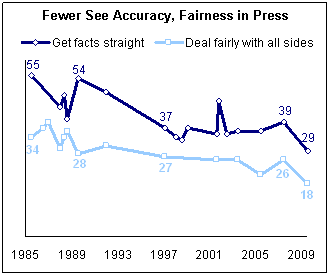
Americans trust the news media less than ever: “Just 29% of Americans say that news organizations generally get the facts straight, while 63% say that news stories are often inaccurate,” according to the latest results from the Pew Research Center released this week. That represents a drop of 10 percentage points from 2007, when 53% of Americans said that news stories were often inaccurate. And an alarming 70 percent of people surveyed believe that news organizations “try to cover up their mistakes.”

Pew Research Center survey report There’s a problem here, for sure. Many journalists understand this and work hard, every day, to try to solve it. Others are in denial. In reaction to this report, journalism scholar Jay Rosen wrote the following series of tweets yesterday:

Top explanations from journalists for fall in public confidence: 1. All institutions less trusted; 2. Cable shout-fest; 3. Attacks take toll

Top explanations from journalists for fall in public confidence, cont. 4. Environment more partisan; 5. Public confusion: news vs. opinion.

Top explanations from journalists for fall in public confidence, cont. 6. People want an echo chamber; 7. Numbers don’t really show a fall.

Each of these explanations doubtless has some merit. But together they constitute a kind of head-in-the-sand stance. Missing from the list is the simplest, most obvious explanation of all: Maybe we’ve lost confidence in the press because of its record of making mistakes and failing to correct most of them.

In other words, perhaps so many people think the news is full of inaccuracies because, er, they’re right.

Read Craig Silverman’s excellent book Regret the Error, based on his blog of the same name, and you’ll learn the sad numbers from the best studies we have on this topic: They show that the percentage of stories that contain errors ranges from 41 to 60 percent. Scott Maier, a journalism professor at the University of Oregon who has studied this field, tells Silverman that he found errors are “far more persistent than journalists would think and very close to what the public insists, which I had doubted.” Only a “minuscule” number of these errors are ever corrected.

Some of these errors are substantive, others seemingly trivial. But each one of them leaves readers or sources who know the topic shaking their heads, wondering how much else of the publication’s work to trust.

Since reversing this dynamic is the central goal of MediaBugs, we’ll be writing about it a lot here.

Filed Under: Media, Mediabugs

Getting MediaBugs started

September 16, 2009 by Scott Rosenberg

I’ve begun blogging over at MediaBugs.org on topics that relate to that project — specifically, journalistic accuracy, error corrections, and the state of trust in media. The blog will also report on our progress bringing that project to life in coming weeks. I’m not going to make a habit of cross-posting my posts between that blog and this one, but today, to kick things off, I’m reposting my thoughts on this week’s Pew survey recording a precipitous drop in public trust in the media. It’ll be the next post.

Today, I’m also putting out the call to hire someone to work with me on the project in the role of community manager. This is a paid, part-time contract position. It’s pretty unique: Since MediaBugs aims to provide a neutral, civil environment for the public to bring errors to journalists’ attention and for journalists to respond, I’m looking for someone with experience managing an online community and experience in a newsroom. Since this initial pilot MediaBugs effort is a Bay Area thing, the person will need to be local here.

If the project interests you and you’re intrigued, you can go here to check out the detailed posting.

Filed Under: Mediabugs

Bowden on Sotomayor: Blame the bloggers, again

September 8, 2009 by Scott Rosenberg

Mark Bowden is a seriously good reporter, and his piece in the new Atlantic, “The Story Behind the Story,” is one that every student of today’s mutating media should read. Bowden traces the route by which the soundbite that came to define, though not derail, Sonia Sotomayor’s Supreme Court nomination entered the media bloodstream. I can wholeheartedly recommend the reporting in Bowden’s piece, but I must take issue with some of his interpretation.

The “wise Latina” clip, it turns out, was first unearthed by a conservative blogger named Morgen Richmond and published on his blog, called VerumSerum. And the problem with that, Bowden suggests, is that Richmond, being a partisan in search of ammunition rather than a journalist in search of truth, presented it to the world without making an effort to understand it or put it in context — to see that, in fact, Sotomayor wasn’t saying anything that outrageous at all: As Bowden puts it, “Her comment about a ‘wise Latina woman’ making a better judgment than a ‘white male who hasn’t lived that life’ referred specifically to cases involving racial and sexual discrimination.”

Bowden credits Richmond as “a bright and fair-minded fellow,” but argues that his “political bias made him tone-deaf to the context and import of Sotomayor’s remarks. Bear in mind that he was looking not simply to understand the judge, but to expose her supposed hidden agenda.”

…he makes no bones about his political convictions or the purpose of his research and blogging. He has some of the skills and instincts of a reporter but not the motivation or ethics. Any news organization that simply trusted and aired his editing of Sotomayor’s remarks, as every one of them did, was abdicating its responsibility to do its own reporting. It was airing propaganda. There is nothing wrong with reporting propaganda, per se, so long as it is labeled as such. None of the TV reports I saw on May 26 cited VerumSerum.com as the source of the material, which disappointed but did not surprise Richmond and Sexton.

The trouble with all this is that Bowden is focusing his ire on the wrong people. Richmond is not, as far as I know, claiming to be a journalist — and yet, as Bowden admits, he is actually “fair-minded” enough to feel that the Sotomayor quote was maybe not that big a deal. Surely the failure here is on the part of the TV news organizations that turned it into a marquee soundbite without looking more deeply into it. Wasn’t that their job, their process, their vetting — the safeguard that ostensibly distinguishes them from the unwashed blogging masses? Aren’t they the ones who are supposed to be after truth rather than scalps?

Blogs may have helped accelerated gotcha journalism, but hit pieces and skeletons-in-closets existed long before their advent. The partisan warfare around Clarence Thomas’s nomination far outdid the Sotomayor hearings, and Anita Hill’s charges — whatever your view of them — required no blog posts to ignite their conflagration. The Web has crowdsourced opposition research, but the conflicts that motivate it have been around for ages.

It is television that creates soundbites; the Web at least allows for far more context and nuance, though it does not always deliver them. I do not understand how Bowden could fail to see this. He writes (of Richmond and his co-bloggers):

I would describe their approach as post-journalistic. It sees democracy, by definition, as perpetual political battle. The blogger’s role is to help his side. Distortions and inaccuracies, lapses of judgment, the absence of context, all of these things matter only a little, because they are committed by both sides, and tend to come out a wash. Nobody is actually right about anything, no matter how certain they pretend to be. The truth is something that emerges from the cauldron of debate. No, not the truth: victory, because winning is way more important than being right. Power is the highest achievement. There is nothing new about this. But we never used to mistake it for journalism. Today it is rapidly replacing journalism, leading us toward a world where all information is spun, and where all “news” is unapologetically propaganda.

“The blogger’s role is to help his side.” This is sometimes true, but no more definitive than to say, “The TV newsperson’s role is to help his side.” It is a broad-brush dismissal of an entire class of writers who are actually far more diverse in their goals and techniques. It is no more accurate than the carping of the extremists (of both left and right) who tar all “MSM” journalists with the sins of a minority of hacks or ideologues. It’s disheartening to see a writer of Bowden’s stature placing himself on that level.

There are pundits and news-show hosts who earn our trust as straight shooters, and there are others for whom partisanship plainly trumps truth. There are reporters who aim to shoot straight, and others who hide their own blatant partisanship behind a scrim of ersatz objectivity. In the end, all we can do is find individuals and institutions who, based on their record and their willingness to show their process, seem to place truth ahead of “victory.” Such individuals and institutions are no rarer on the Web, and among bloggers, than among the old guard of journalism. If the public is being ill-served by echo-chamber coverage and shallow sound-bite gotcha clips, the cable news channels bear primary responsibility. Bowden’s own narrative of the Sotomayor “story behind the story” is just the latest demonstration.

BONUS LINK: Here’s Richmond’s thoughtful response to Bowden.

Filed Under: Blogging, Media, Say Everything

Blogger’s 10th birthday party

September 2, 2009 by Scott Rosenberg

The story of the rise of Blogger from the ashes of a dotcom startup to the largest blogging service in the world takes up a whole chapter in Say Everything. So when Rick Klau of Google’s Blogger team invited me to participate in a panel as part of Blogger’s 10th birthday celebration, I was happy to accept.

Last night I took a seat to talk about where blogging has been and where it’s going alongside Rick and his colleage Siobhan Quinn; prominent tech blogger (and Blogger user) Louis Gray; Blogher cofounder Jory des Jardins; Blogger and Twitter founder Evan Williams; and Twitter cofounder Biz Stone (who long ago worked at the early blog network Xanga and also worked on Blogger after it was acquired by Google).

Klau gave us some Blogger numbers to chew on:

  • Between 9 and 10 million “active contributors” (within past 30 days) to Blogger sites — this includes posts and comments. “7-day active contributors” have doubled over the last two years.
  • “Active readers (30-day)” (which I assume is some version of what we think of as “monthly uniques”) is now over 300 million.
  • 270,000 words written each minute on Blogger — 388 million words a day. About a quarter trillion words written on Blogger since its 1999 launch. (“Some of those,” Biz Stone deadpanned, “might have been cut-and-pasted.”)

He also announced a new partnership between Blogger and Socialvibe, which channels charitable contributions from web pages.

Jory Des Jardins shared some of the research from Blogher: bloggers on that network cite top motivations as “fun,” “self-expression,” and “networking.” Making money always takes last place on these lists, she said.

Klau talked about how Google itself uses blogs (more than 100 now), and now Twitter as well, to talk with its users. (I remember Google’s earliest days, when it really didn’t talk with anyone at all, beyond a handful of media folks.) He also discussed efforts to clean up the Blogspot hosted service, which a couple of years ago had developed the reputation of a spam-ridden “not nice neighborhood.” Today, he said, the percentage of spam page views on Blogspot has declined to “the low single digits.”

Williams recalled the moment, a year or two after the introduction of Blogger, when its creators began to imagine the possibility of a world in which every company and every politician would have their own blog: “At the time, these were crazy ideas.”

Stone pointed out the subtle transition in our understanding of blogging implicit in Blogger’s switch from the “Powered by Blogger” slogan at the bottom of users’ pages to “I power Blogger.”

I reminded people of the irony that, even though Blogger today is known as the sort of Everyman’s blog service, for its first year, it required that you host your own domain in order to use it. That made it tough for everyday people to use it, but perfect for the early-adopter blog-geek crowd — people who already had their own domains, didn’t want to give them up, but appreciated the convenience of Blogger’s publishing tool. This approach — enthrall the in-crowd first, then make it easy for everyone else to join in — turns out to be a very effective formula for startup growth, even if, in Blogger’s case, it was more stumbled upon than planned in advance.

None of this will do you any good, to be sure, unless what you’re offering has some intrinsic appeal and value. Blogger most certainly did, and does — along with all its progeny, including Movable Type and WordPress, all of which together have made posting your words on the Web a thing of once-impossible-to-imagine ease today.

UPDATE: Anthony Ha at VentureBeat posted about the event.

Filed Under: Blogging, Say Everything

Amazon reviews: an author’s view

September 1, 2009 by Scott Rosenberg

“Everyone’s a critic” used to be a joke; now it’s a fact. You may take populist pride in the Web’s profusion of user-contributed reviews; you may wish Yelp had never been invented. Either way, if you create stuff or sell things, you’re going to get written about.

Authors have probably been dealing with this new world longer than any other creative group, thanks to the early introduction to user reviews that Amazon.com gave the publishing industry, beginning in 1995. There has never been a shortage of disdain for the phenomenon from professionals — most recently with Joe Queenan’s satire in the Wall Street Journal last week, imagining classics getting savaged by the unwashed Amazon masses: “Their courageous sniping from behind the bushes, emulating Ethan Allen and the Swamp Fox back in 1776, reaffirms that democracy functions best when you fire your musket and then run away.”

At this late stage in the decline of the media business, however, authors can’t be too picky. The opportunity to be reviewed by professionals — however bittersweet it may be to begin with — is increasingly rare. Newspapers and magazines review only a tiny fraction of the books published each month. These days, we are all going to be reviewed by one another, for better or worse. So which is it?

I had a great experience with the Amazon reviews for Dreaming in Code, and so far, the same is holding for Say Everything, though the volume to date is lighter (my hunch is that people interested in blogs are more likely to have their own blogs and to post their thoughts there). Right now there are four reviews of the book: two highly positive, two quite negative. Plainly I’m happier about the former than the latter. The resulting average star rating isn’t as stellar as I’d like.

But if you read the reviews, you see that the positive reviews are carefully written posts from people who seem to care about the topic. The negatives, on the other hand, well — you can see for yourself: one is hard to make much sense of, and the other is by someone who declares that “most bloggers write solipsisms and only for themselves. Worse yet, most are also obnoxious and ignorant.”

My belief in the value of “everyone’s a critic” stems from my confidence in everyone’s ability to scan a batch of posts and sort out what’s of use. People often complain, “Gee, doesn’t that take work?” Well, no, not that much — if you can skim posts you can take the pulse of the pro and con contributions pretty easily. The other big complaint is that reader reviews are too subjective, and you end up with a lot of contradictory chatter. That’s not precisely wrong, but it really describes any set of reviews. (The San Francisco Chronicle reviewer for Say Everything, Tom Goldstein, thought my book was “snappy,” while the Seattle Times critic said it was a “slog”.)

I should add that Amazon, though still dominant, isn’t the only significant platform for user book reviews. There are Facebook apps for sharing “What I’m reading” notes, and there’s GoodReads, a social network for sharing what you’re reading and what you thought about it.

You never know what you’ll find, either. I headed over to GoodReads and found Wired’s Steven Levy, weighing in on GoodReads’ page for Say Everything: “Really well-reasearched and artfully presented… Scott is very sensitive and perceptive, and doesn’t merely hash over tired controversies, but brings sharp insight to the blogging saga.”

Craig Newmark recently wondered whether user review sites would be “the next big media/advertising disruption”; I think that disruption is already underway. Compared to the old model of hiring, paying and editing professional critics, these sites are cheaper to operate and able to be far more comprehensive in covering things like local restaurants or, for that matter, books.

Can they substitute for the work of the best professional critics? Of course not. But they provide plenty of value, and I don’t think authors or anyone else should be afraid of them. We can cherish what good we find (not just the positive reviews but the negative ones that actually engage with the work) and screen out the pointless chatter and the drive-by snarking — confident that others will be just as adept at that as we are.

Filed Under: Uncategorized