
Wordyard

Hand-forged posts since 2002

Archives

About

Greatest hits

Kiko’s calendar auction and the old “incremental change” song

August 18, 2006 by Scott Rosenberg

Kiko is an Ajax-style Web-based calendar service. (It’s also the title of a fantastic album by Los Lobos.) Kiko’s developers, only a few months after unveiling it, have put it up for sale on Ebay for $50,000. So far, despite wide linkage, no takers.

Robert Scoble says this presages a Web 2.0 shakeout: “There are simply too many companies chasing too few users…. Getting the cool kids to try your technology isn’t the same thing as having a long-term business proposition.”

Could be. With Google’s new calendar gobbling up mindshare in an already crowded space (haven’t you heard that “Google is the New Microsoft“?), Kiko didn’t seem to have much chance.

The problem is that, unlike photo-sharing or video-staring or link-listing or news-rating, activities that have provided grist for successful Web 2.0 mills, calendaring doesn’t easily lend itself to large-scale social interaction and wisdom-of-crowds behavior. Calendars are either personal or apply to small, well-defined workgroups or personal circles. The piece of calendaring that’s most amenable to wide Web networking — the listing and sharing of information about public events — is already being pursued by several ambitious companies (Eventful, Zvents, etc.).

But even if calendars aren’t going to fuel the next Web 2.0 wunder-company, we still need them. The future for calendar software, as Scott Mace keeps reminding us, is more about interoperability than about snazzy Ajax features. Making sophisticated calendar-sharing work, and multi-authoring possible, and import-export painless — these are the things that will matter in this category (as the folks working on Chandler whose work I followed for Dreaming in Code understand so well).

Meanwhile, Justin Kan, a Kiko founder, lists his own set of lessons from the experience. They include the following: “Build incrementally. We tried to build the ultimate AJAX calendar all at once. It took a long time. We could have done it piece by piece. Nuff said.”

But it’s not nuff said, it’s never said ’nuff, it needs to be said over and over until you’re blue in the face and all your coworkers hate you and think you’re a monomaniac who has gotten this word “incremental” implanted in his neurons like some sort of development-process idee fixe. It is an important but counter-intuitive insight. It’s not how businesspeople want things to be. It’s not how developers are used to thinking. So if you actually understand that an incremental process for building an ambitious program or Web site is the best approach, you will have to be insufferable about it.

My friend Josh Kornbluth (who recently recounted some ancient tales from our collaboration 20 years ago on a low-rent radio drama show in the Boston area) once wrote a song titled “Incremental Change.” It was a cappella, it lasted all of 25 seconds and its entire lyric consisted of the following:

I think incremental change is a good thing
Incremental change: good thing!

Software development was almost certainly not on his mind at the time of writing. But the sentiment holds across a surprisingly broad range of fields.

POSTSCRIPT: Paul Graham, whose Y Combinator funded Kiko, says the company spent so little money the failure’s no big deal: “This is not an expensive, acrimonious flameout like used to happen during the Bubble. They tried hard; they made something good; they just happened to get hit by a stray bullet.”
[tags]web 2.0, calendars, software development[/tags]

Filed Under: Business, Dreaming in Code, Personal, Software, Technology

My ancient cellphone: All that is clunky eventually becomes cool again

August 10, 2006 by Scott Rosenberg

I’m not a serious cellphone user; it’s basically a necessity for certain mundane family management tasks, and that’s all I use it for. Email, that’s my bag. (Yes, I know that tags me as the fortysomething I am.)

So I’m still using this fairly clunky old Motorola V-60 that Verizon gave me way back when. No camera, not even color, but hey, it works.

And now, it turns out, this very phone has made Kevin Kelly’s excellent Cool Tools site:

Motorola V60

If 1960s cars can be fashionable in Hollywood, surely late-1990s phones must stage a comeback at some point. When people look with surprise at my “piece of junk,” I tell them I’m just ahead of my time.

Filed Under: Personal, Technology

AFB (away from blog)

August 4, 2006 by Scott Rosenberg

…for the next two days, taking the kids camping (their first time), tent and all. But not far from friends and good food.

Filed Under: Personal

The Technorati dance

August 3, 2006 by Scott Rosenberg

I have been using Technorati since it was running on servers powered by Dave Sifry’s hamsters, and it remains an essential part of my blogging existence. The company recently rolled out a spiffy new design for its service. Hooray.

But: Why are the results still so…unstable? Since I am the perpetrator of a recent blog-address move I’ve been trying to keep an eye on how many, and which, other bloggers have updated the address that they link to me with. (I know it’s a pain; I’ve been guilty of plenty of blogroll-rot myself, though it’s an easier job keeping it up to date now that I’ve outsourced it to Bloglines’ widget.)

What I’m finding is that, depending on the hour of the day, sometimes I will get a list of results from T-rati that’s reasonably up to date and trustworthy, and sometimes I will get a list that’s just wacky — full of results that just don’t seem to have anything to do with my blog, no links evident, no overlapping subject matter, nothing. Furthermore, the results that I get from the T-rati site sometimes differ significantly from those that turn up in the RSS feed that represents that search.

Is this fallout from the monumental war I know Technorati must be waging on the depredations of blog-spammers and spam-blogs? Is it a symptom of some general structural problem with the service’s design, or just side-effects of the company’s constant scaling-up efforts to keep pace with the blogosphere’s exponential growth?

Or is there some deeper logical pattern hidden within the seemingly irrelevant pages T-rati is claiming point to my blog — some guy’s Nirvana playlist; A non-English-language page with a photo of Andrea Bocelli singing “Besame Mucho”; Debby’s World’s list of “34 things worth knowing” — and if only I could decipher that pattern, I could achieve perfect bliss, or at least a more rarefied Technorati ranking?
[tags]technorati, blogging[/tags]

Filed Under: Blogging, Personal, Technology

Paella at Andrew’s

July 23, 2006 by Scott Rosenberg


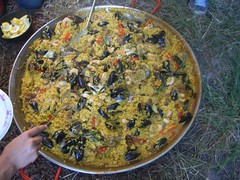
Max’s paella

It’s been a decade or so, I think, that I’ve been attending the midsummer backyard bashes that my friend and colleague Andrew Leonard throws for his friends and colleagues to celebrate his birthday each year. These events are extraordinary outpourings of hospitality, good cheer and culinary excess. (Several years ago, a whole pig was buried in the yard and cooked over coals.)

This year the centerpiece was a paella that Max Garrone cooked up in a colossal shallow metal pan that must have been a yard in diameter. I am still savoring its flavor — and I don’t even really like bivalves. Above you’ll see the dish in all its beauty.

[tags]Andrew Leonard, Max Garrone, Salon.com[/tags]

Filed Under: Personal

New blog notes: Rosetta stone

July 20, 2006 by Scott Rosenberg

In moving the blog over I learned that I’ve written a little over one thousand posts in four years. At 250 a year that puts me averaging one per weekday. In truth, I have had spasms of more vigorous blogging and, particularly during my book leave, periods of radio silence. Still, that’s a useful stat.

The header graphic is a chunk of the old Rosetta Stone. (Turned on its side for, uh, aesthetic reasons: if you slice it horizontally to suit a blog header and you don’t turn it on its side, you only get rows of hieroglyphics, *or* rows of demotic Egyptian, *or* rows of Greek, without the cross-language effect, and that’s no fun.)

I’ve always seen myself as someone whose work translates complex concepts and ideas across various divides. When I wrote theater criticism I aimed to explain the most interesting and ambitious work I encountered for intelligent readers who weren’t necessarily steeped in theater history or the contemporary arts; when I moved on to writing about technology I trie d to immerse myself in the digital world but send back reports that readers back on land could make sense of. So the Rosetta Stone — symbol of translation-breakthroughs across tribes and times — feels right. (I liked the look, too.)

Here’s a Rosetta Stone for code: “Hello World” programs in nearly 200 programming languages.

Filed Under: Blogging, Personal

The blog rebooted

July 20, 2006 by Scott Rosenberg

Almost exactly four years ago, on July 22, 2002, I started my first blog. Blogging felt natural to me since I’d been writing for the Web since 1994 and self-publishing since 1974 (originally via mimeograph).

My blog was part of a larger blogging program I’d put together at Salon, in partnership with Userland. It was the tech-downturn doldrums — an era when every time we at Salon opened the papers or fired up our browsers we knew that someone, somewhere, would be predicting our imminent demise. And there wasn’t a lot of extra cash at the company at the time, so the blogs program was chiefly a labor of love, launched in the wee hours. I did the CSS, wrangling Salon’s home-page design into Radio Userland templates, all by myself (which anyone who knows anything about CSS can probably tell with a single glance at the unruly code).

I loved Radio Userland at the time for the way it combined a blog publishing system and an RSS reader. But times change; Userland put its energy into other products; Salon Blogs produced many great blogs but not a substantial change in Salon’s business; and my blog settled down from the program’s focal point to a personal-publishing bullhorn.

Several months ago, in anticipation of Salon’s plan to build a new platform for users to contribute their own writing, we closed off new signups to the old Salon Blogs platform. Today I’m moving my own blog to a new home, here, at Wordyard.

I’ve managed to export my whole four years’ worth of archives (over 1000 posts, averaging about one per weekday for the whole timespan) to WordPress. (For those who care, I used the Radio Userland exporter, which pops out a plaintext file in Movable Type export format; edited that file to make things like titles and categories work; then imported into WordPress.) The comments, alas, will remain back at the original Salon Blogs location, where they will continue to be available.

With this move, I plan to blog somewhat more vigorously, and to provide more posts about my forthcoming book, Dreaming in Code, as its January 2007 publish date nears. I also look forward to leveraging some of the great features and plugins created by the WordPress open-source community.

If you subscribe to my RSS feed in Bloglines (the reader I’ve been using daily for years), the transition should be transparent — Bloglines will do the flip for you, you don’t need to touch anything. If you subscribe through other feed readers or services, you’ll have to resubscribe to the new feed address, which is here.

More anon!

Filed Under: Blogging, Media, Personal, Salon Blogs, Technology

Fallows, PIMs and Chandler

July 11, 2006 by Scott Rosenberg

James Fallows has been writing thoughtfully about computer software for longer than most of us have been using it. Years ago he wrote a definitive paean (long online here but apparently no longer) to Lotus Agenda, Mitch Kapor’s legendary personal information manager. (I say “a” rather than “the” because this program evoked such loyalty from smart writers it actually ended up with two definitive paeans; the other was by Jimmy Guterman.)

In the new issue of the Atlantic, Fallows writes about two latter-day PIMs — Microsoft’s OneNote and Chandler, the long-gestating project of Kapor’s Open Source Applications Foundation, the tale of which forms the central narrative of my book, Dreaming in Code. He interviewed me for the article; though most of our conversation wound up on the cutting-room floor, I did make it into one paragraph. I wish the article were online (there’s a stub here, but the full piece is only accessible to subscribers). But I couldn’t ask for a better venue for my first distant-early-warning book publicity. Here’s the relevant graph:

Despite substantial follow-up grants from foundations and universities, the team developing Chandler has so far released only a partly functional calendar application. Scott Rosenberg, of Salon magazine, became an “embedded journalist” on the Chandler project from 2003 to 2005 in order to investigate why good software is so hard to make. (His book about Chandler and complex software design, Dreaming in Code, will be published in November [now, January]). “It is taking a long time, but anyone who writes off Chandler is being short-sighted,” he told me. “They are on a quest.”

Fallows asked me whether I thought the book had turned out to be a comedy or a tragedy.

“Neither,” I replied, thinking furiously on my feet, my brain flashing back to my decade as a theater and movie critic. “It’s an epic!”
[tags]James Fallows, Dreaming in Code, Chandler[/tags]

Filed Under: Dreaming in Code, Media, Personal, Software, Technology

The Dolls and the Aeneid

July 9, 2006 by Scott Rosenberg

I have been preoccupied with work and reviewing the copy edits on my book, a surprisingly lengthy and arduous process. (I thought I’d satisfied the gods of the Serial Comma, but there appear to be other complex negotiations I neglected relating to contractions and the use of “and” and “but” to begin sentences. Who knew? I am drawing the line at a proposed correction in the punctuation of my quotation from “A Midsummer Night’s Dream,” which I think deserves a once and final “stet.”)

But I note with amazement the apparently imminent release of a new album by the New York Dolls. They are probably best known for their glam wear, but it was their proto-punk sound — in particular, the roaring bleating chords of their “Personality Crisis” — that won over my adolescent soul. Three of the original band’s lineup are now dead, including the astounding guitarist Johnny Thunders, but that doesn’t seem to have stopped the surviving two, David Johansen and Sylvain Sylvain, from putting out a worthy reunion album, if Rob Levine’s piece in New York is to be believed.

What I am trying to wrap my brain around is their title, One Day It Will Please Us to Remember Even This. If I am not mistaken, this is a translation of one of the more famous lines from the Aeneid, which I was studying in high school around the time that the Dolls were putting out their second album — one of Aeneas’ rally-the-troops orations, in which he tells his men, chin up, someday you’ll be tickled to remember just how awful what you’re going through right now was.

Are the New York Dolls closet Latin freaks? Is there some actual relationship between these minstrels of our epoch’s imperial city and the epic poet who shaped the imagination of the Roman imperium? If we live long enough, do connections emerge between every single thing we know and love?

Filed Under: Culture, Music, Personal

Back

June 28, 2006 by Scott Rosenberg

We spent the last week up at Sea Ranch (or “The Sea Ranch” as it seems to be called) on the Northern California coast, watching seals, building sand castles, cooking and entertaining the kids. (They entertained us, too.)

Spending a week offline is a true luxury, for me — a chance to think more slowly and (I hope) deeply, or, alternately, rest the brain cells.

Returned to the Bay Area only to hop a plane for New York, for meetings at my publishers and a long-overdue visit to the Salon offices here. Some catch up posts will follow; apologies for some older links.

Filed Under: Personal

« Previous Page
Next Page »