
Wordyard

Hand-forged posts since 2002

Archives

About

Greatest hits

Newsies beat bloggers? Some caveats on memetracker study

July 13, 2009 by Scott Rosenberg

news-cycle-image2

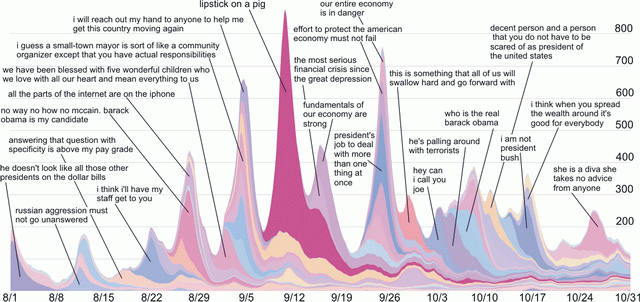
A new study examines the interplay of mainstream news outlets and blogs in forming the news cycle. One of its findings is that, as a report by Steve Lohr in today’s Times puts it, “For the most part, the traditional news outlets lead and the blogs follow, typically by 2.5 hours.”

This story won’t buck that trend. Lohr’s piece was posted online last night and my post here follows by about 10 hours or so. One reason for this is that I slept through the night. Another is that I decided to actually read the study before posting.

The study — Meme-tracking and the Dynamics of the News Cycle, by Jure Leskovec, Lars Backstron and Jon Kleinberg — is fascinating work; though I’m not qualified to assess its math, I found it careful and thoughtful in its approach to the subject. But before its core finding coalesces into a hardened soundbite — “pros beat bloggers by 2.5 hours!” — I want to offer some cautions and raise some red flags.

The most important caveat is that the study isn’t really tracking “news.” It looks at the propagation of specific quotations in news and blog coverage of the final three months of the 2008 election cycle. In other words, it’s tracking soundbite phrases — like “lipstick on a pig” and “palling around with terrorists.”

Such phrases are sometimes proxies for real news but most often they’re just part of the partisan slagfest. The memetracker study emphasizes the trivial at the expense of the substantive. In its world, if there’s no brief quotation that sums up a particular story, the story doesn’t exist.

Last fall, surely, the biggest story of all was the near-collapse of our financial system. In the study, this story is represented by a few phrases like “our entire economy is in danger” and “fundamentals of our economy are strong.” While these phrases are reasonable ways to track the language the candidates used to discuss the crisis, they don’t provide any hooks for understanding the extraordinary outpouring of explanation and analysis of an extremely complex story in both the mainstream media and the econo-blogosphere.

The researchers find that the news cycle is governed by two factors: “imitation” and “recency.” In other words, phrases rise in prominence because media and blogs copy one another, and fall as individual phrases age. This is a useful model, but it leaves no room for valuing originality in coverage. (No surprise, since it’s looking exclusively at quotations.) Both traditional news organizations and bloggers place great value on getting a story that no one else has, or expressing a point of view that can’t be found anywhere else. Most of us — bloggers and pro journalists alike — assume that originality drives attention. But the memetracking research is biased against originality, and it simply excludes material that doesn’t hang off the soundbite quotes of public figures, so it offers no help assessing whether we’re right in that assumption.

One of the central argument of my book Say Everything is that blogs have enhanced our culture by extending the width and depth of public dialogue. But the memetracker researchers’ focus on quoted phrases excludes such contributions.

As for that 2.5-hour lag: since the study focuses on quotations as a sort of genetic marker for ongoing news threads in election coverage, of course the traditional media are going to have the jump on bloggers. They’re following the politicians around with microphones and notebooks. The study did find that, 3.5 percent of the time, phrases are injected into the news cycle first by blogs and then picked up by traditional news outlets. It’s certainly possible that this pattern would be found to apply outside of election news, and with a wider set of stories than those defined by political quotations. But we don’t know that.

Another limitation of the study: It misses the interplay between both traditional media and blogs on the one hand, and the two other vast channels through which soundbites propagate, cable news outlets and social networks like Twitter and Facebook.

Finally, the study relies on Google News to draw a boundary between the news media and blogs. A site that appears in Google News is considered media; everything else is a blog. While this approach is convenient, it ends up slicing off some of the top layer of the blogosphere in arbitrary ways: for instance, Gawker and Daily Kos end up as “media” rather than blogs, but Talking Points Memo is a blog.

I think the study’s authors are being careful about not overreaching in their claims for their research. Kleinberg tells Lohr: “You can see this kind of research as further elevating the role of sound bites… But what we’re doing is more using them as the approximation for ideas and story lines… We don’t view quotes as the most important object, but algorithms can capture quotes.”

Nonetheless, I fully expect to see it taken as conventional wisdom from this point forward that “news starts with the traditional media and then moves into the blogosphere.” Perhaps the Memetracker folks can follow the phrase “2.5 hours” and show us exactly how that happens.

[You can find neat visualizations of the data from the study at a companion site, memetracker.org, from which I inserted the image at the top of this post.]

BONUS LINK: Chris Anderson outlines his research into the news cycle. Anderson took one story, followed it through the maze of coverage online and in print. It’s what he calls a “qualitative” approach to complement the Memetracker study’s quantitative work.

UPDATE/CORRECTION: I wrote above that Talking Points Memo would be considered a blog by the study because I couldn’t find any posts from it on Google News, but Zach Seward at Nieman Lab did (here). I’m further confused by the study’s description of the list of “early reporters” of many stories as being “blogs and independent media sites” including HotAir.com and Talking Points. This whole business of dividing the world between blogs and traditional media is, as Mark Glaser argues in the comments to Seward’s piece, increasingly difficult to pursue or defend.

Filed Under: Blogging, Media, Say Everything

“Images are not a representation of reality”

July 8, 2009 by Scott Rosenberg

Last Sunday the NY Times mag ran a photo feature on abandoned, half-built real estate projects — casualties of the big bust. The pictures were stunningly otherwordly — eerily lit, human-free canvases of financial devastation. Dayna, my wife, handed me the magazine and asked, “Are these computer generated?” They had, she added, an uncanny-valleyish feel.

The feature noted that photographer Edgar Martins “creates his images with long exposures but without digital manipulation.” Now it turns out the Times has removed the photos from its website and posted an embarrassing editor’s note admitting that the photos had been “digitally manipulated: “Most of the images,” the editors wanly declare, “did not wholly reflect the reality they purported to show.” It seems that, in some sort of misguided effort to create more pleasing images, Martins duplicated and then flipped portions of some photos to create a barely perceptible mirror image: a sort of fearful — but now, we know, bogus — symmetry.

As I read up on the controversy (here’s the original conversation on Metafilter that exposed the matter, here’s Simon Owens’ account of how that happened, and here’s some photographic detail) I had two thoughts: One, sounds like this photographer didn’t come clean to his editors, and that’s unprofessional and probably unforgivable. But, two: the images did not wholly reflect the reality they purported to show? Huh? Does any image? Can any image? Or article, or representation of any sort?

Before I get any more Borgesian on you, let me point you back to the interviews I did with the photographer and multimedia artist Pedro Meyer back in the early 90s — one from the San Francisco Examiner, and one from Wired. (Please note that the Wired piece got mangled somewhere between the magazine and the Web; the intro paragraph appears at the end.)

This, from the Examiner piece:

Pedro Meyer points to one of his photographs and says, “Tell me what’s been altered in this picture.”

The photo shows a huge wooden chair on a pedestal – a Brobdingnagian seat that looms over the buildings in the background with the displaced mystery of an Easter Island sculpture.

It’s difficult to say what’s going on here: A trompe l’oeil perspective trick? Or the product of digital special effects?

Meyer is a serious artist and philosopher of technology, but today he’s playing a little game of “what’s wrong with this picture?”… The truth about the chair photo is that it’s a “straight” image: It’s just a really big chair.

Meyer says he took the shot outside an old furniture factory in Washington, D.C. But the self-evidently transformed pictures that surround it in his exhibit – like that of a pint-sized old woman on a checkerboard table carrying a torch toward an angelic girl many times her size – call its accuracy into question. We stare and distrust our eyes.

So is Pedro Meyer, who started out as a traditional documentary photographer, out to subvert our faith in the photographic image, our notion that “pictures never lie”? You better believe it.

“I think it’s very important for people to realize that images are not a representation of reality,” Meyer says. “The sooner that myth is destroyed and buried, the better for society all around.”

[You can see that chair photo in the “Truths and Fictions” gallery available off this page — click through to screen 26.]

And this, from the Wired interview:

I’m not suggesting that a photograph cannot be trustworthy. But it isn’t trustworthy simply because it’s a picture. It is trustworthy if someone we trust made it.

You’re interviewing me right now, you’re taking notes and taping the conversation, and at the end you will sit down and edit. You won’t be able to put in everything we talked about: you’ll highlight some things over others. Somebody reading your piece in a critical sense will understand that your value judgments shape it. That’s perfectly legitimate. Turn it around: let me take a portrait of you, and suddenly people say, That’s the way he was.

We don’t trust words because they’re words, but we trust pictures because they’re pictures. That’s crazy. It’s our responsibility to investigate the truth, to approach images with care and caution.

After learning what Meyer was trying to teach me, I can’t get too huffy about Martins’ work. There is no sharp easy line between photos that are “manipulated” and those that aren’t; there is a spectrum of practice, and when a photo is cropped or artificially lit or color-adjusted or sharpened or filtered in any way it is already being manipulated, even if Photoshop is never employed. Martins’ pictures are beautiful and arresting, and if he’d simply told the world what he was up to, I don’t think anyone would be too upset.

Of course, if Martins had been forthright the Times would probably not have printed his work, because it has an institutional commitment to, I guess, attempt to “wholly reflect” reality. Somehow.

I don’t demand that of photographers or journalists or newspapers. I just ask them to tell me what they’re up to. As David Weinberger put it at the Personal Democracy Forum: “Transparency is the new objectivity.”

Filed Under: Culture, Media, Technology

Why people blog — and why journalists keep missing the point

July 8, 2009 by Scott Rosenberg

There is a shortsighted misunderstanding of the motivation of most bloggers that I keep encountering as I’m out there talking about Say Everything. The people asking me questions are naturally, for the most part, journalists; and as I write in the book, journalists as a class have a particularly hard time understanding why most people blog.

This jumped out at me as I read this passage in today’s Wall Street Journal review of Chris Anderson’s “Free,” which was written by Jeremy Philips, who is executive vice president of Rupert Murdoch’s News Corp., which owns the Journal along with vast tracts of the media landscape:

If you have a blog, “no matter how popular,” the revenue from AdSense — a Google service that places ads on Web sites — will probably never “pay you even minimum wage for the time you spend writing it.” Of course, that’s fine for bloggers more interested in fame or influence than in money or for blogs (like Mr. Anderson’s own) that are loss leaders for more lucrative endeavors, such as writing books or making speeches. But if you have to earn a living from the Web, “free” can be a problem.

Note the alternatives Philips offers: You might blog for money. You might blog for fame or influence or as a “loss leader” for your real business. But nowhere in his world is there room for the actual motivation that drives most bloggers: a desire to express themselves, to think out loud, to exult in the possibilities of writing in public — and learn from the pitfalls, too. Maybe there’s a payoff in enhancing your reputation, but there can also be a payoff in simply enhancing your experience at communicating your thoughts and ideas. Speaking to a big crowd is alluring but speaking even to a small group of friends is rewarding, too. For the great majority of participants, blogging is a social activity, not an aspiration to mass-media stardom.

It is very hard for journalists to understand this because the opportunity to express themselves in public has always been a part of their professional birthright. So they won’t notice that motivation even when it’s staring them in the face. When you point this out, you are almost always greeted with a sort of cynical sniff: You can’t be serious. But I am!

Filed Under: Blogging, Say Everything

Linked endnotes for Say Everything

July 8, 2009 by Scott Rosenberg

Now live on the Say Everything website: The book’s entire set of endnotes, all properly linked to their mostly URL-based sources.

When I started writing for the Web in 1994 I quickly understood that the ability to link directly to sources was a godsend for demonstrating the quality of your work. So when I returned to print to write Dreaming in Code, I was a little frustrated: endnotes are a valuable tradition, but when the bulk of the sources are on the Web, you wind up with a bunch of lengthy URL codes sitting there dead on the paper. So with that book I duplicated the endnotes on the book’s site. And I’ve now done that again.

I hope this will help those readers of the book who want to dig deeper into the source material. It will also give anyone who is on the fence about whether they’re interested in the book’s topics another way to explore its contents before buying.

Filed Under: Say Everything

Say Everything appearances and events

July 7, 2009 by Scott Rosenberg

Today Say Everything is officially on sale, available from your favorite bookseller.

Here’s some quick info about upcoming appearances in the Bay Area:

On July 16, at 7 p.m., I’ll be speaking at Books Inc., the Opera Plaza bookstore in downtown San Francisco.

On July 29, at 7:30 p.m. at the Hillside Club in Berkeley, I’ll be speaking at an event cosponsored by Berkeley Arts and Letters and the Berkeley CyberSalon. ($10, $5 students, members, at Brown Paper Tickets or the door if available.)

On Aug. 3, at 7 p.m., I’ll be presenting at Book Passage, Corte Madera, part of the Left Coast Writer’s Salon.

Also, I will be appearing in mediated form:

On July 16, at 7:30 a.m., on the KPFA Morning Show.

Say Everything comes to Second Life on Sunday, July 12, on Mitch Wagner’s Copper Robot show.

It’ll be great to see you at any of these!

Filed Under: Events, Say Everything

Two additional entrypoints to the story of blogging

July 5, 2009 by Scott Rosenberg

When I set out to chronicle the rise of blogging in book form, I knew there was no way my work could hope to be comprehensive. This story simply has too many strands and facets. The ones I chose to focus on are, I believe, among the most significant. But there are many other legitimate and valuable ways to approach the subject. Here are two examples.

(1) A couple days ago I finished reading Eric Boehlert’s new book, Bloggers on the Bus: How the Internet Changed Politics and the Press. Eric and I were colleagues at Salon for years, but I hadn’t known that he was working on this subject as I worked on Say Everything. When I ordered the book I worried a bit, as authors will, that there might be a lot of overlap between Boehlert’s account of the rise of the political blogosphere and my own.

It turns out the books are highly complementary. Say Everything uses the story of Josh Marshall’s evolution as a blogger-journalist as a thread to follow the larger tale of the rise of the political blogosphere, as blogging leaped from the tech world to the political realm in the aftermath of 9/11. Bloggers on the Bus is more of a group biography of the progressive blogging universe, concentrating on its role in the 2008 election cycle.

Boehlert’s book is full of vivid anecdotes and thoroughly reported portraits of bloggers on the left. I recommend it for anyone who wants a deeper understanding of how blogging and new-media organizing set the stage for Obama’s victory — as well as for readers of Say Everything who want a more detailed account of the people and events that shaped today’s blue-state blogging world.

(2) On Friday, thanks to Dave Winer’s post and tweet about it, I came across a new paper by Rudolf Ammann, a scholar in London who is studying the roots of blogging. Its title is “Jorn Barger, the NewsPage Network, and the Emergence of the Weblog Community,” and it’s an unusually thorough and careful attempt to exhume the details of the process by which the pre-Blogger-era blogosphere (circa first half of 1999) emerged from one of its roots– the users of Dave Winer’s NewsPage Suite software beginning in 1997. Ammann’s thesis is that the NewsPage users never really coalesced into a community until Jorn Barger, of Robot Wisdom WebLog fame, set out to organize them as such.

As befits a work of scholarship as opposed to popular journalism, Ammann’s paper pursues this subject far deeper into the weeds than I do in Say Everything. Where I focused my effort to understand Barger by reading his writing on artificial intelligence, Ammann spent his time digging into the Usenet archive of the alt.hypertext group, and came up with some good stuff.

I have a number of thoughts and comments on the paper that I’m going to reserve till I’ve had a chance to reread it carefully. But my initial take is that, as with Bloggers on the Bus, it provides a valuable complement to my book — filling in some details I left out and offering an alternative angle on some tales I did cover.

The history of blogging turns out to be an even bigger subject than I expected. It’s good to have company here!

Filed Under: Blogging, Say Everything

Say Everything: some initial coverage

July 3, 2009 by Scott Rosenberg

Say Everything’s official publication/on-sale-in-stores date is July 7, but it’s already received some great coverage I want to acknowledge and tip you off about:

  • While in New York I stopped by BusinessWeek for a chat with Steve Baker (whose book The Numerati is pretty fascinating). Here’s the video.
  • Steven Levy interviewed me in the July Wired:

    Wired: Here’s something I bet a lot of people ask: If blogs are so great, why did you have to write a book?

    Rosenberg: It’s an inevitable question, but it’s illogical. When Greil Marcus writes a book about Bob Dylan, do you say to him, “Why’d you write a book? You should have written a song.”

  • Paul Kedrosky, the super-sharp econoblogger (and an early pioneer of hosted blogging), wrote: “Rosenberg’s book is funny, authoritative, full of great-great stories and anecdotes, and admirably even-handed.”
  • At his Bloggasm site, Simon Owens interviewed me as a followup to the piece he did last year.
  • Rafe Colburn, who was blogging before we called it that, wrote two posts (first and second) with his reactions to the book: “It’s pretty clear to me that this book will be seen one day as incredibly important.”
  • And there was a lovely starred review in Kirkus Reviews that concluded: “Rosenberg suggests that blogging’s ‘outpouring of human expression’ should ‘delight us.’ This fair and fascinating account should delight as well.”

Filed Under: Say Everything

Every newspaper is a glass house

July 3, 2009 by Scott Rosenberg

The halls of professional journalism rang out with schadenfreude-fueled howls of derision this week at the Washington Post’s ludicrously misbegotten “salon” scheme. (Catch up with the story here if you’re out of the loop.) That the Post’s publisher would have even considered trying to turn her living room into a sort of influence-peddling bazaar has shocked, shocked everyone in its newsroom and most journalists outside.

Of course it was a bad idea. Arguably the Post did even more damage to its credibility in trying to explain itself than it did with the original concept — as for instance with the declaration that a beautifully designed and widely distributed flyer was a “draft.” (Surely the paper of Watergate record understands the old adage about the coverup being worse than the crime? Maybe not.)

But before the critiques gets too self-righteous, let’s recall that the blurring of editorial and business lines is happening everywhere. Magazine journalism is full of it. We will see even more of it as the business of print publishing continues to decay and publishers scramble for revenue. The Post’s “salons” aren’t the first instance of this kind of aggressive monetization of a journalistic reputation, and they won’t be the last. Because, alas, integrity doesn’t pay for health insurance. I say that with no glee, but rather as someone who fought countless similar battles over the years at Salon — mostly, I’m happy to say, winning ones — to keep the lines from blurring too far.

The Post’s hamfisted exercise in influence-peddling was a sitting duck the moment it became public. It’s the more obscure and fuzzy integrity questions that can be more dangerous to a publication’s credibility over time. I’m thinking of the questions that popped into my head as I read a recent New York Times profile of a society wife named Lisa Marie Falcone. About halfway into the piece, the writer informs us that Falcone is married to a man named Philip Falcone whose hedge fund “owns about 20 percent of The New York Times Company.” Whoa! (The story also tells us that Falcone became a billionaire by betting against subprime mortgages. So while the government was busy bailing out the financial firms that had made the stupid bets in the mortgage market, the cash went right into the pockets of the people who’d made the smart bets — presumably, the Falcones of the world.)

Is there any direct connection between Falcone’s stake in the Times and the article I read? Probably not — but who really knows? The piece’s problematic scent is unmistakable; you can’t help thinking that every word it uses to describe its subject — “wide-eyed idealism,” “quirky, independent” — had to have been agonized over. And that awareness on the reader’s part that something is off about the piece makes it unsatisfying and opaque. Whatever the story behind the story is, we’re not getting it.

The dance of awkward partial disclosure performed by journalists given the unenviable job of writing about their owners is even more painful to watch than the ritual self-lashings of an institution caught, as the Post was, in straightforward acts of corruption. I can’t help thinking that one remedy for both species of trust-eroding behavior is for newsrooms to get way more serious about transparency — which is a fancy way of saying they should be honest, forthright and open. Journalists have the opportunity to model for the rest of the world the behavior their work demands of others: tell the truth; don’t hide from questions; reveal your practices and processes; and if you screw up, tell all, fast.

The Times profile of Falcone concludes with this quote from her: “”I speak from my heart… I know that sometimes can get me in trouble. But that’s the only way I know how to be.” On the basis of the Times piece I actually think Falcone is hardly a paragon of “speaking from the heart.” But it would be nice if more journalists, editors and publishers understood how valuable “speaking from the heart” can be today. And if they did, we might pile on them a little less mercilessly on those occasions when they screw up.

Filed Under: Media

At Personal Democracy Forum

June 29, 2009 by Scott Rosenberg

I’m in NY attending the Personal Democracy Forum, an annual gathering where political geeks (from both ends of the partisan spectrum) meet geeky politicos. It’s got a great lineup of speakers and events.

I’m talking tomorrow on a panel titled “Why Blogging Still Matters,” with Dan Froomkin, whose recent unceremonious booting by the Washington Post has occasioned much justifiable outrage; Eric Boehlert, who’s got a new book out titled “The Bloggers on the Bus” tracing the impact of the Web on the 2008 election; and conservative blogger Jon Henke. It’s moderated by Ana Marie Cox and should be fun. I’ll link to coverage later.

Filed Under: Blogging, Events, Personal

Another Say Everything excerpt: Journalists vs. Bloggers

June 23, 2009 by Scott Rosenberg

Today: a second full-chapter excerpt from Say Everything for your consideration. This time, it’s Chapter Nine: Journalists vs. Bloggers. (Previously I’ve posted the introduction and Chapter One, the story of Justin Hall.)

I have been writing about the tormented relationship between journalists and bloggers for a decade. When I reached the part of Say Everything that involved chronicling this long relationship, part of me quailed: Oh, no — not again!

Then I started writing and everything came together: 10,000 words or so of my effort to wrangle this sprawling subject into a single narrative.

A side note: My reflex in naming the chapter was to write, “Bloggers vs. Journalists.” But after finishing it, I realized that over time, the preponderance of the aggression in this relationship has shifted. Once upon a time, certainly, you would find bloggers on the attack more frequently, and journalists simply going about their business. Today, I think, the situation is more frequently reversed. Thus the ordering of the title.

Filed Under: Blogging, Media, Say Everything

« Previous Page
Next Page »