MediaBugs, now in a WordPress plugin

Announcing the new MediaBugs plugin for WordPress. It’s for anyone who’s running a WordPress-based site that does journalism and wants readers to know that correcting errors is a priority.

Now adding a MediaBugs “report an error” button to any website that runs WordPress is a super-simple, 30-second process. If you know how to install a plugin, you can do it. (Alas, this will only work with self-hosted WordPress installations — or “WordPress.org” sites — and not with WordPress.com blogs, which don’t run plugins.)

We’ve had a MediaBugs widget that played nice with WordPress for some time now (it’s what I’ve been running here at Wordyard for some time now), but the plugin makes it much easier to add to your site — you don’t need to mess with your theme templates unless, you know, that’s something you enjoy. (Hey, some of us do!)
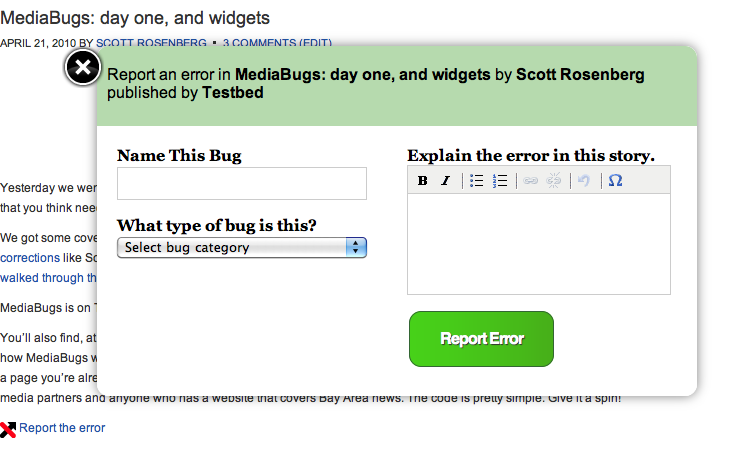
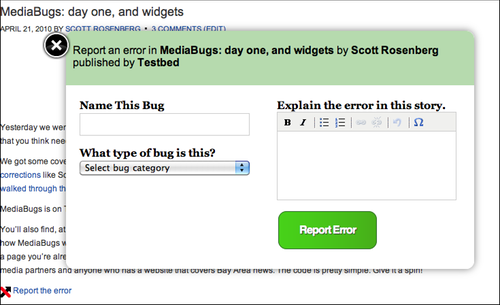
Here’s what the plugin does: It adds a link to the bottom of every post for users to report errors. The link is customizable — you can use text or an icon or both, and you can edit the text easily, too. When a user clicks on the link, the MediaBugs error-reporting form pops up as an overlay, with the page’s Web address and headline automatically filled in. When the user has filled out the form, the error report gets filed at MediaBugs. (Wanna see? Just click on the little “Report an Error” icon at the bottom of this post!)

If you install the plugin, you can also sign up at MediaBugs to receive an email or RSS notification each time someone reports an error on your WordPress site.

The MediaBugs plugin lives here in the WordPress.org plugin directory. Let us know if you install it — we want to know how it goes!

[Cross-posted from the MediaBugs blog]

Another misleading story reports that blogs ‘r’ dead

The technology press has been keen on the “blogging is dead” (or “dying”) meme for some time now, but it’s tough to find actual data or evidence supporting the notion. Blogging, of course, is changing; in the digital world, all is flux. But if you’re going to declare, as today’s New York Times headline does, that blogging is “waning,” it would be good to be able to show a decline in numbers. And that, sadly, is missing from the Times story — which cherry-picks statistics that look very different in their original contexts.

The peg for “Blogging Wanes as the Young Drift to Sites Like Twitter” is a study (here’s the summary) from Feb. 2010 — more than a year ago. The study showed that the number of kids ages 12-17 who are blogging dropped in half from 2006 to 2009 (14 percent report blogging, from 28 percent). The same study showed that the percentage of adults 30 and older who blog rose from 7 to 11 during the same period. Meanwhile, a more recent Pew study, the Times reports, finds that “Among 18-to-33-year-olds…blogging dropped two percentage points in 2010 from two years earlier.”

But if you actually look at that report, you find that, overall, blogging is still growing, not waning at all:

Few of the activities covered in this report have decreased in popularity for any age group, with the notable exception of blogging. Only half as many online teens work on their own blog as did in 2006, and Millennial generation adults ages 18-33 have also seen a modest decline—a development that may be related to the quickly-growing popularity of social network sites. At the same time, however, blogging’s popularity increased among most older generations, and as a result the rate of blogging for all online adults rose slightly overall from 11% in late 2008 to 14% in 2010.

Fourteen percent of online adults are making some effort to write regularly in public! That remains a phenomenal fact; if you’d predicted it a decade ago, as only a handful of visionaries did, you’d have been dismissed as a nut (or maybe a “cyber-utopian”).

So the actual story — which, to be fair, the Times’ article mostly hews to (it’s the headline and lead that skew it more sensationally) — is that blogging keeps growing, but it’s losing popularity among teens.

Social networking is changing blogging. (My postscript to the paperback edition of Say Everything addresses those changes at length.) More of us are using Facebook and Twitter for casual sharing and personal updates. That has helped clarify the place of blogging as the medium for personal writing of a more substantial nature. Keeping a blog is more work than posting to Facebook and Twitter. So I wouldn’t be surprised if, long-term, the percentage of the population blogging plateaus or even declines.

Maybe we’ll end up with roughly ten percent of the online population (Pew’s consistent finding) keeping a blog. As the online population becomes closer to universal, that is an extraordinary thing: One in ten people writing in public. Our civilization has never seen anything like it.

So you can keep your “waning” headlines, and I’ll keep my amazement and enthusiasm.

BONUS LINKS: WordPress founder Matt Mullenweg addresses the story:

At some point you’ll have more to say than fits in 140 characters, is too important to put in Facebook’s generic chrome, or you’ve matured to the point you want more flexibility and control around your words and ideas.

And Anthony DeRosa points out that Twitter isn’t very popular among the teen set either.

The road to Web serfdom: Huffington’s free-as-in-beer posts vs. the free-as-in-speech Web

When you post to Facebook, are you a “serf”? When you write a blog post for a site that doesn’t pay you, are you a “galley slave”?

These are terms that journalists at the New York Times and the Los Angeles Times have recently applied to the content users contribute to various Web sites and services.

The LA Times’ Tim Rutten writes of the business model of the Huffington Post, “You need to picture a galley rowed by slaves and commanded by pirates.”

In the New York Times, David Carr’s column headlined “At Media Companies, a Nation of Serfs” chronicles a Web of companies worth millions and billions — Facebook, Google, Twitter, Quora, Tumblr and, again, Huffington — and notes, “The funny thing about all these frothy millions and billions piling up? Most of the value was created by people working free.”

I resisted the urge to jump on Carr’s column because, though its confused thinking induced much head-scratching, it also contained a lot of sense. Having heard Carr reinforce some of the confusion in a brief NPR Morning Edition spot today, I think I better just say this:

As we talk about the plight of journalists trying to earn a living in a rapidly evolving digital marketplace that has devalued each individual contribution and untied the product bundle that till recently paid the media bills, we need to distinguish between the plight of the journalist in a glutted market and the concerns of the citizen seeking a free voice.

Publishing a blog post at Huffington Post for no pay is nothing like being a galley slave. No whips! No chains! It’s voluntary (as Anna Tarkov argues). You get to sit at home and type out your ideas and get a bunch of people to read them. You may well feel shafted when you realize that Huffington & co. just walked off with $300 million in AOL cash and you didn’t get a cent, but nobody made you give Arianna your words for nothing. Presumably, you gave them because you thought her site was a good place to spread your ideas or your reputation, sell your books or bring some visitors to your own site. (Stowe Boyd looks at the non-financial incentives.)

Maybe you’ll rethink that bargain now. If large numbers of people do, then Huffington and her investors may have just played AOL’s Tim Armstrong for a sucker. (Although, by Nate Silver’s calculations, most of the value and traffic on HuffPo derives from the content produced by paid staffers.) Maybe it would have been smart for Huffington to share some of her plunder with her unpaid contributors (as Dan Gillmor and others have urged); it would have been fair, certainly. But my hunch is the HuffPo bloggers aren’t going to stop writing for free. Most of them like the bargain.

There is a reasonable argument to be made about “serfdom” online, but it doesn’t have anything to do with Huffington’s paycheck-less bloggers. It has even less to do with Google’s search engine, which draws its intelligence from the links we all embed in our Web pages. One problem with Carr’s column is that he conflates all these different services and — like so many content-obsessed journalists — ignores the contributions of the platform-builders and their technology. At Google, as at many of the companies Carr lists, there’s enormous value created by paid employees — but they’re writing code instead of copy.

The aspect of the idea of digital “serfdom” that makes sense has little to do with getting a paycheck for your writing; it’s about control of the platform that delivers your writing and ownership of any (typically meager) fruits from that labor. It’s why many people, like me, choose to buy their own domain name and run their own blog software rather than use one of the free-but-corporate-owned alternatives. It doesn’t take much to have your own fief these days.

Interestingly, this is the point made by the writer from whom Carr borrows the feudal analogy — Reuters’ Anthony DeRosa:

In a perfect world, we wouldn’t have any of these platforms. In a perfect world everyone would have their own piece of the web that they own entirely. … Those tech savvy enough to rent out rackspace, install their own web server and plop down their virtual piece of land on the web control and capitalize on all of the content that they deliver there.

However for most of the people on the web today, this isn’t the case. We live in a world of Digital Feudalism. The land many live on is owned by someone else, be it Facebook or Twitter or Tumblr, or some other service that offers up free land and the content provided by the renter of that land essentially becomes owned by the platform that owns the land.

(I would just add that to emancipate yourself, you don’t need to rent out rackspace and manage your own server; all you need to do is know how to FTP and pay a few bucks a month to an ISP and a domain registrar.)

The argument about “digital labor” is real and valuable and has been unfolding for some time now in the academic wing of the new-media studies world. It’s what Dave Winer has recently been writing a lot about, as he urges us to find an alternative to Twitter and Facebook that we own ourselves.

Professional journalists worried about their salaries in a world awash in posts and “content” have one set of problems; the much larger population of social-media users who ought to be thinking hard about who controls their contributions have a different one. I wish Carr had done a better job of distinguishing between these different realms rather than lumping them together in one big morass of “people working for free.”

As they say in open-source land, there’s free as in “beer” and free as in “speech” — “gratis” versus “libre.” People aren’t going to stop writing “gratis” for Huffington and her ilk, and that will continue to lower the market price of all but the most specialized and rarefied kinds of old-fashioned journalism. Of course this doesn’t make me happy as a writer, but I’m not going to pretend it will stop. For that very reason, those of us who care about our words will need to pay greater attention to the “libre” side of the freedom ledger, and pitch our posts on ground that we own or control.

There are other good posts on this theme from Michele McLellan at the Knight Digital Media Center:

Fretting about unpaid contributors is just another way of grieving journalism’s past. They’re here. They’re on social media. They’re talking. They’re writing. Get over it, journalists, and use the energy to figure out innovative ways to add the unique value of the journalist to the mix.

And Mathew Ingram at GigaOm:

The funny thing about online content, as former eHow owner Josh Hannah noted in contrasting Demand Media’s paid content-farm model with that of free sites like WikiHow, is that you often get better quality content when people write for nothing than you do when you pay them tiny sums of money, as Demand does. In other words, some people are more than willing to write for the recognition and reputation value and sheer passion (or other intangibles) rather than for money. And there will always be media entities like The Huffington Post that take advantage of that.

The Daily vanishes into the memory hole

The Daily blog crowed about their three, count ‘em, three different news covers yesterday tracking the fast-metamorphosing Egypt story. And they got some props for it from folks like PaidContent’s Stacy Kramer. Today, they’re proudly showing how they display a breaking-news ticker on their cover.

They’re working fast over there at News Corp., cranking out the New York Post-style headlines (“Gypt,” get it?). And that’s just great. It means that the Daily’s staff is rapidly ascending the same learning curve that the creators of the first wave of Web news sites experienced 15 years ago as they realized that a daily news cycle for any Internet-based operation was hopelessly rigid and slow. Their only problem is that they’ve baked the cycle into their brand name. Whoops.

What I’m wondering now is, what happens to all the cleverness of those cover headlines — and any other content that the Daily updates? How do you access the record of the past as recorded in the present by the Daily’s writers and editors? It’s not clear that the shareable, Web-based content pages have any permanence. On the 1.0 iPad app (I haven’t downloaded the update yet), there’s no apparent way to access past content that you haven’t chosen to save.

Right now, the Daily seems to be simply throwing away its archive. You pay for it, you read it and then the next day you can’t get it back. What will Heather Havrilesky, or any other Daily writer, do when they want to review their clips a year from now? What will anyone do when they want to go back and see what Havrilesky said about their favorite TV show?

This looks like just another way in which the Daily, even as it’s asking for your subscription dollars, seems to offer you less than standard, free news websites — which figured out a decade ago how to archive and preserve their back catalog.

It’s not as if the Web has solved every problem: I’ve been arguing for a long time now that news sites ought to be preserving every version of a story as it gets updated over time. I think the Web will gradually move to this “track-changes” method of preserving history, but plainly it’s going to take time. Still, it’s a shame to see the tablet universe start again from scratch.

Do we have to reset the learning clock at zero each time we move to a new platform?

Washington Post gets the report-an-error-button religion

Beginning Monday, every new staff-written article on the Washington Post’s website came with a prominent link labeled “YOUR FEEDBACK: Corrections, suggestions?” One click takes the reader to a form for reporting errors or providing other feedback to the newsroom.

This makes the Post the first major U.S. news outlet to heed the call that MediaBugs, Craig Silverman and I made with the Report an Error Alliance, urging news sites to make this sort of link a standard feature, like the now-ubiquitous “share” and “print” links.

Actually, Post managing editor Raju Narisetti explained in an email that the new corrections link has been long planned as part of a broader content-management system upgrade. Conversations about corrections practices at NewsFoo, a digital news conference organized by O’Reilly in December (both Narisetti and I were there, along with Greg Linch, who recently joined the Post as a web producer), triggered more internal discussions at the Post.

When the software upgrade’s January launch got delayed, the Post decided to move forward with a pilot of the report-an-error feature sooner, using a Google Docs form to collect readers’ input. As Josh Young pointed out, this sort of nimble, “grab whatever tool’s handy” web development is typical at startups but less common at large media companies.

The newspaper recently took heat from departing ombudsman Andrew Alexander, who wrote that the paper had “become riddled with typos, grammatical mistakes and intolerable ‘small’ factual errors that erode credibility.”

In the Post’s blog post announcing the new feature, Narisetti said, “It addresses a chronic complaint that we don’t make it easy for our online audiences to engage with us on stories, whether it is about factual issues or other ways to get us to meet their needs.”

The Post is hardly the only major news outlet to hear this complaint. Our MediaBugs survey of correction practices across U.S. news sites chronicled a widespread pattern of obscurity and inaccessibility in this realm.

But don’t news sites have comments? And can’t readers just post there about errors?

In theory, yes. But in practice, on most news sites, the freewheeling debates and endless digressions of comment forums provide an inefficient channel for the public to get reporters’ and editors’ attention about mistakes and problems in stories. The urgent signal that “you got something wrong” gets buried in the noise.

A dedicated channel for corrections reports and substantive complaints can be a labor-saving device for newsroom managers — a means to solicit priceless intelligence from the readers who, collectively, as Dan Gillmor famously says, know more than any individual journalist does.

I asked Narisetti about reactions inside the Post and from the public.

“The newsroom response so far has been good,” Narisetti replied, “in the sense it helps streamline what was an ad hoc process online even as we have very evolved policies on this in print.” After one day, he said, the paper had received “about six” submissions; two were about points of fact, and one has already led to a correction.

“It’s early so premature to judge,” Narisetti added, “but the real goal is to make it easy for our audiences to engage with us.”

That’s a goal worth setting and working on. What media executives call “engagement” is closely related to what other companies call “customer service.” Whatever you call it, journalists aren’t always comfortable with it, but newsrooms desperately need more of it, and the Post deserves hearty applause for pursuing it.

Here are some suggestions for the Post to consider as it reviews this project and its practices evolve:

Use an icon. The Post places its “YOUR FEEDBACK” link fairly prominently, in a right-column inset. But it’s all text, and the reader’s fast-scanning eye doesn’t always locate it on first pass. (Several people who read an early mention of the feature on Twitter mentioned that they couldn’t find it on the page.) Some sort of icon or image would really help. The Report an Error Alliance has proposed one icon as a standard (it’s right at the bottom of this post!), and there’s an advantage to providing an image that users can recognize across many sites (like the RSS-feed icon). But we also know that most sites are picky about the look and feel of icons, and really, any icon is better than none.

Make the form even easier to use. For instance, right now the form requires the user to input the web address (URL) of the story page by hand. In the final version of the feature, I hope the Post will automatically fill in the URL when the reader clicks on the feedback link from a story. Each step that you can streamline for the user is worth taking.

Coordinate the new feedback loop with the old one. The Post site, like many newspaper sites, still displays a kind of split personality between the corrections policies and practices on the print side and those of the online newsroom. For instance, the “corrections” link at the bottom of every Post page points to a list of recent corrections and a block of instructions that appear to relate mostly to the print product. This gets confusing to readers, who don’t understand the organizational divisions behind such disconnections — and shouldn’t have to.

Make the whole process public. The ultimate purpose for a newsroom to open an error-reporting channel is to restore public trust in the process of verification underlying the news report. To earn maximum trust, the channel ought to be transparent: It should be clear to the public whether the news organization is responding appropriately to reasonable feedback. Placing those responses out in the open, in turn, can help defend the newsroom when it becomes the target of unfair or irresponsible critics. Such transparency creates a kind of bedrock of trust, and it’s one of the motivating principles behind MediaBugs. Whether a news organization partners with a neutral organization like ours or prefers to handle the process by itself, conducting the exchange openly keeps everyone more honest.

We know this all requires some new thinking, and maybe even a leap of faith, for many editors. It isn’t going to happen overnight. But we’re convinced it’s the future.

This post originally appeared on the PBS MediaShift IdeaLab blog.

Huffington is to AOL as AOL was to Time Warner

A late Sunday night in winter and the surprise announcement of a big merger, with Kara Swisher one of the key people breaking the news: No wonder the Huffington Post/AOL announcement last night gave veteran tech and media-biz reporters a flashback to 2000 and the colossally ill-fated AOL/Time-Warner deal.

The events are similar in another way: despite all the CEO happy-talk about synergy, we are once again watching two companies in trouble taking a big gamble that the other will solve its problems.

People think of Huffington Post as the leading popular liberal-Democratic news site. Huffington is now at least suggesting that the progressive point of view isn’t a part of what she’ll be pursuing at AOL. “Ms. Huffington said her politics would have no bearing on how she ran the new business,” says the NY Times story. Really? This strikes me as strange, disingenuous, and about as credible as Roger Ailes claiming that Fox is not a partisan-driven institution.

One possibility is, Huffington is just saying what the corporate script requires and actually the plan is to position AOL as a sort of Democratic alternative to Fox News/Drudge — which I think would be a really interesting move. I have to assume Arianna has big TV ambitions; I have yet to meet a new-media empire builder who didn’t secretly yearn to do an Ailes (or an Oprah).

The other, more likely possibility is that this whole thing is about the money, the investors needed to cash out, HuffPo’s numbers weren’t looking good enough for an IPO, and Huffington is basically improvising. She’ll spend a couple years at AOL and then move on. This means that, in 2011, Huffington Post will be playing the same role in relation to AOL that AOL played in relation to Time Warner back in 2000: selling itself at the top of a market bubble, pocketing the profit from a sale that couldn’t be earned from customers, and leaving a bigger, older company with all the headaches.

I was one of the few outspoken skeptics of Time Warner/AOL back in 2000. This time around there are more — see Om Malik, who looks at some numbers; Dan Lyons, who’s funny; and Ken Auletta, who views the deal as AOL CEO Tim Armstrong’s “hail Mary pass.”

Having all this company in doubt gives me a little pause. Maybe Huffington and Armstrong will prove a great team: the queen of low-cost SEO-driven content paired with the guy who built the Google ad machine that made SEO-driven content pay. But I still think this union is unlikely to end well. AOL remains a generic blandness factory when it comes to journalism. Huffington’s brand could change that; far more likely, it will just dissolve into the corporate miasma.

Murdoch’s Daily: post-Web innovation or CD-ROM flashback?

A decade ago, if you were a “digital” person — if you were interested in how computer technology was changing our culture and economy — then you were a Web person. The Web, built on top of the Internet and ultimately eclipsing its source, dispatched its competitors — the closed online services, the packaged-goods multimedia/CD-ROM industry — and became, for a time, the single face of the digital revolution.

This week’s launch of Rupert Murdoch’s iPad “newspaper,” the Daily, is a milestone: It’s the first significant attempt, since the Web conquered the digital world in 1995, to create a major new media product that embraces technology yet spurns the Web — and the public Internet, too. Chris Anderson’s Wired “Web is Dead” package was the warning shot for this phenomenon, but the Daily’s introduction puts it in front of us in palpable touch-screen form. It boldly declares: We’re digital people but we’re not Web people.

Why do I say that the Daily spurns the Web and the Net? I mean, beyond the obvious reason that there is no Web site that offers its contents in a convenient form each day. It’s not just that. The Daily also contains no links. (Some today see this as a plus; I do not.) There are no RSS feeds. No email addresses to contact the writers and editors. No email alerts or mailing list. Comments on the articles, yes, but not reachable through the Web. No, archives, back issue index, or search! (They’re on Twitter, however. They have a blog, too, and it’s not bad.)

In other words, most of the apparatus of two-way communication that every serious digital publishing venture of the past 15 years has taken as a given is missing from the Daily. They’re serious about this iPad-only thing! But they don’t seem to realize that they’re repeating the mistakes of the very recent past.

The Daily’s designers are eager to show off sparkling graphics, integrated video, and the swipe-ability that the iPad allows. Unfortunately, they are defining “interactivity” the way the lost pioneers of the 1994-era CD-ROM “multimedia revolution” defined it. They have built a gleaming but limited set of interfaces for users to interact with static, prepackaged content. The Web taught us that true interactivity was the interaction between people moderated by the network — along with the personalization you could build into the network based on those people’s behavior.

The Daily’s one concession to today’s Web is the mechanisms it provides for its readers to share individual stories via the usual routes — Facebook, Twitter, email. The recipient of your share notice receives a link to a URL that’s a Web-page version of the Daily article. We don’t know how long these web addresses will be good for. But for the moment, at least, it’s pretty easy to assemble a set of links that points you to the Web-accessible versions of each article in the day’s Daily edition. That’s what Andy Baio has done.

How long will Baio’s index last? Will it still be easy to assemble after the Daily’s first-two-weeks-free period ends? Will the News Corp. folks ask him to take it down? We’ll have to wait and see.

The question is whether the Daily’s secession from the Web is a matter of convenience or ideology for its creators. Did they put their energy into spiffing things up for the iPad — the hard, fun, innovative part — figuring that they can circle back to beef up their Web offerings later? Or do they feel that it is their calling, their mission, to leave the Web behind?

My prediction: If they’re pragmatists about the Web, they’ve got a chance — they can adapt and evolve their product so it’s a little more up to date, less hermetic and more inclusive of the public that lives online today. But if they’re ideologues — if they really believe that what is essentially a magazine “pasted on a screen” is the future of journalism — then they’re in deep trouble, and the Daily will only be Murdoch’s latest and most spectacular digital money-sink.