
Wordyard

Hand-forged posts since 2002

Archives

About

Greatest hits

Fallows on Iraq

October 6, 2006 by Scott Rosenberg

We’d sent James Fallows my book because I knew he’d had a longstanding interest in software — how it’s created and how creative people use it — and so I figured there was a chance he’d enjoy it. I’d chatted briefly with him when he interviewed me last spring for an article he was writing about Chandler. But I’d never met him in person.

So when I learned that he was scheduled for a book-tour stop right here in Berkeley today, on the publication of his new Blind Into Baghdad, I rolled myself down the hill to the UC Journalism School for his packed lunchtime talk on Iraq.

If any American journalist has a right to shout “I told you so!” about everything that’s gone wrong in Iraq, it’s Fallows: his Nov. 2002 Atlantic piece, “The 51st State,” foretold the endless difficulties the U.S. would face in the wake of a successful assault on Saddam Hussein’s regime.

Shouting isn’t Fallows’ style. Instead he spoke forcefully and thoughtfully for 45 minutes. He argued that, right now, there are simply no good alternatives or “right” choices for the U.S., just varying degrees of bad options. The Democrats, he said, shouldn’t fall into the trap of offering specific proposals about what to do to fix things. Instead, they should point to the upcoming elections as a simple moment of accountability — a chance to offer a vote of no confidence in a president who says “stay the course!” and a vice president who says he’d do everything “exactly the same” if he had another chance. Then, if Democrats succeed in winning any share of power, they’ll need to devise an “adaptive” policy, since no one can predict how events will unfold.

Asked about how future historians will view the Bush administration, Fallows pointed to 2002 as a pivotal year, in which the nation started with a budget surplus, considerable national unity and unprecedented global support. Where did it all go? Why did Bush throw so much down the Iraq hole? Ten days after 9/11 the president delivered a great speech — then he did nothing in the months that followed to summon national resolve, develop an energy policy or express a broader strategy.

Questioned about the prospect of military action against Iran, Fallows said an attack would be “the most reckless military action in my lifetime. And I don’t think it’s going to happen.” The U.S. military is “100 percent” opposed, he said. He guessed that the Bush administration’s hints and leaks about possible military moves against Iran were part of a “crazy man negotiating strategy.”

This gave me a flashback to fall of 2002, when I’d returned to my high school alma mater for the celebration of its newspaper‘s centennial, and hosted an alumni panel of journalists and political insiders discussing the prospect of an invasion of Iraq.

The consensus of the panel — Robert Caro, Marc Fisher, Mark Penn, and Nicholas Horrock — was that the Bush administration was unlikely to deliver on its threats to invade Saddam’s Iraq. The sabre-rattling was a negotiating tactic — a big game of chicken.

Oops. That was one inaccurate consensus — composed, I imagine, of part wishful thinking and part underestimation of the Bush administration’s recklessness. I dearly hope Fallows’s guess on Iran isn’t rooted in a similar thought-mix.
[tags]James Fallows, Iraq, Iran, Blind into Baghdad[/tags]

Filed Under: Media, Personal, Politics

Fallows on Dreaming in Code

October 6, 2006 by Scott Rosenberg

In his technology column in the new Atlantic, James Fallows had some extremely nice things to say about my book. In a sidebar to a piece that reviews lots of different information-organizer programs, he names Dreaming in Code as “this month’s tech-literature pick”:

The book is the first true successor to Tracy Kidder’s Soul of a New Machine, and is written with a combination of technical sophistication and narrative skill not seen in many years. Read it to understand what all these software wizards actually do.

I’m grateful for the advance enthusiasm. (The book won’t be in stores till January, but there’s always Amazon pre-order…) To be associated favorably with The Soul of a New Machine in the pages of the magazine that served as its author’s home is an honor. I hope I can live up to it!

I’ve always been a little cautious about connecting Dreaming in Code with The Soul of a New Machine. Kidder’s book is a non-fiction classic that I’ve always admired. But the comparison sets a high bar and raises expectations to daunting levels. If people end up feeling that my book is one-quarter as good as Soul of a New Machine, I’ll take it as a compliment.

Kidder’s book — exactly a quarter century old this year — introduced a whole generation to the romance and the nightmare of building computers. It didn’t matter that he was writing about refrigerator-sized minicomputers just as the IBM PC was bringing the “microcomputer” into the spotlight and ushering in the computer-on-every-desk era. The book’s great achievement was its glimpse into the world of Route 128 engineers and managers — the intense, focused way they lived their work and worked their minds.

That world has become a widely familiar one in our era of “knowledge work” and startup-company culture. The opportunity for a writer today lies not in exploring this realm for the first time, but instead in trying to fathom some of its enduring mysteries. I’ve always been fascinated by the minds and work of programmers, and I wanted my book to tell a story that would capture some of their pleasures and terrors — and tell us something about why, 50 years into the computer era and 25 since The Soul of a New Machine came out, writing the software that runs our world remains a singularly unpredictable undertaking.
[tags]james fallows, dreaming in code[/tags]

Filed Under: Dreaming in Code

Foley: With so much mud flying, it’s hard to think clearly

October 5, 2006 by Scott Rosenberg

The Foley scandal has reached that point of implosion where the endangered pols are flinging anything and everything against the wall, praying that something will stick. So before the air becomes completely unbreathable, let’s just lay out a handful of principles that should be obvious to anyone who’s been paying attention:

(1) This isn’t about homosexuality, or, for that matter, homophobia. Certainly, the fact that Foley’s sexual come-ons were directed at teenage males rather than females grosses out some Republican leaders, along with most of their “base.” But this scandal’s offenses would be identical whether Foley was hitting on male or female pages. This story is about abuse of the power of office, betrayal of the responsibility not to take advantage of young people who are under your protection, and a party that placed protecting its majority over protecting those kids.

Which is why (2) “Blame the liberals!” is a non-starter. There is no logic to the right-wing diagnosis that Foley’s disgrace is a byproduct of liberal permissiveness and support for notions like gay marriage. (See David Brooks’s bizarre argument that “expressive individualism,” not political self-interest, is the root problem here.) Foley is a conservative Republican leader who wrote laws to protect minors from predators, remember? If making passes at pages is the inevitable end-result of support for gay rights, surely Foley would have had to wait in line for his fun behind a long list of jailbait-hunting liberal congresspeople. The only way this bizarre argument makes sense is if you believe that, beneath the surface, basically anyone who’s gay is itching to molest teenagers. Come to think of it, maybe this argument will make some headway with “the base.”

(3) It’s just like Monica? No. Why this story is different: (A) Monica wasn’t underage. (B) She was over the age of consent. (C) Did we say she was not a minor?

(4) Why it is similar to Monica: The disgraced politician(s) failed to tell the truth.

(5) Why it’s really different from Monica: The hypocrisy factor. Bill Clinton disgraced himself with his intern scandal, but the nation that ultimately forgave him understood that he’d lied about a stupid and weak mistake that really had nothing to do with the policies and ideas he stood for. Foley was a member of a GOP leadership whose party’s idea of “family values” excludes gays and which drums up votes by “tougher on pederasts than thou” positions. So his personal lapse not only harmed the kids he hit on; it made a mockery of his, and his party’s, policies.

(6) There’s no vast left-wing conspiracy here. How could there be? Dennis Hastert has echoed some of the nuttier right-wing sites in complaining that the whole Foley affair is somehow a late-election-cycle dirty trick — that it’s all the Democrats’ fault, that Democrats knew about this all along but waited till they could do maximum harm to engineer a scandal.

This notion evaporates on first contact with fact: When the page oversight committee chair heard about the complaint that started this scandal, he failed to notify the committee’s one Democratic member. And ABC’s original source for the story was no Clinton operative; it was a Republican who stepped forward. This whole saga is about information moving — or not moving — among Republicans. The whole point of the scandal is that some Republicans knew about Foley’s problem for years, and the GOP leadership failed to investigate or take action. Far better to hold onto a precious seat. They played dumb, and now they’re trying to play dirty, instead of clearing the air.
[tags]Mark Foley, Denis Hastert, David Brooks, Bill Clinton, Monica Lewinsky[/tags]

Filed Under: Politics

October surprise watch

October 4, 2006 by Scott Rosenberg

As Josh Marshall has pointed out, the GOP argument that the Foley scandal is somehow all a political setup or dirty trick of some kind doesn’t make much sense:

Is this really a winning argument or is it, as it seems to me, a sign that the House GOP leadership is currently exploring the outer reaches of the galaxy of desperation?

I mean, is it a diabolical plot to reveal that one of members of the House leadership (Foley was a deputy whip) spent the last decade hitting on teenage pages and passed the time between votes having cybersex with them?

Is he like a plant? A pervy Manchurian candidate hived into the 1994 Republican Revolution by the Dems?

Foley’s downfall was no October surprise. But now that it is crowding the headlines and threatening to deep-six Republican hopes to hold onto Congress, I’ve set my timer. I’m just not going to be too surprised if some time in the next few days we wake up to read one of the following:

  • Terror alert level raised (only to be lowered after the polls close)
  • Justice Department nabs group of plotters in Florida/upstate New York/North Dakota (later we learn that they’re just doofuses who fell for an FBI sting)
  • Osama bin Laden captured at last!

In other words, October still has a long way to go, and the party in power has the October surprise controls, so — look out. As it is, we’ve already got Hastert arguing that if he loses his job over this, it’s a win for the terrorists. Anything is possible in the dying days of a corrupt regime (alas, we’re only talking about the GOP Congressional regime — the Bush administration is likely to be thrashing in lame duck-ness for two more years no matter what).
[tags]bush, october surprise, mark foley[/tags]

Filed Under: Politics

Free books to Code Reads contributors

October 3, 2006 by Scott Rosenberg

OK, the response to my invitation to a discussion of The Mythical Man-Month hasn’t been…overwhelming.

Maybe nobody’s read the book. Or those that have done so have nothing to say about it. Or I said too much myself and nobody felt like adding anything. Or everyone’s too busy wondering when Denny Hastert’s going to quit. Or everyone’s too busy writing code to actually stop and think much about writing code. Or everyone’s too busy, period. Or I just haven’t gotten that Slashdot or Digg link yet.

I’m not worried — I figured this Code Reads thing would take time to get rolling.

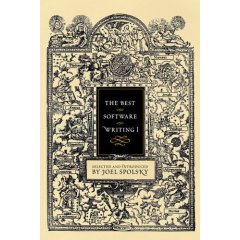
But I do have a little incentive to offer: Thanks to the kindness of Gary Cornell, the publisher of APress, I’ve got five copies of Joel Spolsky’s excellent The Best Software Writing I to give away to Code Reads participants.

This great collection has 300 pages of entertaining and incisive writing by people like Clay Shirky, Eric Sink, Michael “Rands” Lopp, Paul Ford, Paul Graham, John Gruber, Cory Doctorow, Adam Bosworth, Raymond Chen, danah boyd, Aaron Swartz and many others. Each one of these pieces is worth a discussion in its own right. (Spolsky’s introduction and the full contents list is here.)

I’ll award these books at my discretion to contributors of value — substantive or simply diverting — to Code Reads discussions.

If The Mythical Man-Month didn’t ring your bell, next Monday I’ll be posting something about Edsger Dijkstra’s famous 1968 paper, “Go To Statement Considered Harmful.” Among other things, it has the virtue of being about 1/100th the length of The Mythical Man-Month.
[tags]code reads, best software writing, mythical man month, go to statement considered harmful[/tags]

Filed Under: Code Reads, Software

Code Reads #1: The Mythical Man-Month

October 2, 2006 by Scott Rosenberg

Code ReadsThis is the inaugural edition of Code Reads, a weekly discussion of some of the central essays, documents and texts in the history of software. This week we’re talking about Frederick Brooks’s The Mythical Man-Month. (OK, let’s be honest: I’m talking about it. I’m hoping you, or you, or you, may want to, as well! If you don’t want to read my essay, you can just go straight to the comments and post something.)

Frederick Brooks’s The Mythical Man-Month came out in 1975, and I first heard its title later that decade. I’d already been a teenage programmer of sorts (of games in BASIC) for a few years, but I knew nothing of the world of large software projects that Brooks’ work addressed. I did know that the phrase “mythical man-month” grabbed my interest. It sounded less like the management-science term it was, more like a description of some prehistoric beast, heaving itself out of the primordial swamp to lumber across a desolate landscape.

Transmuting dry corporate-speak into evocative imagery? That was some trick.

The Mythical Man-MonthWhen I finally did read Brooks’s book, more than two decades later, there, on its cover, were those beasts — struggling to pull their limbs free of the tar pit that served as Brooks’s starting metaphor for the awful dilemmas of software-project scheduling. By that time, I’d become more familiar with the sort of work Brooks’s book addressed. I’d knocked my head more than once against the wall of software development. And I found, as so many readers had before me, that this quarter-century old book anticipated and analyzed most of the problems I’d encountered — and even offered some useful advice on how to avoid them.
[Read more…]

Filed Under: Code Reads, Software

Mark Foley: “Measure for Measure,” 2006 edition

September 29, 2006 by Scott Rosenberg

The saga of now-former congressman Mark Foley has evolved in less than a day from a tawdry scandal confined to a single Florida district into something considerably more consequential.

For those who haven’t been haunting the blogs (Talking Points Memo has been keeping tabs through the night), the deal seems to be this: the Republican House leadership knew last year that Foley had been engaging in salacious IM sessions and emails with underage House pages. The Republican House leadership did not investigate. The Republican House leadership did not, apparently, do anything.

The fact that takes this sorry tale of individual misbehavior and political fumbles and elevates it to a grander level of political melodrama is this: Foley wasn’t just your average conservative congressman; he was one of the leaders of the GOP’s “Let’s protect our young ‘uns from those pervs on the Net” brigade. As tomorrow’s Washington Post explains, “Foley chaired the House caucus on missing and exploited children and was credited with writing the sexual-predator provisions of the Adam Walsh Child Protection and Safety Act of 2006, which Bush signed in July.”

That’s not just appallingly hypocritical — it’s “sick sick sick sick sick,” to quote one of the pages at the receiving end of Foley’s attentions. While he was authoring laws aimed at (as the White House’s press release on the law puts it) “Making It Harder For Sex Predators To Reach Our Children On The Internet,” he was trading tips on masturbation techniques with teenage House pages. Nice.

The historical record is full of puritanical hypocrites who publicly campaign against some carnal sin while privately indulging it. It’s an archetype, dating back at least as far as Shakespeare’s Angelo — the substitute ruler in “Measure for Measure” who brings the death penalty to Vienna’s fornicators, only to fall bad for a near-nun when she comes to plead for her brother’s life. Angelo’s fall is swift; he’s transformed overnight from puritan scourge to lascivious blackmailer. But at least he starts out with a clean slate.

From what we can tell, Foley seems to have the “Measure for Measure” sequence backwards: first he indulged in sordid behavior, then he toughened the laws against said behavior. That’s not just outrageous, it’s stupid — and could result in a cruel sort of justice, if the penalties of the Adam Walsh law end up falling on Foley himself.
[tags]politics, mark foley, sexual predators, shakespeare, measure for measure[/tags]

Filed Under: Politics

Weisberg : the Iraq war is hopeless, but if you say so I’ll complain that you’re a divisive fringe leftie

September 29, 2006 by Scott Rosenberg

Slate’s Jacob Weisberg was most recently warning Democrats that if they let themselves get too worked up into an anti-war lather through their support of Ned Lamont they will repeat the divisions of 1968 and exile themselves to the political wilderness. But now he’s criticizing Democrats for not talking enough about what to do in Iraq: “The situation is hopeless. The best that our leading foreign-policy minds have been able to come up with is a grim choice among forms of failure and defeat. In a country of optimists, no politician wants to deliver that message.”

Excuse me, but isn’t that pretty much the message Ned Lamont offered in response to Joe Lieberman’s mindless “stay the course”-itude? Back when Lamont said it, Weisberg slapped him for being a “callow” “novice” heading up an antiwar movement that would destroy the party. Now Weisberg’s complaining that Democrats are too chicken to admit the disturbing truth.

If Slate’s editor isn’t careful, he will find his self-contradictions escalating to a height of Escher-like complexity previously attained only by David Brooks.

(On the other hand, I give Slate much credit for publishing Tim Wu’s ode to the high art of Chinese dumplings, which reminded me to go out for dim sum more.)
[tags]slate, jacob weisberg, iraq, ned lamont, tim wu, dumplings[/tags]

Filed Under: Media, Politics

Kinsley, Time, and the scourge of automatic linking

September 29, 2006 by Scott Rosenberg

Print is in trouble these days; everyone’s saying it, most recently Michael Kinsley in Time, so there must be something to it. Kinsley’s piece is a discourse on how some news organizations will survive and prosper in the transition from print to online and others won’t.

Given this context there’s an amusing gaffe in the piece as it’s presented on the Time Web site. At one point in his argument, Kinsley writes, “There is room between the New York Times and myleftarmpit.com for new forms.” I assumed “Myleftarmpit.com” was just some phrase Kinsley invented as a generic put-down for a personal Web site, but there it was on Time.com, highlighted as a link. Gee, maybe it’s real! Some obscure site Kinsley wants us to see?

I clicked on it. Oops — file not found. There is no myleftarmpit.com. But some dumb process in Time’s content-management software recognized the domain name and automatically turned it into a link.

Additional, inadvertent lesson from Kinsley’s piece: When news organizations transition from print to online, they need to pay attention to the links they post. Links aren’t technical window-dressing; they are as or more important than the words around them. They need to be edited, too.
[tags]linking, michael kinsley, time magazine[/tags]

Filed Under: Media

Larger meaning in H-P’s scandal

September 27, 2006 by Scott Rosenberg

In a column today aimed at defending corporate boardrooms from additional regulation in the wake of an outrageous scandal, The Wall Street Journal’s Holman Jenkins — who never met a business story he couldn’t twist to suit his own ideology — declares that “The H-P snafu is devoid of larger meaning.”

“Larger meaning” is always, ultimately, in the eye of the beholder. Was H-P’s spying on journalists and its own board members simply a matter of poor judgment, loose ethics and a betrayal of the “H-P Way” (the original Don’t Be Evil imperative)? Maybe. But It doesn’t take a private detective firm to see that there’s a likely connection between H-P’s shame and a broader trend in U.S. corridors of power. Information is power; information is increasingly unresponsive to command; leaders — from the board room to the White House — are fighting harder, and dirtier, to try to bring it back to heel.

As access to once-inside information becomes increasingly difficult to block, institutions have a simple choice: they can accept that board members are going to talk to the press (in H-P’s case, the leaker was saying positive things!), employees are going to blog, and news and information is going to flow no matter what, so they might as well embrace transparency; or they can resort to ever more desperate ploys (cf. also: Apple) to repair cracks in informational dams and hound people who are trying to build conversational routes around those barriers.

That’s a large enough meaning for me.
[tags]hewlett-packard, wall street journal[/tags]

Filed Under: Business, Media

« Previous Page
Next Page »