
Wordyard

Hand-forged posts since 2002

Archives

About

Greatest hits

Archives for August 2010

“Perfecting Sound Forever”: great book on history of recording

August 4, 2010 by Scott Rosenberg

I’ve written a bit here about the curse of over-compression in recorded music:

For those of us already unhappy with the music industry’s bungling of the transition to digital distribution, here’s another thing we can blame them for. Seeking to have their products “stand out,” they entered a sonic race to the bottom… The irony is that we can only perceive loudness through contrast, so the contemporary recordings sound miasmic, not punchy. When you crank up all the dials to, as Spinal Tap would say, 11, everything sounds the same, your ears get tired, and you wonder why music doesn’t sound as good as it did when you were younger.

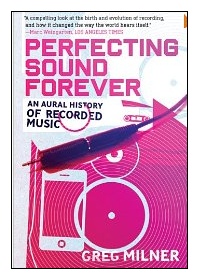
So when I discovered, belatedly, that Greg Milner has written an entire book about the birth, history and present plight of recording, I grabbed it. It’s called Perfecting Sound Forever: An Aural History of Recorded Music.
If, like me, you have always cared about sound quality but never had much of a vocabulary or structure for discussing or understanding it, it’s a wonderful read.

Milner’s tale starts with Edison’s famous “sound tests” (where they’d pit live vs. recording in front of an audience) and carries through to our MP3-muddled present. It’s fascinating to see how certain threads follow us from the days of sound cylinders up to the iPod era. Each successive generation of technology promises — and, for everyday listeners, seems to deliver — the utopia of perfect, life-like sound, sound captured so well that you cannot distinguish the recording from reality. But you soon realize a truth that Milner elegantly excavates: this “reality” is a chimera — an unobtainium of the ear. Our norms for “realistic sound” are hopelessly subjective. If Victrola recordings that crackle in our ears today sounded like “reality” to 1920s listeners, what will music-lovers of the 2120s think about the over-compressed recordings our culture is now producing?

There’s so much that’s fun and unexpected in Perfecting Sound Forever: the early religious wars between the proponents of acoustic recording and believers in the electrical approach that won out (presaging today’s analog vs. digital argument); how the advent of recording tape began to move us from the notion of sound reproduction to the idea of composing in the studio; how competition between radio stations upped the compression ante until we reached the point where the Red Hot Chili Peppers became “the band that clipped itself to death”; and much more.

Music criticism has fallen on hard times today, what with the fragmentation of the audience and the collapse of the industry. But Milner’s book is one case where writing about music most certainly isn’t like dancing about architecture — it’s more like dancing with ideas. Here’s a taste:

We never fully agree on what perfect sound is, so we keep trying, defining our sonic ideals against those of others, playing the game to the best of our abilities, in whatever position we occupy on the field. We add more reverb, we pump up the bass, we boost the treble, we compress dynamic range, we send the band back into the studio because we don’t hear a single — and we then remix that single, we press the song on vinyl, on disc, as a ghostly collection of ones and zeros that we send around the world. We do what we can to make it sound right and then we hear the sound flow from the speakers and we call it perfect.


With this post I intend to begin more regularly reviewing the books I’m reading, right here on Wordyard. Because, as my friend Laura Miller keeps reminding us, readers are scarcer than writers — or, as Gary Shteyngart was just saying on Fresh Air, “Nobody wants to read but everybody wants to write.”

Well, I intend to keep doing both! And, just so you know, I will also be wiring up my links to Amazon with partner codes; these will funnel a tiny bit of change back to me so I can keep buying those books.
Filed Under: Books, Culture, Music

Change is good, but show your work: Here’s a WordPress revisions plugin

August 3, 2010 by Scott Rosenberg

A couple of weeks ago I posted a manifesto. I said Web publishers should let themselves change published articles and posts whenever they need to — and make each superseded version accessible to readers, the way Wikipedians and software developers do.

This one simple addition to the content-management arsenal, known as versioning, would allow us to use the Web as the flexible medium it ought to be, without worrying about confusing or deceiving readers.

Why not adopt [versioning] for every story we publish? Let readers see the older versions of stories. Let them see the diffs. Toss no text down the memory hole, and trigger no Orwell alarms.

Then I asked for help creating a WordPress plugin so I could show people what I was talking about. Now, thanks to some great work by Scott Carpenter, we have it. It’s working on this blog. (You can get it here.) Just go to the single-page form of any post here (the one that’s at its permalink URL, where you can see the comments), and if the post has been revised in any way since I published it, you can click back and see the earlier versions. You can also see the differences — diffs — highlighted, so you don’t have to hunt for them.

The less than two weeks since my post have given us several examples of problems that this “show your work” approach would solve. One of them can be found in the story of this New York Times error report over at MediaBugs.

An anonymous bug filer noticed that the Times seemed to have changed a statistic in the online version of a front-page story about where California’s African Americans stood on pot legalization. As first published, the story said blacks made up “only” or “about 6 percent” of the state population; soon after it was posted, the number changed to “less than 10 percent.” There’s a full explanation of what happened over at MediaBugs; apparently, the reporter got additional information after the story went live, and it was conflicting information, so reporter and editor together decided to alter the story to reflect the new information.

There is nothing wrong with this. In fact, it’s good — the story isn’t etched in stone, and if it can be improved, hooray. The only problem is the poor confused reader, who saw a story that read one way before and now reads another way. The problem isn’t the change; it’s the failure to note it. Showing versions would solve that.

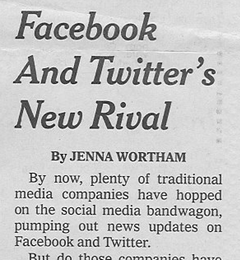
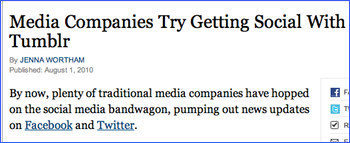
Another Times issue arose yesterday when the paper changed a headline on a published story. The original version of a piece about Tumblr, the blogging service, was headlined “Facebook and Twitter’s new rival.” Some observers felt this headline was hype. (Tumblr is successful but in a very different league from the vastness of Facebook and Twitter.) At some point the headline was rewritten to read “Media Companies Try Getting Social With Tumblr.” Though the article does sport a correction now fixing some other errors, it makes no note of the headline change.

I don’t know what official Times policy is on headline substitution. Certainly, Web publications often modify headlines, and online headlines often differ from print headlines. Still, any time there’s an issue about the substance of a headline, and the headline is changed, a responsible news organization should be forthright about noting the change. Versioning would let editors tinker with headlines all they want.

I do not mean to single out the Times, which is one of the most scrupulous newsrooms around when it comes to corrections. Practices are in a state of flux today. News organizations don’t want to append elaborate correction notices each time they make a small adjustment to a story. And if we expect them to, we rob ourselves of the chance to have them continuously improve their stories.

The versioning solution takes care of all of this. It frees writers and editors to keep making their work better, without seeming to be pulling a fast one on their readers. It’s a simple, concrete way to get beyond the old print-borne notion of news stories as immutable text. It moves us one decent-sized step toward the possibilities the Web opens up for “continuing stories,” iterative news, and open-ended journalism.

How the plugin happened: I got some initial help from Stephen Paul Weber, who responded to my initial request to modify the existing “post revision display” plugin so as to only list revisions made since publication. Weber modified the plugin for me soon thereafter (thank you!). Unfortunately, I failed to realize that that plugin, created by D’Arcy Norman, only provided access to version texts to site administrators, not regular site visitors.

Scott Carpenter, the developer who’d originally pointed out the existing plugin to me, stepped up to the plate, helped me work up a short set of requirements for the plugin I wanted, and set to work to create it. Here’s his full post on the subject, along with the download link for the plugin. We went back and forth a few times. He thought of some issues I hadn’t — and took care of them. I kept adding new little requirements and he knocked them off one by one. I think we both view the end-product as still “experimentally usable” rather than a polished product, but it’s working pretty well for me here.

As the author of a whole book on why making software is hard, I’m always stunned when things go really fast and well, as they did here. Thanks for making this real, Scott!

If you run WordPress and like the idea of showing your work, let us know how it goes.

Filed Under: Media, Mediabugs, Software

You are not an eyeball: Why tracking is the ad biz’s last gasp

August 1, 2010 by Scott Rosenberg

Marketers are following you around on the Internet. They don’t know your name but they know what you do, what you buy, where you buy it, what you’re interested in, and more. The sites you visit collect this information on behalf of networks that then roll you up with other like-minded people in packages, as if you were a subprime mortgage, and sell your eyeballs to advertisers.

People inside the Web industry generally know all this and take it for granted. People outside mostly don’t. That explains some of the wide variation in reaction to a big package the Wall Street Journal published Saturday that chronicles how advertisers track users online.

I found it fascinating that two of the smarter Web veterans I know — Jeff Jarvis and Doc Searls — arrived at opposite perspectives on the Journal coverage. How did that happen? Let’s climb what I’ll call the ladder of reaction to this story, and we can see.

At the bottom rung, we have a simple everyday reader’s freakout. OMG They’re spying on us! This, it seems to me, is the level at which the Journal’s coverage was pitched. It’s full of loaded language: A headline that refers to “your secrets.” References to “surveillance” and “surreptitious” practices. Repeated use of the phrase “sophisticated software” to describe run-of-the-mill stuff that we’ve lived with for years, like the cookie files invented at the dawn of the Web by Lou Montulli (and that anyone can easily delete from their browser).

On the next rung up the ladder we have what I predict will be the response of the punditocracy, the editorial page writers and columnists. They will weigh in early this week, shake their heads in disapproval and demand that the government step in and pile more privacy regulations on the Internet advertising industry.

This will drive the Web industry insiders — up on the ladder’s third rung — even crazier than the Journal feature itself did. For them, the activities the Journal describes are simply old news. This is where we find Jeff Jarvis, who described the Journal feature as “the Reefer Madness of the digital age”: “I don’t understand how the Journal could be so breathlessly naive, unsophisticated, and anachronistic about the basics of the modern media business.” Similarly, Terry Heaton found the Journal’s coverage biased and behind the curve: “It’s like somebody at the paper had been sleeping for ten years and woke up to discover it’s the year 2010!”

Insiders will worry that an anti-tracking backlash might throttle the Web advertising industry at just the moment when big media institutions are praying that online ad revenue might help them make up for all the ad income they’re losing in their offline businesses.

Even more important, they will argue that tracking isn’t an invasion of privacy at all, since the advertisers mostly don’t know you by name or personal identity. Instead, they see you as a bundle of demographic traits and acquisitive tendencies. We owe the maintenance of this important distinction to an ad-tracking scare of a previous era, the great DoubleClick/Abacus controversy of 1999. Yes, this issue has been with us since 1999, which does make you wonder about the Journal’s breathless tone today.

The most important argument the insiders make is the very simple one that tracking, done right, actually performs a useful service: It helps reduce your exposure to ads you don’t care about and shows you more ads that you actually want to see.

This brings us up high to rung number four, where we meet Doc Searls, who is sitting on his own little platform that he’s built over the years, and inviting us to sit down with him and listen.

And he’s saying to the Web insiders: You guys are missing two points. The first is that “most real people are creeped out by this stuff,” even if it is old hat to you. The second is that you aren’t thinking big enough if you think that tracking users’ behavior is the best the Web can do.

You think the Web is all about making inefficient advertising more efficient, when it’s really about eliminating advertising as we have known it entirely, by giving us “better ways for demand and supply to meet — ways that don’t involve tracking or the guesswork called advertising.”

Searls has been elaborating this argument from the early days of the Cluetrain Manifesto to his current work at Project VRM. He’s saying: We know ourselves and our needs better than any third party’s guesswork. The Internet can enable us to speak directly to the marketplace about what we want. We can have a direct conversation with vendors of the things we are thinking about purchasing:

if I had exposed every possible action in my life this past week, including every word I wrote, every click I made, everything I ate and smelled and heard and looked at, the guesswork engine has not been built that can tell any seller the next thing I’ll actually want… Meanwhile I have money ready to spend on about eight things, right now, that I’d be glad to let the right sellers know, provided that information is confined to my relationship with those sellers, and that it doesn’t feed into anybody’s guesswork mill.

I find Searls’ vision appealing, even as I recognize the disruption it portends. The end of advertising also means the end of the business of delivering eyeballs to advertisers. It means that creative people and journalists and other “content creators” will need to abandon the old media’s compromised triangle trade (with creators ferrying consumers to advertisers) and learn how to fill public needs directly. That means we’ll need new ways to fund public-good information (foreign news, accountability journalism, investigations) once we can no longer pay for it with the overflow from advertising-monopoly profits.

That’s the future. Today, I actually think the Journal is doing a public service by writing about stuff industry insiders already know about — even if the paper went over the top in its intimations of dark marketing conspiracies. But it would be so much more of a service to look beyond the desperate thrashings of the badly wounded ad industry — and toward the better model that is struggling to be born.

Filed Under: Business, Media

« Previous Page