
As a young man in love with the nuts and bolts of publishing, beginning in high school in the 1970s, I spent a lot of time in print shops. The industry had just undergone a wrenching transition from “hot type” to “cold type” — abandoning a venerable technology involving hulking machines and heavy metal slugs in favor of phototypesetting systems that input text digitally (usually clumsily, via paper-tape rolls) and churned out fast-drying galleys on thick paper. Many print shops of the time existed, like those used by both my high school and college papers, as small offices carved out of much-larger spaces that had been used for the hot-type machinery. Often, the big old rooms were dark and still littered with debris — linotype detritus, boxes of metal slugs. The homes for the cold-type machines were comparative oases, well-lit and air-conditioned to keep the expensive new equipment happy.
This technological transition seemed momentous for the newspaper industry at the time; it rendered an entire tradition of printing skills obsolete and led to wrenching labor battles. But of course it was only a preface.
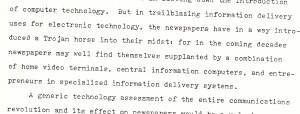 I was cleaning out my garage recently, combing through some old files, and stumbled on a research paper I wrote in 1981 as a senior in college. The title was “The Electronic Newsroom and the Video Display Terminal.” I was writing about the moment that the digital transition rolled out from the back shop to engulf the newsroom, as — almost overnight — the typewriters were put out to pasture and a generation of journalists learned to love cut/paste and the “delete” key. What would that mean for the future of news?
The paper isn’t a big deal; it was written for a course I’d taken mostly for its reputation as an easy way for humanities types like me to fulfill the science requirement. But I’d spent enough time as both a student journalist and a computer enthusiast to know that the changes taking place wouldn’t stop at the newsroom door. Here’s what I wrote:
In trailblazing information delivery uses for electronic technology, the newspapers have in a way introduced a Trojan horse into their midst: for in the coming decades newspapers may well find themselves supplanted by a combination of home video terminals, central information computers, and entrepreneurs in specialized information delivery systems.
Let’s see: “Home video terminals”? Check: that would be your PC. “Central information computers”? Check: the vast network of web servers that feed you your Google, YouTube and so on. “Entrepreneurs in specialized information delivery systems”? That would be your blogging multitude.
I make no claim for great prescience — quite the reverse. I was a college kid who had no particular inside knowledge or knack for future-gazing. Even so, it wasn’t hard to see where things were leading.
I’ll think of my little paper every time I hear news execs making the excuse that “no one could see” how things were going to play out between print and the online world. If a kid could see it nearly 30 years ago, maybe they should have tried a little harder.
Post Revisions:
- January 7, 2011 @ 08:32:23 [Current Revision] by Scott Rosenberg
- January 7, 2011 @ 08:32:05 by Scott Rosenberg
- June 9, 2009 @ 14:04:27 by Scott Rosenberg