
Wordyard

Hand-forged posts since 2002

Archives

About

Greatest hits

Archives for October 2006

Free books to Code Reads contributors

October 3, 2006 by Scott Rosenberg

OK, the response to my invitation to a discussion of The Mythical Man-Month hasn’t been…overwhelming.

Maybe nobody’s read the book. Or those that have done so have nothing to say about it. Or I said too much myself and nobody felt like adding anything. Or everyone’s too busy wondering when Denny Hastert’s going to quit. Or everyone’s too busy writing code to actually stop and think much about writing code. Or everyone’s too busy, period. Or I just haven’t gotten that Slashdot or Digg link yet.

I’m not worried — I figured this Code Reads thing would take time to get rolling.

But I do have a little incentive to offer: Thanks to the kindness of Gary Cornell, the publisher of APress, I’ve got five copies of Joel Spolsky’s excellent The Best Software Writing I to give away to Code Reads participants.
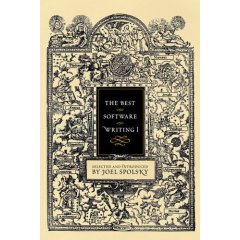
This great collection has 300 pages of entertaining and incisive writing by people like Clay Shirky, Eric Sink, Michael “Rands” Lopp, Paul Ford, Paul Graham, John Gruber, Cory Doctorow, Adam Bosworth, Raymond Chen, danah boyd, Aaron Swartz and many others. Each one of these pieces is worth a discussion in its own right. (Spolsky’s introduction and the full contents list is here.)

I’ll award these books at my discretion to contributors of value — substantive or simply diverting — to Code Reads discussions.

If The Mythical Man-Month didn’t ring your bell, next Monday I’ll be posting something about Edsger Dijkstra’s famous 1968 paper, “Go To Statement Considered Harmful.” Among other things, it has the virtue of being about 1/100th the length of The Mythical Man-Month.
[tags]code reads, best software writing, mythical man month, go to statement considered harmful[/tags]

Filed Under: Code Reads, Software

Code Reads #1: The Mythical Man-Month

October 2, 2006 by Scott Rosenberg

Code ReadsThis is the inaugural edition of Code Reads, a weekly discussion of some of the central essays, documents and texts in the history of software. This week we’re talking about Frederick Brooks’s The Mythical Man-Month. (OK, let’s be honest: I’m talking about it. I’m hoping you, or you, or you, may want to, as well! If you don’t want to read my essay, you can just go straight to the comments and post something.)

Frederick Brooks’s The Mythical Man-Month came out in 1975, and I first heard its title later that decade. I’d already been a teenage programmer of sorts (of games in BASIC) for a few years, but I knew nothing of the world of large software projects that Brooks’ work addressed. I did know that the phrase “mythical man-month” grabbed my interest. It sounded less like the management-science term it was, more like a description of some prehistoric beast, heaving itself out of the primordial swamp to lumber across a desolate landscape.

Transmuting dry corporate-speak into evocative imagery? That was some trick.

The Mythical Man-MonthWhen I finally did read Brooks’s book, more than two decades later, there, on its cover, were those beasts — struggling to pull their limbs free of the tar pit that served as Brooks’s starting metaphor for the awful dilemmas of software-project scheduling. By that time, I’d become more familiar with the sort of work Brooks’s book addressed. I’d knocked my head more than once against the wall of software development. And I found, as so many readers had before me, that this quarter-century old book anticipated and analyzed most of the problems I’d encountered — and even offered some useful advice on how to avoid them.
[Read more…]

Filed Under: Code Reads, Software

« Previous Page