
Wordyard

Hand-forged posts since 2002

Archives

About

Greatest hits

Archives for July 2010

Politico, Slate, and story versioning — or: the only Web constant is change

July 21, 2010 by Scott Rosenberg

Last month, the hardworking gang at Politico got into a dustup with critics after an editor made a change in an already-posted story. The story was about the Rolling Stone/General McChrystal affair; the change removed a phrase that described how beat reporting works; the phrase had drawn considerable attention, and so did its disappearance.

I’m not going to add to the volume of commentary on that affair. I’m interested here in the larger issue of the mutability of online content, and how responsible news organizations deal with it.

A story posted at Slate yesterday sheds considerable light on this issue, in the course of making a few stumbles of its own. (The story includes quotes from a recent post I wrote about best practices in online corrections.) It’s remarkable that, after 15 years of Web publishing experience, we haven’t gotten better at handling changes to news published online. Before this post is done, I will offer a straightforward, concrete proposal for doing so.

[Read more…]

Filed Under: Media, Mediabugs

You’re the notorious flamingo smuggler!

July 20, 2010 by Scott Rosenberg

We created what we hope is a fun little video explaining the basic concept behind MediaBugs. All credit to the awesome talents of Kate and Nate at Beep Show — and their stock company of men in shorts.

The Story of MediaBugs from Beep Show on Vimeo.

Filed Under: Mediabugs

Party context of that staggering debt chart

July 19, 2010 by Scott Rosenberg

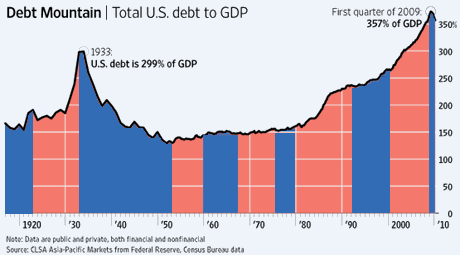
The Journal published one of those jaw-dropping charts about the U.S. national debt last Thursday, and it looked pretty bad:

There are two things to argue about here: One is the economic debate about how dangerous this “debt mountain” really is, and whether deficit-cutting today amid high unemployment would just stall the economic recovery (the famous “mistake of 1936”).

The other is the political debate. We’re in the middle of an election cycle, so charts like this fuel voter anger and “throw the bums out” sentiment.

I’m a timeline-oriented sort of person, and so the first thing I did when I looked at this chart was ask, “OK, let’s plot the presidential administrations by party along the horizontal axis and see what we find.” Since what I found was pretty remarkable, I marked up the chart below. Blue bars are Democratic administrations.

US Debt Chart By Presidential Party

Pretty much speaks for itself, no? The main observation is that the huge runups in the debt that we’ve experienced since 1980 are almost entirely the results of the policies of two Republican presidents, Reagan and Bush Jr. (The elder Bush deserves some credit for a willingness to tackle the debt through a modest tax increase.) Yes, these presidents sometimes had the cooperation of some Democrats in Congress. But the disastrous supply-side-style tax cut policies were authored by these presidents’ administrations, and they are responsible for them.

The truth of the last three decades of American economic history is simple: The GOP has repeatedly pursued a policy of “cut taxes and let our kids pay for it.” Some supported it out of a mistaken belief that tax cuts would always pay for themselves in economic growth. Others supported it out of a Machiavellian belief (“drag it into the bathroom and drown it in the bathtub”) that if you cut taxes enough, you could force the government to scuttle popular government programs that Republicans detest like Medicare and Social Security. Others supported it out of plain old self-interest (tax cuts are always popular).

Whatever their motivations, every Republican politician who rails against the evils of the debt should be shown this chart and asked to explain it.

CORRECTION/UPDATE: As William Sullivan points out in comments, this chart, which I mistook for a graph of public debt only, actually aggregates public and private debt. I’ll poke around for a public-debt-only graph. In the meantime, it’s interesting to think, gee, what does it mean that both public and private debt together surge under our most recent Republican administrations? The positive spin, I suppose, would be: Business is humming and consumers are confident during these expansive GOP eras so people take on more debt.

Given what we experienced in 2008, however, I think a more accurate read would be: Our supposedly conservative Republican presidents actually presided over massively risky leveraging of our economy without thinking about how either the government or private citizens would actually pay it all off. Which, to me — speaking as a liberal who has paid off his credit card bill every month of my adult life — sounds like the opposite of “conservative.”

Filed Under: Politics

More songs about whistling

July 19, 2010 by Scott Rosenberg

There is nothing quite as catchy as a great pop song that deploys whistling. I was reminded of this truth last night at a show by the New Pornographers last night at Oakland’s majestic Fox Theater, where the band’s generous set included “Crash Years” — a song from its new album, Together, that features an infectious whistling chorus.

(I have to admit that the whistling volley loosed by the NPs last night was so solid, indeed so flawless, no stray sibilance or wobbles offkey, that I did wonder if it was live or sampled. I mean, the band members were whistling into their mikes. But these days, who knows?)

I was all set to write up a post about other great whistling songs, but soon discovered that it’s been done already.

The Spinner list is a pretty good one. But it’s heavy on songs that use whistling as a drop-in solo or a bridge or an outro. Those are great, but this aproach neglects examples in the grand “Colonel Bogey March/Bridge On the River Kwai” tradition — where the whistling carries the entire tune of a refrain.

My own favorite in this genre is Brian Eno’s “Back in Judy’s Jungle” — the missing link connecting the world of Colonel Bogey with that of “Crash Years.”

As for the rest of the New Pornographers show? With eight, sometimes more, people on stage, they have turned into indie power pop’s equivalent of a Big Band. Indeed, at times, with their tight harmonies and deep catalog of songs that feel like instant classics, they made me think of our era’s equivalent of the Band — with roots dug not in the country-folk tradition but instead in the now-long history of eccentric smart pop. Great, complex music: we’re lucky to have it.

Filed Under: Culture, Music

Redecorating the place

July 18, 2010 by Scott Rosenberg

Welcome to the long-overdue revamp of this blog’s design.

Our new look is courtesy of the Genesis theme framework from StudioPress, which makes things like choosing a column layout really simple. I just fiddled a bit with some of the colors and fonts and style-sheet stuff.

WordPress has become so much more powerful and elegant as a content management system over time — the widget framework for dropping in features like the Twitter box, the navigation boxes and my little book promotions is awfully straightforward. Thanks to all the developers who have brought us to this fine place!

I’ve tested things out on various browser/platform combos but let me know if you see anything funky.

Filed Under: Blogging, Personal

MediaBugs report on Bay Area corrections flunks most news sites

July 13, 2010 by Scott Rosenberg

Because web pages are just computer files, news stories on the web can be altered at will after publication. That makes corrections on the web a little more complex than corrections in print — but it also makes them potentially much more effective. Unlike in print or broadcast, you can fix the original. You can make errors vanish — though not without a trace, if you’re doing it right.

So why do so many news organizations continue to handle their online corrections so poorly? At MediaBugs, where we’re devoted to improving the feedback loop between the public and the press, we’ve just published our first survey of corrections practices at more than two dozen Bay Area news outlets. The report’s top-line conclusion? Mostly, they’re doing it wrong.

Three quarters of the 28 news outlets we reviewed provide no corrections-reporting link of any kind on their home or article pages. Even media organizations that show signs of working to handle corrections carefully fall down in various ways — and lots of others don’t look like they’re even trying.

Many bury information about how to report errors behind confusing trails of links. Some provide multiple, poorly labeled avenues for feedback without telling readers which ones to use for error reports. Others provide no access to recently corrected articles beyond a search on “corrections,” which often turns up multiple stories about prisons.

These findings are disheartening — not simply for how poorly editors are protecting their readers’ trust in them, but also because handling these matters better doesn’t take that much effort.

There’s really just a small number of things any news website needs to do if it wants to handle corrections and error reports responsibly:

  • Append a note to any article that’s been corrected, explaining the change;
  • Keep a list of these changes, linking to the corrected articles, at a fixed location on the site;
  • Post a brief corrections policy, with information about how readers can report errors they find;
  • Make sure that your corrections listing page and your corrections policy (whether they’re on the same or different pages) are part of your site navigation — they should be accessible by one click from any page on your site.

In addition to our survey, we’ve provided a brief summary of best practices for corrections and error reporting that we hope will be helpful to news site editors and their readers alike.

Fifteen years ago, in the early days of web publishing, it might have been understandable for editors to have a hard time figuring out how to handle corrections: This pliable medium was new and strange.

But news on the web is no longer in its infancy, and “We’re new to this” just doesn’t cut it anymore as an explanation for the kind of poor practices our MediaBugs survey documents. The explanations you generally hear are truthful but don’t excuse the problems: “Our content management system makes it too hard to do that” or “we just don’t have the resources to do that” or “we’ve been meaning to fix that for a while but never seem to get around to it.”

The web excels at connecting people. That’s what its technology is for. Yet when it comes to the most basic areas of accuracy and accountability, the professional newsrooms of the Bay Area (and so many other communities) continue to do a poor job of connecting with their own readers.

It’s time for news websites to move this issue to the top of their priority lists and get it taken care of. They can do this, in most cases, with just a few changes to site templates and some small improvements in editing procedures. Of course, we hope, once they’ve done that, that they’ll do more: At MediaBugs, we want to see that every news page on the web includes a “Report an Error” button as a standard feature, just like the ubiquitous “Print” buttons, “Share This” links and RSS icons.

MediaBugs offers one easy way to do this — our error-reporting widget is easy to integrate on any website. You can now see it in action on every story published over at Spot.Us (as it is on every post here at my Wordyard blog). But there are plenty of other ways to achieve this same end.

As long as readers can quickly and easily find their way to report an error with a single click, we’ll be happy. But before we get there, we’ve all got some basic housekeeping to take care of first. End the suffering of orphaned corrections links and pages now!

[Cross-posted from the MediaShift Idea Lab blog]

Filed Under: Mediabugs

« Previous Page