
Wordyard

Hand-forged posts since 2002

Archives

About

Greatest hits

Archives for 2009

The passion of Jim Cramer

March 13, 2009 by Scott Rosenberg

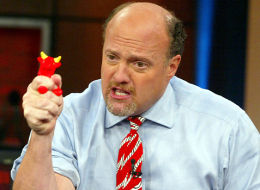
cramerBy now the entire Internets have witnessed the extraordinary performance on Jon Stewart yesterday, in which Jim Cramer, the bug-eyed host of CNBC’s Mad Money show, took withering, and deserved, shots about his, and his network’s, participation in the market’s recent massive failure. (TPM has the whole thing up here if you want to watch it again.)

For me the high point came towards the end, with Stewart calling Cramer on the investing hucksterism that has been standard fare on CNBC for so long:

I understand you want to make finance entertaining, but it’s not a fucking game… Selling this idea that you don’t have to do anything — any time you sell people the idea that, sit back and you’ll get 10 or 20 percent on your money, don’t you always know that that’s gonna be a lie? When are we gonna realize in this country that our wealth is work, that we’re workers, and by selling this idea of, hey man, I’ll teach you to be rich, how is that different from an infomercial?

Cramer spends most of the lengthy interview admitting failure and hanging his head. I give him credit for showing up — something that ludicrous grandstander Rick Santelli couldn’t bring himself to do — even though I found his rationalizations mostly unconvincing.

Watching Cramer’s show, which I have only rarely done, has always been a bizarrely alienating experience for me. I got to know the host three decades ago when we both worked at the American Lawyer magazine, Steve Brill’s feisty startup. (I recently wrote a bit about that experience.) I was a callow summer intern, Cramer was a hard-working reporter, and he was extraordinarily generous and helpful to me. I learned a lot from him about how the work of investigative reporting is done. He was clearly an intense and driven guy who seemed to require very little sleep. But, with me at least, he was also for real.

On TV these days, of course, he is anything but. He presents a strange caricature of the addled, hyper-reactive Wall Street lunatic. Since I knew Cramer under other circumstances, I have always assumed that this was a persona, a dramatic construct, a Brechtian parody of the personality of capitalism — and a daily illustration of the “greater fool” theory.

Maybe that’s giving Cramer the benefit of too much doubt; but it does seem hard to miss that the show is intended as comedy. Do people actually make investment decisions by listening to a man who (as Stewart puts it) “throws plastic cows through his legs shouting ‘Sell, sell, sell!’ “? And if they do, should Cramer at least share with them the blame for losses resulting from such gullibility?

I don’t know. But I do know that if you play a role long enough, you become the part. (As I recall, Vonnegut’s Mother Night has something to say about this. Also, in a different vein, Kurosawa’s Kagemusha.) In his Jon Stewart appearance, I thought I saw glints of the real Cramer poking through the madman act. But at this stage of the show, they’re pretty faint.

Filed Under: Business, Media, Personal

Columbia J-School walks backward onto the Web

March 12, 2009 by Scott Rosenberg

Eye-opening New York mag piece on a rift at the Columbia Journalism School as it struggles with the concept of “new media”: The current faculty doesn’t have the skills in digital storytelling that (some of) the school’s leadership wants to teach. Hiring adjuncts costs a lot of money. So they’re considering crash courses for the professors. And it sounds like they’re still ambivalent. This quotation from the school’s dean, Nick Lemann, deserves some unpacking:

“You can go to the Learning Annex and take a Flash course. I don’t think what we should do is be replicating courses you can take at the Learning Annex. But you have to have some familiarity, or you’re not able to execute a website.”

This straw man is so lightweight it’s amazing it didn’t evaporate as Lemann spoke it. The Learning Annex has a pretty extensive curriculum, you know; they’ll teach you writing and reporting too. All the basic skills that Columbia Journalism School teaches can be learned at extension schools and night schools and in the school of one’s own pajamas. The value the school presumably offers is in how it teaches writing (and photography and, one hopes now, online journalism): not just the basics of accuracy and clarity and economy of expression — the nuts and bolts of reporting and writing — but the ethics and the thoughtfulness and the passion. Right?

Columbia presumably understands that this is its job when it comes to teaching traditional newspaper and broadcast reporting. But suddenly, when the skills involved are newfangled Webby things, that job becomes discounted, something anybody can learn from any old extension school, or any faculty member can pick up by cramming.

Of course these journalism professors should familiarize themselves with the tools if they haven’t already. But you wouldn’t want to try to learn the soul of the discipline from a newbie, would you? Any more than Columbia would ask someone who’d just written their first headline to teach basic news editing. The roster of Columbia faculty is an impressive list, but they are mostly veterans of an era that is fading today, and it is unfair to both them and their students to expect them to become overnight experts in a new world that most of us are just beginning to understand.

The condescension on display toward new media forms here is a recapitulation of what the pioneers in photojournalism encountered in the early days of that field, when it was more technically forbidding but hardly seemed like a serious part of covering a story. Today, one hopes any serious journalism educator understands that learning photojournalism is a lot more than just acquiring the technical facility of taking a decent shot. Similarly, the business of learning to use different online media forms to tell a story goes way beyond just “taking a Flash course.”

We need journalism schools like Columbia to take the journalistic traditions that they have long preserved and carry them forward into the digital age. But they will not be able to play that role until they take these new media forms seriously. The New York piece describes the school’s efforts to begin to integrate digital-era skills with its basic curriculum. That’s promising. But if it’s serious about this, it needs to hire people who know Web journalism as thoroughly as the current faculty knows the journalism of previous eras.

Filed Under: Media

Why is the Journal flubbing its biggest story ever?

March 11, 2009 by Scott Rosenberg

You’d think that the Wall Street Journal would own the biggest story of the past year, the meltdown of capitalism-as-we’ve-known-it. But the paper’s coverage has lagged. It did good work on the collapse of Bear Stearns a year ago, but for the most part it has done a mediocre job of explaining all that has gone wrong with our economic system. It has been left to the marquee names at the paper’s biggest competitor, the New York Times, to help us begin to understand where we are and how we got here: writers like Joe Nocera, Gretchen Morgenson, David Leonhardt, Floyd Norris, and of course Paul Krugman. Their pieces — like, for instance, Nocera’s explanation of where those billions we’re shoveling at AIG are really going — have regularly been essential reading, whereas the Journal’s coverage just hasn’t risen to that level too often.

One can think of several possible explanations for this failure. For one thing, the Wall Street collapse represents not only a story on the Journal’s home turf but also the disintegration of its motivating vision. The paper that champions “free people and free markets” is, I think, having a hard time coming to terms with the fact that free markets have just failed free people in a very big way. It has also, I imagine, been hard for the Journal’s troops to concentrate as they undergo a wrenching change of ownership and begin to adjust to new marching orders from the Murdoch regime.

Wall Street JournalStill, it seems very wrong-headed that, at the precise moment the Journal ought to be (pardon the usage) capitalizing on its strength in in-depth financial coverage, it is instead distracting itself with an effort to become a sort of upscale USA Today (with utterly superfluous features like a new sports section).

In Mother Jones, former Journal reporter Dean Starkman asks “How Could 9,000 Business Reporters Blow It?” One suggestion is that the Journal’s tradition of attending to the colorful titans of the business world became a liability in covering an impersonal credit crisis:

Jesse Eisinger, a former financial columnist for the Journal and now a senior writer for Portfolio, says the paper, like business journalism generally, clung to outdated formulas. Wall Street coverage tilted toward personality-driven stories, not deconstructing balance sheets or figuring out risks. Stocks were the focus, when the problems were brewing in derivatives. “We were following the old model,” he says.

Where did that old model come from? Monday’s Journal happened to carry a review of a new book by former Journal exec Richard Tofel — a biography of Barney Kilgore, the legendary editor who made the Journal what it is today (or, rather, what it was till recently).

Kilgore believed in humanizing articles on even complicated subjects, insisting that editors and writers try to make room in news stories, whenever possible, for anecdotes, narrative details and portraits of individuals, thus bringing topics alive for that “average reader.”

So was it Kilgore’s fault the Journal failed to offer early insight into the real estate crisis, derivatives, the instability of the banking system, and so on? We can’t blame him exclusively for that; the approach credited to him is one that is nearly universal in journalism today. The reasons behind the Journal’s weak showing in the current crisis seem of more recent vintage.

Still, there’s a lesson here in the limits of the daily journalism world view. Sometimes the heart of the story lies beyond “one person’s tale.” Sometimes, as Felix Salmon’s fascinating piece in the latest Wired — The Formula That Killed Wall Street — shows, it lies with a mathematical insight. Sometimes we need to turn to demographics, or history, or science.

Reading the Journal’s review of the Kilgore book, I did get an odd feeling that there was some elephant-in-the-room avoidance going on. Both review and book laud the man who shaped the modern Wall Street Journal at the very moment that new owners are radically altering, if not dismantling, that institution. Yet the review did not even offer a tip of a hat or wink of an eye to that fact.

It’s not easy to write about change at a newspaper in the pages of that newspaper, but it’s one of the things we expect our independent press to be able to handle when the occasion arises. This occasion is one that appears to have been handled by sheer ostrich-like avoidance.

Filed Under: Business, Media

Reverse market psychology

March 3, 2009 by Scott Rosenberg

The wisdom of Wall Street has it that the market never hits bottom until the last bull capitulates. In other words, there is no hope of things turning around until everyone has given up hope of things turning around.

If this is true, then this morning’s Wall Street Journal lead story ought to give us hope, because it reports a bleak absence of hope.

“Investors around the globe appeared to be giving up hope and girding for a prolonged recession.”

I thought it’s been crystal clear since last September, if not before, that the “prolonged recession” scenario was the best case. But maybe it’s been looking different to the folks on Wall Street. Maybe that’s why they’re still in trouble?

“Traders said the latest downdraft broadly reflected a deepening sense of gloom among investors. Gone are the days where the mantra among investors was to “buy the dips,” on the belief that when stock prices fall, they’re likely to rebound. Instead, the opposite sentiment has taken hold.

“It’s like an unending nightmare,” says Kent Engelke, managing director at Capital Securities Management in Glen Allen, Va.

So it sounds like the last of the bulls has thrown in the towel. Which ought to mean that we’re at or close to a market bottom.

But here is why this particular strand of Wall Street wisdom always seemed problematic to me. If it were accurate, then some portion of the market would follow it — in other words, some group of investors would always see the general rout and think, “Aha! Market bottom! Time to buy!” And those investors would be the very hope-filled buyers whose existence would indicate the market hadn’t hit bottom yet after all.

Okay, it’s not exactly Zeno’s Paradox, but it’s a flaw in the logic, yes? Not that it’s anything but an idle question, for me, at any rate. Market timing, I have always felt, is for people looking for ulcers.

Filed Under: Business

Writing and rewards: an author marches on his stomach

March 3, 2009 by Scott Rosenberg

The thing about writing a book is — pardon the obviousness — you have to write a whole lot of words.

Now, plenty of bloggers do lots of writing, over a period of six months or a year they might easily reach the 80-100,000 word sum of a typical book. There are two big differences for the author of a book: First, you’ve got to write according to a plan, so that the little bricks of words you are piling up form something coherent and shapely, whereas bloggers win a free pass to be discursive each time they hit “post.” Second, bloggers’ work is fueled by a daily reward of feedback and reaction to their posts, whether it’s an onslaught of comments or just a small jump on the site-traffic meter. Authors don’t get that. That is why, so often, we devise systems of our own — tracking systems to help keep ourselves on plan, to know whether we’re ahead or behind, and personal reward mechanisms, to provide incentives across arduous weeks and months.

My tracking system is simple: a small spreadsheet with word-count quotas and tallies. I don’t really need to do this, but the ritual of recording each day’s verbal production keeps me moving. The reward mechanism is even simpler.

I have a taste for red licorice. I grew up loving an odd Danish confection called Broadway Licorice Rolls — you got four little rolls of tape-like shapes in a plastic foil wrapping from the candy-store counter. Far as I can tell, they no longer exist. (A brand called Delfa Rolls was distributed online until recently, but is now marked discontinued.) Haribo red licorice wheelsThe closest substitute I have found is Haribo red licorice wheels. I buy them in bulk and dump a big bag in a candy jar in my office. When I’m writing a book, each day after I’ve drafted my target amount of prose — usually 1000 words, sometimes more if I’m behind — I mark the occasion with one or two of these fragrant corn-syrup-solid bonbons.

Now, I know what you’re thinking; or rather, I know there are two groups of you out there. One group is snorting with derision at this crude methodology — self-doping with sugar! All I can say to them is, you do whatever it takes to get the job done. The other bunch is thinking, “How do you avoid stuffing your face every time you hit a rough spot?” All I can say to them is, that would feel like cheating at solitaire. Maybe I scored when they passed out the genes for delayed gratification.

On yesterday’s Fresh Air the science writer Jonah Lehrer was describing a bit of brain research that he discusses in his new book How We Decide. Test subjects divided into two groups were asked to memorize numbers. One group was assigned two digit numbers, the other seven digit figures. Then the members of each group were offered a choice between some sort of gooey, fatty dessert and an austere fruit salad. Of course the seven-digit crew opted much more heavily for the junk food than the double-digit gang.

This result, according to Lehrer, displayed how easily the prefrontal cortex can be overtaxed. The task of remembering the longer numbers had impaired the subjects’ long-term decision-making capacity — the part of their brains that would say, “Don’t eat that crud, it’s bad for you.”

Maybe so. Lehrer has read the study and I haven’t. I only know that as I heard him describe the experiment, and before he offered his interpretation, I sat there and thought: of course the seven-digit people went for the sugar. They’d been asked to do something hard! Now they were rewarding themselves.

Filed Under: Personal, Science

The Times, John Dean and the elephant in the room

February 22, 2009 by Scott Rosenberg

New York Times ombudsman — excuse me, “public editor” — Clark Hoyt published a piece today about a sorry recent incident in which the Times ran a front-page piece granting some exposure and credibility to Watergate revisionists. The piece described the efforts of a writer named Peter Klingman to discredit the work of historian Stanley Kutler, suggesting that Kutler had doctored his transcripts of the Watergate tapes in an effort to protect John Dean and blacken President Nixon’s name.

Hoyt’s piece is fine as far as it goes: it basically points out how weak the Times story was, and how unfair to Kutler. Hoyt concludes that “the Times blew the dispute out of proportion with front-page play, allowed an attack on a respected historian’s integrity without evidence to support it, and left readers to wonder if there was anything here that would change our understanding of the scandal that ended Nixon’s presidency.”

But Hoyt’s discussion conspicuously avoids the elephant in the room (and yes, it is an elephant). I don’t know Klingman’s exact motivations or political affiliations, but it doesn’t take much thought to realize why someone in 2009 might be interested in attacking John Dean and lightening Nixon’s burden of guilt. Dean’s testimony was central in the collapse of Nixon’s presidency. Dean served a prison sentence for his role in Watergate — time that Nixon should have served, too, but avoided by wangling a corrupt pardon for himself. But many conservatives are still itching to exact further punishment for Dean’s betrayal. In the past decade, Dean became an outspoken critic of the Bush administration. Discrediting him would be sweet revenge.

It is bizarre to watch Hoyt dig in at such length about so many of the scholarly and journalistic issues surrounding this story yet fail to discuss the politics.

Full disclosure: I worked closely with Dean back in 2002 on an ill-fated (but still, to me, worthwhile) e-book titled Unmasking Deep Throat. You can read Dean’s take on the Times controversy in this column from the Daily Beast.

Filed Under: Media, Personal, Politics

California gridlock, courtesy GOP diehards

February 18, 2009 by Scott Rosenberg

Here in the state of California we are being treated to the spectacle of a small minority of Republican dead-enders in the legislature holding the entire state economy hostage to their tax-cutting religion.

The story, for those blissfully beyond Sacramento’s reach, is that our state rules require a 2/3 vote to pass a budget. So that even though Democrats control both houses of the legislature, they need a few Republicans to pass a budget. And our local GOP reps have apparently signed a pact in blood that they will never, ever, under any circumstances, support tax increases. The Democrats — along with our Republican governor — have found two GOP state senators to come to terms with reality, but they need a third, and can’t seem to find it. (It’s as if Obama’s stimulus package died in Congress because one of the three Republican moderate senators got cold feet.) In the latest development, the GOP diehards have spurned their own leader as an apostate because he was willing to negotiate with the evil tax-boosters.

Every time something like this happens we need to remind ourselves of the deep misreading of history that underlies the tax-cutting religion. The theory is that the only way to grow the economy is by cutting taxes. Reagan cut taxes in the early ’80s, and the ’80s were a good decade if you were a bond trader or an investor in the PC industry, but for the middle class they were, at best, so-so. Bush pere and Clinton raised taxes in the early ’90s and the ’90s were the best decade economically that most of us have experienced. Bush fils cut taxes in the early 2000s and we had a lousy decade again, except if you were a hedge-fund investor or a house-flipper, and even a lot of them got clobbered in the end, along with everyone else.

Given all this, anyone who preaches the universal efficacy of tax cuts is, in my book, not fit to sit at the grownup table.

If California is going to meet its obligations, California has to raise taxes. Would it be kinder to the people of California not to raise their taxes in the face of the bad economy? Of course. The state could use a lot more help from Washington (where, whoops, the GOP has stood in the way of greater aid to state and local governments). Someday, these tax increases probably ought to be rescinded. But right now? The state can’t print money, and it needs to pay its bills.

Which brings us to the real question: as this economic calamity courses through our system and our lives, how much of the machinery of government and the infrastructure of local communities are we going to allow it to destroy? And what kind of a society do we want to have left on the other side of the cataclysm?

What the Republicans who stand in the way of a California budget are saying to our community’s schools and fire departments and other services is: shut down. Go away. We don’t need you. It’s the logical endpoint of the strangle-government-in-the-bathtub philosophy of America’s hard right, which actively wants to wreck government’s ability to serve as a stabilizing and supportive force in our lives and our economy.

With any luck, this crisis will help voters see this philosophy for the dead end that it is. Obviously we here in California need to change the 2/3 rule that gives a small minority this kind of power over the public’s business. We can also hope that the communities who elect these ostrich legislators never have to face the full brutal consequences of their ideological idiocies.

Filed Under: Politics

Where’s Scott?

February 17, 2009 by Scott Rosenberg

As the new book is finishing the copy-edit phase of its production cycle, I’ve turned my energy to a number of new projects, which explains the slow blogging here.

I’ve already posted a bit about my entry in the Knight News Challenge competition — MediaBugs, a public “bug tracker” for errors and other problems with media coverage. I’ve now submitted a budget for that project, and we’ll see how far I get as the competition advances.

I’m also working with two great collaborators — Dan Gillmor and Bill Gannon — on developing a new site focusing on media criticism. We’re still in the early stages but moving quickly, and I’ll be writing more here about the work as it moves toward public release.

Then I’m also in the early stages of building a site devoted to blog history. In the course of my book research I accumulated a huge amount of material relating to blog history, vastly more than could be included between the covers. There is no reason for this material to be locked away on my hard drive. Much of it is of course public already on the Web, but scattered. Some of it is off the live Web and now accessible only through Internet Archive URLs. Some of it is original interview material that just didn’t make the book but that’s valuable in its own right.

I would like to put as much of this information out onto the Web as I can, in a useful way, as an open public resource on the subject. I’ve been exploring options for wikifying it all and will report more on that as it moves forward.

So that’s all keeping me busy indeed — and staving off anything like the writerly equivalent of post-partum depression.

Filed Under: Personal

Isaacson’s pitch for micropayments

February 5, 2009 by Scott Rosenberg

Today Walter Isaacson, the venerable former editor of Time and current boss of the Aspen Institute, unleashes a multipronged offensive on behalf of the idea of micropayments for news. In a lecture delivered yesterday and also in a Time magazine essay, he argues that the advertising-only model for Web revenue warps traditional journalistic values, and advocates new efforts by publications to charge tiny sums for access to individual pieces of content.

I have to admit that my jaw dropped at the point where Isaacson admitted that he no longer pays for the New York Times. Something tells me Isaacson is in a slightly higher income bracket than me, yet I still buy the paper. Thanks, Walter, for making me feel like a chump! Keep talking and you may yet drive the Times’ circulation down a few more points.

Seriously, though, Isaacson’s argument is worth following. In his speech he presents a ready familiarity with the history of the early Internet and its evolution from the “walled gardens” of the for-profit online services to the open Web. (He was running Time’s ill-fated digital efforts back then, so he knows the stories first hand.) Though he admits that recent history is littered with failed micropayment schemes, and mentions the “many tracts and blog entries [that] have been written about why the concept can’t work because of mental transaction costs and the like,” he believes that “things have changed.” Like David Carr before him, he points to the success of iTunes and the Kindle as “pay-per-drink” precedents.

The key for attracting online revenue, I think, is coming up with an iTunes-easy, quick micropayment method. We need something like digital coins or an E-Z Pass digital wallet — a one-click system that will permit impulse purchases of a newspaper, magazine, article, blog, application, or video for a penny, nickel, dime, or whatever the creator chooses to charge.

Micropayments may seem newfangled to some newspaper managers, but in advocating them, Isaacson is tapping into one of the longest-running debates on the Web. The canonical “tract” about why micropayments can’t work is Clay Shirky’s from 2003. Shirky, in turn, points back to a 1996 essay by Nick Szabo on the “mental transaction costs” of micropayment systems (the paper, alas, is no longer online). Here’s Shirky’s thesis:

The vanishingly low cost of making unlimited perfect copies put[s] creators in the position of having to decide between going for audience size (fame) or restricting and charging for access (fortune), and the desire for fame, no longer tempered by reproduction costs, [will] generally win out.

Shirky’s essay offered a critique of a new micropayments scheme then being championed by Scott McCloud (author of Understanding Comics), who was experimenting with charging a small amount for a new comic strip. As the author of Understanding Comics, McCloud already had a substantial following among the geek set who were interested in his project. McCloud also responded at the time to Shirky.

In April, 2007, the company that McCloud was using to sell access to his comic went under. McCloud began giving away his comic. Round to Shirky.

But April 2007 was another market peak like early 2000, and the micropayments debate revives every time there’s a downturn. My own experience at Salon, where we began selling subscriptions in early 2001 and briefly “closed the gates” on all of our news content after 9/11 sent advertisers into hiding, suggests that it cannot and will not save the newspaper business: We were a popular, high-traffic news website with enormous good will from our users and Web colleagues. Yet when we started asking for money, our traffic plummeted — users fled, and other sites stopped linking.

We soon changed course. True, we were asking for subscription fees, not per-article payments, but our experiments with the latter were failures as well. When you demand money for access, you’re not only invoking the “mental overhead” of a decision on the reader’s part; you’re effectively seceding from the Web, cutting off the online circulatory system of inbound links, and risking a slow, painful slide into irrelevance.

Here’s a telling example: as I prepared this post I found a reference to an IEEE article from 2004, Micropayments: An idea whose time has passed twice?, by M. Lesk, which is highly pertinent to the subject. But I originally decided not to link to it because I couldn’t easily read it. Even if you built an easy-to-use micropayment system allowing access to that article, I’d be thinking, “Should I point my readers to something that’s going to cost them money? Shirky’s post is pretty good reading, and it doesn’t cost a cent.”

OTHER LINKS: Bill Wyman takes Isaacson’s argument apart: “Newspapers had an advertising-only model. They made untold millions. (Billions.) And they did produce a lot of sections about gardening and home improvement.”

Mark Potts: “The idea that forcing readers to pay for general online newspaper content will somehow magically solve the industry’s problems–never mind the horrific effect subscription plans would have on traffic-based ad revenue–is just folly.”

The LA Times’ David Sarno wrote about micropayments last month, interviewing Shirky and Columbia professor William Baker. Doug Fisher wrote a response, quoting Wired editor (and Free author) Chris Anderson: “The huge psychological gap between “almost zero” and “zero” is why micropayments failed.”

In 1998 and again in 2001, Web usability expert Jakob Nielsen predicted micropayments would become a prevalent economic model.

The CapGemini consultancy assembled this report on micropayments in 2004.

Filed Under: Business, Media

YouTube – 1981 primitive Internet report on KRON

January 29, 2009 by Scott Rosenberg

This newscast from KRON in San Francisco in 1981 has been making the rounds recently. It’s labeled “primitive Internet report,” but what it presents is actually one example of the many pre-Internet efforts that the newspaper industry made to try to plan for an online future — and stake out its own turf in that forthcoming world.

This particular example has a lot of personal resonance because the newspaper involved is the SF Examiner. The video’s now antediluvian-looking images have a Proustian quality for me: In 1981 I was just graduating from college, but five years later I’d be going to work in the newsroom you see in this video. Those green-on-black screens you can see the reporters working on (“Coyotes,” they were called) strained my eyes for a decade. Dave Cole, the guy who introduces the Examiner’s “experiment” in making its content available via modem to home computer users, was still there, working on the computerization of the paper’s operations; he went on to become a well known industry consultant.

In the video, you can hear Cole say, of the “Electronic Examiner” he was demonstrating, “We’re not in it to make money.” At the end, the announcer points out that an entire edition of the paper takes two hours to download, at a $5/hour cost — making this “telepaper” little competition for the paper edition. “For the moment at least,” the reporter declares, over the image of a sidewalk news vendor hawking the afternoon edition, “this fellow isn’t worried about being out of a job.”

Though the piece does say that “Engineers now predict the day will come when we get all our newspapers and magazines by home computer,” its underlying message is — Don’t worry. This crazy computer stuff isn’t going to change anything much for now. And indeed it took 10 years for any sort of online service to become even remotely popular. Almost 30 years later, newspapers are still in business; some are even still sold by guys on sidewalks. It has taken this long for the technology to transform the newspaper biz in a big way.

What you can see at work in this clip is the “computers will replace trucks!” perspective that continued to hobble the news industry’s online efforts for many years. The “Electronic Examiner’s” use of the computer as an efficient transport mechanism for the same old product was understandable; it was a Herculean effort in 1981 just to get this stuff to work (and there were precious few customers/users).

But even as the downloads sped up and the connect-time costs dropped, the industry held onto that approach, instead of coming to grips with the fundamentally different dynamics of a new communications medium. What had made sense in the early days over time became a crippling set of blinders. The spirit of experimentation that the Examiner set out with in 1981 dried up, replaced by an industry-wide allergy to fundamental change.

“Let’s use the new technology,” editors and executives would say, “but let’s not let the technology change our profession or our industry.” They largely succeeded in resisting change. Now it’s catching up with them.

More on this stuff from Jeff Jarvis (who was there at the Examiner in the early ’80s, before me) and Susan Mernit.

Filed Under: Business, Media

« Previous Page
Next Page »