
Wordyard

Hand-forged posts since 2002

Archives

About

Greatest hits

Archives for 2009

Carr on reporting and roach motels

June 5, 2009 by Scott Rosenberg

Simon Dumenco of Advertising Age interviewed David Carr of the New York Times. They’re friends, so the interview has a little bit of a smarmy feel. But it’s worth reading for a couple of passages. Carr recently came out with a book of autobiographical reporting on his own violent, addiction-riddled past. He offered this comment about what it was like for him to be covered by other journalists:

Carr: There are two kinds of reporters that I experienced. One was people that just showed up, asked a lot of questions, wrote down what I said, and then went and wrote a story about my answers and what they knew. And then there was another version of reporter that showed up, made a speech about what my book was about, made a number of assumptions about why I wrote it, asked me a few questions and then went and wrote what they thought. And I’ve always, I think, had tendencies toward the second kind of reporter. The people who just came and asked questions, their stories were 10 times better, and I gotta say that had a profound effect on me. I don’t need to make a speech before I start in on a story. I don’t need to explain what I think. I need to find out what the other person knows and then write it up. I need to show more curiosity about the matter at hand, and less authority.

There are several ways to read this passage. One is to think, right, the reporter with the agenda or the angle is never going to give you as open-minded or responsive a reading of reality than the reporter who just opens his eyes and ears. And you can’t really argue with that. Another reading is to notice that the moment the reporter becomes a subject (with a book to promote), he suddenly sees the value of the reporter-as-stenographer and discounts the journalism of perspective and interpretation and challenge.

Of course, it’s also possible that Carr is simply saying, “I’ve always been too interested in impressing my interviewees with how smart I am. Now I know why that’s a bad reporting technique.” And that is something we can all learn from.

Here is the other comment from Carr worth thinking about: He’s lamenting how quickly the pay scale for even the more successful New York journalists has plummeted, and then notes:

I feel as if media has become a kind of reverse roach motel, in that once you’re out, you’re probably not coming back in.

I read that and blinked at first — was this a misprint? The doors of today’s media world are wide open; it costs virtually nothing to publish yourself. There is more creation of media — more publishing of words, images, and video — than at any time before in human history. The roaches aren’t leaving the motel, never to return; it’s more like, the entire world has become a roach colony. We’re all roaches now! (Please note I am not addressing the question of roach quality here, simply the matter of roach identity.)

Then I realized, oh — when Carr says “media,” he isn’t thinking, “people publishing stuff for others to read.” He’s thinking, “the New York media business that I cover and am a part of.” When he says “media,” he means “well-paying media jobs” in a community where, apparently, a dollar a word is not enough to make ends meet.

That’s understandable, but it’s a habit we might as well break. Because we have no choice. “Media” as an industry providing a professional paycheck is rapidly becoming unmoored from “media” as a description of a human activity. It’s a disruptive transition, and it carries curses and blessings, and it’s going to keep on providing us with these moments of misunderstanding, these eye-blinkers.

Carr: What if the combination of secular and cyclical change that we have — what if this is normal? What if all the money that was sloshing around was in fact from the housing bubble, from easy credit, and that credit does not return? I think that’s a much more difficult and scary problem. I haven’t seen the money coming back yet.

Dumenco: Yeah, I don’t think it’s coming back.

I’m afraid I’m with Dumenco on that. And yes, it’s “scary,” but only in the way any economic disruption is — from the collapse of Wall Street to the imploding auto industry. Any time large numbers of jobs vanish it’s a “scary problem.” But in this vast, roachy media realm that’s emerging, at least journalists are much better positioned than, say, auto workers to find new opportunities.
Filed Under: Business, Media

Form and content: not separated at Web’s birth

June 4, 2009 by Scott Rosenberg

Looking for inspiration as I worked on my video for Say Everything, I went back and re-viewed Michael Wesch’s brilliant Web 2.0 video, “The Machine is Us/ing Us.” It’s had something like 10 million views on YouTube, so you probably saw it already, but if not, it really is worth your 4 minutes.

One of Wesch’s basic points is that it was the separation of form from content — of the software layer that presents content from the layer that stores the data — that made the entire boom of the user-contributed Web possible. In many ways this is inarguable. Such separation is a basic principle of good content-management software; the tool that publishes my blog (and millions of others) depends on code that keeps these realms pretty much in their respective corners, allowing us to alter at will how we dress up what we publish, and to flow the same material easily through different digital pipes.

But two things nag at me about this argument.

The first is a historical observation. The code we rely on today to produce Web sites and blogs, with its XML and XHTML and versatile but painfully complex CSS templates, is daunting to the uninitiated. When I built my first website in 1994 you could learn enough HTML to do so in an hour or so. You couldn’t do a fraction of what we can do today; but you could publish. As Justin Hall trumpeted on his how-to pages, “HTML is easy as hell!”

And it was that sort of ease that kickstarted the early Web and inspired the whole long train of development that has led to millions of blogs and Flickr and Facebook and Twitter and whatever’s coming next. It wasn’t essential to separate form and content to get this stuff going. Had HTML been more elegant, it would probably also have been more impenetrable and unforgiving. And we would all be the poorer for it.

Now today, of course, most of us don’t know or care about either HTML or the more complex layers behind it; our tools (mostly) succeed in hiding all that from us. But it’s important to remember that the vision of a fecund, collaborative, populist Web preceded the emergence of the tools that made it a mass reality. And the vision was in turn inspired by the “easy as hell” nature of the Web’s original authoring technology — which didn’t bother to separate form from content.

The second observation is an aesthetic one. Even as Wesch’s video is extolling the cordoning off of form from content, it is giving us a lesson in the intricate interweaving of content and form. Wesch tells his story in images and screen-grabs that embody the points he is making. The video’s own saga — in which a hitherto obscure young anthropology professor in Kansas cobbles together a video and reaches a global audience of millions — further reflects its themes.

This inseparability of form and content has always been a hallmark of artistic achievement. In successful creative work, form infuses content and content informs form and the two are joined at the hip in ways only a fool would ever wish to separate. That is something Wesch obviously understands. It’s important for the rest of us, in this era of streamlined content management and templated presentations, not to forget it.

Filed Under: Blogging, Media, Say Everything

Once more into the pay-wall breach: No gravedancing edition

June 3, 2009 by Scott Rosenberg

Rick Edmonds at Poynter offers a summary of a white paper that the American Press Institute provided to attendees of the recent newspaper execs’ conclave. (The paper doesn’t seem to be available on the API site. UPDATE: Nieman JLab has it.)

The overall thrust seems to be: time to make the customer pay up. Newspapers must “establish that news content online has value by charging for it.” If this is really the level of the paper’s economic reasoning, the industry is in even worse trouble than I thought. News flash: Pricing a product does not establish its value. What you have to do is find a price that people will pay.

Similarly, the report urges a new “Consumer Centric” strategy, which sounds dandy, until you realize that “Refocus on consumers and users” does not mean “serve the customer better” but rather “refocus” on their wallets instead of those of advertisers.

Reading this made me sigh. In the contours of this latest iteration of the argument over charging for content, I’ve recognized an unfortunate pattern. Those who advocate the “charge ’em” strategy cast themselves as hardheaded pragmatists and their opponents as wild-eyed Web idealists and anarchists.

Sadly, however, I submit that most of us in the “charging for content is a bad bet for newspapers” camp are coming at this from the perspective of bitter experience. We are grizzled veterans of this argument. We have Been There and Done That. We aren’t grave-dancing; we’re saying, “Maybe you don’t want to fall into that grave that almost swallowed us.”

During my time at Salon we tried every online revenue strategy you can imagine: Gate off some of the content. Gate off all of the content. Don’t gate any content but ask users for cash to join a premium program. Slate tried a subscription program well before us. Many others followed. Yes, there are differences between such sites and local newspapers. Yes, 2009 is different from 2000-2002. But the fundamental lesson remains: you can get some revenue from readers, and there’s nothing wrong with trying; but if in doing so you cut yourself off from the rest of the Web in any way, you are dooming yourself to irrelevance and financial decline. Don’t make your content less valuable at the instant you’re telling people it’s going to cost them more to get it.

The strongest confirmation of this fact (as I pointed out in an earlier post that was recently echoed by Silicon Alley Insider, and it’s nothing new either) comes from that poster-child for pay-wall advocates, the Wall Street Journal. The Journal has the longest-running and arguably most successful subscription program around, but it has smashed a giant hole in its pay wall and allowed anyone arriving from Google to read any article on its site. (That’s right: you don’t need a WSJ subscription. Just plug any WSJ headline into Google and walk on through the wall.)

The Journal execs can say, “Hey, we’re just being flexible, it’s a hybrid strategy,” and they’re correct, in a sense. What their strategy fails to take into account is how much traffic and mindshare they have lost from the perception that their articles aren’t a linkable part of the Web.

The Journal’s subscription model isn’t a crime or a disaster. It just isn’t the future. As the company’s own discovery that it needs to let Googlers in for free shows, this model is classic newspaper-industry short-term thinking. It’s backward-looking, and won’t help newspapers figure out where they need to be tomorrow.

Filed Under: Business, Media

iBank failure: reporting problems

June 1, 2009 by Scott Rosenberg

Besides Ecco, Quicken is really the last app that I still need Windows for. (Quicken for the Mac is way inferior.) So I thought I’d finally figure out which of the Mac personal-finance contenders would best suit my needs: simple budget and expense tracking on several checking accounts and a credit card or two. All evidence pointed to iBank. I downloaded the program on free trial and checked it out. The register worked nicely, the interface was smooth, and it seemed like importing my 12 years’ worth of Quicken data could be accomplished. So I plunked down the not inconsiderable charge for the program, spent an hour or two figuring out how to avoid having transfers appear twice after the import, and thought I’d solved my problem.

Then I tried to create a report. And the program that had until that moment seemed well-built and -designed turned to sand between my fingers. Report? iBank basically says. What’s that? Oh, you have to create a chart and then you can generate a report? That seems silly — I don’t need a pie chart, it doesn’t tell me what I need to know, but if I have to pay the pie chart tax before I can get to my report, OK! I’ll make some pies! So finally I click the button to make a report and wait for the program to ask me some questions about, you know, which categories and dates and accounts I want to include in the report. But there is no dialogue box. The program grinds through its data and a minute later it spits out a clumsily formatted PDF. Wait a minute; I can customize the chart, and that should then change the report, right? But no, that would be too logical. Whatever I do to the chart, the report is still the same useless, largely unreadable junk.

This is a problem, because, really, the only point to the tedium of entering all these transactions is that at the end of the labor you can click a few buttons and actually gain some insight into where and how you are spending your money. iBank is like a financial-software roach motel: you can get your data in easily enough, but just try getting useful information out the other side!

My guess is that coding up a useful report generator must’ve fallen off the developers’ feature list somewhere along the way and keeps dropping off the upgrades list. Obviously I’m hugely disappointed, particularly since the trial version of iBank doesn’t let you enter more than a handful of transactions, so you never really have the chance to test out the report quality.

I think the next step is to give up on this category altogether and experiment with the online/cloud-based alternatives. Of the available choices, Wesabe, which I’ve begun playing with, and Mint appear to be the likeliest contenders. I’ll let you know how it goes, and welcome any tips and experiences you may have.

Filed Under: Business, Personal, Software, Technology

Say Everything video: Who was the first blogger?

June 1, 2009 by Scott Rosenberg

Today, for your diversion and amusement, I offer you a little home video related to Say Everything, which is now just a bit over a month away from publication: Who was the first blogger?

While I was pondering whether to write a book about the story of blogging in 2007, there was a little flurry of stories claiming that blogging was now ten years old, since Jorn Barger had coined the word “weblog” in 1997. And I thought, hmmm, that’s a pretty debatable proposition. Mike Arrington asked, “Will Someone Who Actually Cares About Blogging Please Write the History Of It?,” I thought, yes: that’s going to be worth doing.

Filed Under: Blogging, Net Culture, Say Everything

Rosen and Sotomayor: Blame it on the blog

May 31, 2009 by Scott Rosenberg

During the runup to Obama’s announcement of his pick for the Supreme Court, Jeffrey Rosen wrote a piece for the New Republic’s website, passing on anonymous slurs against Sonia Sotomayor, amounting to a characterization of her as a cartoonish loose cannon: “not that smart and kind of a bully,” in the words of one of Rosen’s anonymous sources. In retrospect the piece looks not only irresponsible but plain wrong.

Glenn Greenwald, who’s been dogging this controversy from the start, has more today, in the wake of an NPR report on the controversy.

What’s most interesting to me is Rosen’s attempt to wriggle out of responsibility for his poor judgment by dismissing his piece as mere “blogging”:

its author, the noted legal writer Jeffrey Rosen, says he’s been burned by the episode, too — enough that he’s swearing off blogging for good.

“It was a short Web piece,” Rosen says now, sounding a little shell-shocked. “I basically thought of it as a blog entry.”…

Rosen says he’s drawn a lesson from how his initial essay was treated by people of both ideological stripes. He won’t be blogging any more. He wants to spend more time with the material before hitting “send.”

So Rosen had written a 1000-word article for the New Republic website. But somehow he was seduced into lowering his standards by the nature of the medium!

In this ludicrous excuse Rosen resembles another New Republic scribe, that titan of responsibility-evasion Lee Siegel. Siegel, you’ll recall, was the hard-charging cultural critic who got caught in “sockpuppetry”: adopting a pseudonym in comment threads on his own writing so he could sing his own praises and slam his detractors. Then he wrote an angry book attacking the entire Web for its “thuggish anonymity,” and dismissed his own ethical lapse in one paragraph as a harmless little joke, a mere bagatelle. (I deal with Siegel’s case at greater length in Say Everything.)

Both these writers’ behavior displays a simple lack of respect for the form of blogging and for its practitioners. Instead of admitting, “I dropped my professional standards” or “I goofed,” their stance becomes “I visited the wrong part of town — hung out with the wrong crowd — I won’t be lowering myself again!”

In the Rosen-Siegel continuum, apparently, simply writing for the Web is a dangerous undertaking than can force otherwise high-minded and punctilious scribes to lose their ethical bearings. To blog is to slum, and risk staining your shirt. As Greenwald points out: “Countless people who write blogs every day — all year long — give ample thought before ‘hitting the send button,’ and do so without descending into irresponsible gossip-mongering and what The New York Times Editorial Page called ‘character assassination’ and ‘uninformed and mean-spirited chattering’ driven by ‘anonymous detractors’ that was ‘beyond the pale of reasonable debate.’ ”

Filed Under: Uncategorized

It’s not the pay, it’s the wall

May 29, 2009 by Scott Rosenberg

When we talk about “charging for articles” we sometimes mix up the impact of charging itself and the impact of the steps taken to make sure people pay. I was guilty of this in my “charging for articles” post.

The problem with newspapers charging for their articles on the Web isn’t that there is anything wrong with publishers seeking to obtain revenue from their Web pages. Publishers can and will find ways to make money from the Web. They just won’t be the same as they were in print, and they probably won’t be as lucrative, because print was often a monopoly in a way that the Web will never be.

The problem is that the steps publishers take to maximize revenue end up minimizing the value and utility of their Web pages. Building a “pay wall” typically means that only a paying subscriber can access the page — that’s why it’s a wall. So others can’t link directly to it, and the article is unlikely to serve as the starting point for a wider conversation beyond the now-narrowed pool of subscribers.

In other words, when you put up a pay wall around a website you are asking people to pay more for access to material that you are simultaneously devaluing by cordoning it off from the rest of the Web. This makes no sense and is never going to work to support general-interest newsgathering (though it can be a perfectly good plan for specialty niches).

If your journalism is utterly unique you might be able to make a go of this approach, though even then I think it would be tough sledding and take a long time to become self-supporting. But 98 percent of the material newspapers are likely to start charging for can’t claim that kind of uniqueness. It’s wishful to think otherwise.

(I wrote more on this last month in The OPEC Plan For Newspapers.)

Filed Under: Business, Media

Do you prefer Google Wave’s swirl or a clean river?

May 29, 2009 by Scott Rosenberg

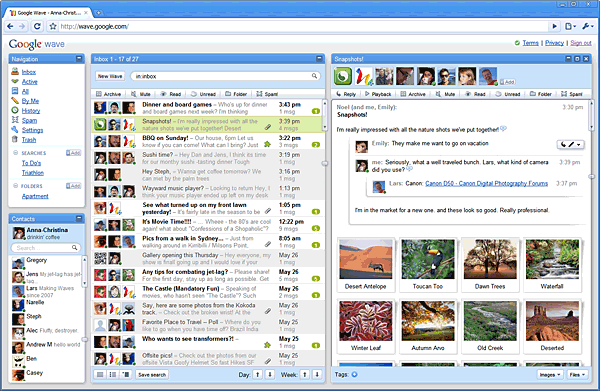
Google Wave interface

Google’s Wave announcement yesterday kicked off an orgy of geek ecstasy yesterday. Why not? A novel new interface combining email, instant-messaging, social networking and sharing/collaboration, all backed by Google’s rock-solid platform, and open-sourced to boot. Who couldn’t get excited?

When I first looked at the screenshots and demo of Wave, I got excited too: It’s a software project with big ambitions in several directions at once, and I have a soft spot in my heart for that. But the longer I looked, the more I began thinking, whoa — that is one complex and potentially confusing interface. Geeks will love it, but is this really the right direction for channeling our interactions into software?

One of the most interesting pieces I read this week was this report on a scholarly study of information design comparing the effectiveness of one-column vs. three-column layouts. The focus was more on social-networking sites (Facebook vs. LinkedIn) than on news and reading, but I think the conclusions still hold: People like single-column lists — the interface that Dave Winer calls “the River of News” and that most of us have become familiar with via the rise of the blog.

In Say Everything I trace the rise of this format in the early years of the Web, when designers still thought people wouldn’t know how to, or wouldn’t want to, scroll down a page longer than their screen. It turns out to be a natural and logical way to organize information in a browser. It is not readily embraced by designers who must balance the needs and demands of different groups in an organization fighting for home-page space; and it is the bane of businesspeople who need to sell ads that, by their nature, aim to seduce readers’ attention down paths they didn’t choose. Nonetheless, this study validates what we know from years of experience: it’s far easier to consume a stream of information and make choices about what to read when there’s a single stream than when you’re having to navigate multiple streams.

Wondering why Twitter moved so quickly from the geek precincts into the mainstream? For most users, tweets flow out in a single stream.

I think about all this when I look at the lively but fundamentally inefficient interfaces some news sites are playing with. Look at the Daily Beast’s unbearably cacophonous home page, with a slideshow centerpiece sitting atop five different columns of headlines. There is no way to even begin to make choices in any systematic way or to scan the entirety of the site’s offering. When everything is distracting, nothing is arresting. You must either attend to the first tabloid-red editorial shout that catches your eye — or, as I do, run away.

I feel almost as put off by the convention — popularized by Huffington Post and now increasingly common — of featuring one huge hed and photo and then a jumble of run-on linked headlines underneath. These headlines always seem like orphan captions to me. The assumption behind this design is that you must use the first screen of content to capture the reader’s attention. That’s only the case if you are waving so many things in front of the readers’ eyes in that one screen that you exhaust them.

Google Wave has an open API that will presumably allow developers to remix it for different kinds of users. So just as Twitter’s open API has allowed independent application providers to reconfigure the simple Twitter interface into something far more complex and geeky for those who like that, perhaps Wave will end up allowing users who like “rivers” to take its information in that fashion. But the default Wave looks like a pretty forbidding thicket to navigate.

ELSEWHERE: Harry McCracken wonders whether Wave is “bloatware.”

Filed Under: Blogging, Media, Say Everything, Technology

How charging for articles could hobble the future of journalism

May 28, 2009 by Scott Rosenberg

Apparently there was a big meeting of news executives today in Chicago under the auspices of the Newspaper Association of America. The de jure name for the topic at hand was “Models to Monetize Content” but the de facto subject of the conclave seems to be building paywalls and ending what James Warren glibly calls “the age of content theft.” Such conversation needed to take place under the watchful eye of a legal counsel to avoid antitrust problems; but who can doubt that some sort of collective action — simultaneous, if ostentatiously uncoordinated — is at hand?

We are, then, nearing a moment of real decision on the part of the beleaguered newspaper industry, a genuine fork in the road. The papers can decide to keep participating in the open Web, which would require accepting that their legacy business — the old paper bundle and the broadcast model — is going to change into something almost unrecognizable. Or they can decide to put up the walls and gates and behave as if it’s 1997 again, and the Web is just a better delivery truck rather than an intricately evolving social organism. Down one path, dissolve into the Web; down the other, secede from the Web.

These two paths map neatly onto the two camps into which you can group virtually everyone in the old argument about the news business and the Web. On one side, you have the people who feel that newspapers simply took a wrong turn on their journey to the Internet. They were seduced by the Web hypesters! They should have charged for their articles from day one! Because they didn’t, they’re in a bind now — but their only hope is to shut the door belatedly and salvage what can be salvaged. We heard this same cry back in 2000-2002, during the last Web-business ice age.

If this is what you believe, then the appropriate business strategy is a no-brainer: Start charging your readers. Start demanding that Yahoo and Google et al. pay to link to you. Then see what happens — and, I’d advise, duck as the masonry starts to crumble.

In the other camp, the one where I put my own tent, you find everyone who believes that the Web has radically and irreversibly changed the way people get their information, weakening or dismantling all of the buttresses and structures that held the old business of media together. This change is neither all good nor all bad; but it is real, and wishing it away won’t help.

I’ve argued this position consistently for years now, but here is another angle worth considering. In at least one area, the newspaper web sites of the 90s didn’t give away the store. The Web was an obviously superior platform for delivering classified ads, but newspapers traditionally made a good chunk of their revenue from classifieds, so many newspapers adopted a sort of half-hearted classified strategy: if you paid for a print classified ad, you got a web listing free. Or maybe the paper would sell you a Web classified at a different rate from a print classified.

So, in this realm at least, the papers never committed that original sin of offering their product for free. What happened? The papers mostly sat tight and figured that their brand and their prominence in their communities would outweigh the lameness of their software and their indefensible overcharging for a product that now cost little or nothing to deliver. There were big venture-funded startup companies that set out to build standalone classified businesses, and some of them prospered as for-profit enterprises. But the greatest success of all came in the unlikely form of Craigslist, a community-based enterprise led by a shy programmer who offered classifieds not as a profit-making enterprise but (in all but a tiny subset of categories) as a free service.

As a result, newspapers’ classified businesses today have been devastated. But you can’t blame Craig Newmark; if he hadn’t done it, others would have, in some slightly different form. The Web itself made that inevitable. Newspapers had the opportunity to be Craig Newmark; they couldn’t imagine that. Regrettable, but understandable.

Similarly, you can blame Wikipedia for the woes of Encyclopedia Britannica’s paper-edition business, but really, it was less that unforeseen project that doomed the bound-volume encyclopedia than the very existence of the Web itself, which gave people an ill-ordered but livelier source for much of the information they sought.

In each of these cases, no one gave the store away. The shopkeepers didn’t play along, they tried to fight. But the scope of Web-induced change made their battle mostly hopeless. And their choice to fight the Web rather than work with it meant they only hastened their own downfall.

Similarly with the pay-wall argument. I fear that if our newspaper publishers take the collective charge-our-users approach, they will not only doom their own enterprises but will also make the transition we are currently facing — from a paper-and-broadcast news world to a purely digital one — longer and more wrenching.

If news publishers today accept that their future is online and that said future will not and cannot offer the same profit margins, or support the same size staff, as a monopoly, they can still participate in building new models for the new world. Some will survive and some will fail, but all of them (and all of us) will benefit from the lessons they can teach us. But if they shunt themselves off behind pay walls, they will not only surely fail, they will also make it far harder to seed the Web with the knowledge and experience of today’s professional journalists. The work of newsroom professionals will be cordoned off into their own disconnected islands online that fewer and fewer people will visit. New traditions will evolve independent of the old ones.

I can understand that news publishers — the owners and stockholders and managers — will do everything they can to cling to a failing model, because that is the way of the business world. A revenue stream is a revenue stream; it’s hard to give it up today, even when you know it’s going away tomorrow. But the journalists who care about their own craft’s values and traditions should think twice before applauding the intransigence of their business colleagues. In the long run, it will do nothing to save their jobs. And it will make it that much harder for all of us to rebuild a vibrant and sound news tradition online.

UPDATE: Recommended reading — Steve Buttry on “Seven reasons charging for content won’t work”

Filed Under: Blogging, Business, Media

Site for “Say Everything” is now live

May 28, 2009 by Scott Rosenberg

Today I humbly offer you the website for my forthcoming book SAY EVERYTHING: How Blogging Began, What It’s Becoming, and Why It Matters. The book’s publication date is July 7. (But it’s never too early to preorder it.)

Among much else, I’ve posted the full text of the book’s introduction and first chapter — which is all about Justin Hall, the early-Web wunderkind who helped create the original template for websites as mirrors of the self. The evolution of Hall’s site at links.net in its first few years prefigured the future phases of the entire Web: from repository of information to haphazard efflorescence of creativity to structured daily updates.

Like many people caught up in the Web excitement of 1994 and 1995 in the Bay Area, I met Justin, liked him and admired the prodigious energy behind his personal publishing project. But I also found myself wondering, “Why is he posting so much personal information? Isn’t it going to come back and bite him?” My chapter tells the story of Hall’s personal storytelling online from its effusive start in 1994 to its abrupt end in a traumatic video posted in 2005. Hall hasn’t vanished from the Web — today he’s creating online games at the helm of a new company — but he’s using the medium in an entirely different way. His story provides an outline of the allure and the pitfalls of online self-revelation — a tale that is, if anything, even more pertinent today than it was when Hall lived it.

Also on the Say Everything site, you’ll find a full table of contents for the book; a brief FAQ about it; and a page with some of the kind things some early readers of the book have had to say about it (i.e., blurbs).

This site launch marks the start of a number of Say Everything-related projects and posts that I’ll be rolling out here over the next six weeks. Once the book is out, I’ll also be posting the full index of the book with all links fully HTML-ized and wired up to their original sources.

Filed Under: Blogging, Personal, Say Everything

« Previous Page
Next Page »