Archive for February, 2008

Word processing, then and now

Monday, February 25th, 2008

Clive Thompson writes about how software can shape our creative work:

Our tools, of course, affect our literary output. And all this made me wonder how other writing tools affect what’s written. I use Movable Type to write my blog, and I’m constantly annoyed by how small the text-entry boxes are. Whenever I write an entry, the text quickly flows down several box-lengths, which can make it hard to keep track of my argument. The problem, of course, is that the tool was designed with the idea that people would be writing extremely short, pithy entries … whereas my entries tend to drag on and on and on. It reminds me of the writing on one of those old, proprietary-hardware word-processors from the 80s, which were outfitted with screens that only let you see seven lines at a time.

Wordpress lets you set the posting box to any size you want. But for longer posts, I compose in a text editor. It’s just handier. I have no doubt, though, that browser-based editing will eventually evolve to the point where I don’t need to do that.

Thompson also references Virginia Heffernan’s recent Times piece on word processors, which recommends the Zen-like blank-screen approach of the Mac-based WriteRoom. (Of course, the dominant DOS-based word processor, WordPerfect, offered what was very close to a blank screen; in a pre-Windows world, you didn’t have a browser or e-mail always competing for screen real estate.)

For those of us who learned Basic on a Zenith Z19 and started word processing on a Kaypro (anyone?), the retro green-and-black now takes the breath away. It’s not just the vintage features available on WriteRoom, it’s also that the whole experience is a throwback to a time before user-friendly interfaces came to protect us from technology’s dark places. In those days, the mystery of the human mind and the mystery of computation seemed both to illuminate and to deepen each other.

All of which brings back involuntary, wincing memories of one of my earliest word-processing experiences, at the Boston Phoenix. In the early ’80s the Phoenix had some ancient minicomputer sitting in a back room, feeding the newsroom’s small and much-fought-over handful of dumb terminals. When I say dumb, I mean really dumb. In a limitation that is inconceivable today, these terminals had so little memory that they could only handle a few hundred words at a time. Most Phoenix reviews were way longer than that, yet many of us composed directly on this system (who could afford one’s own PC on what that alternative paper paid its writers?).

To compose a lengthy piece you had to write a chunk (a “buffer”), then save it — sending it on a leisurely journey back to main memory — to make room on the terminal for the next installment of your opus. Unfortunately, these terminals also had a habit of crashing. Too often you’d press that “send” key only to see the screen freeze, and you’d know then that you’d just lost all your work stretching back to the last time you’d saved your work. Only sometimes pressing “save” would itself trigger the dreaded freeze — a tragic Catch-22 indeed.

As a result — in a tableau that somehow seemed to epitomize all the pain of human composition in a technological age — you might occasionally spy some desperate writer hunched over notebook and pen in front of a frozen screen, painstakingly copying the slim remnant of his verbiage that was still visible, rescuing some fragment of inspiration before the inevitable reboot wiped the words clean.
Be Kind Rewind and the infinite garage

Monday, February 25th, 2008

I haven’t yet seen Michel Gondry’s Be Kind Rewind, but A.O. Scott’s New York Times review made me want to:

…It treats movies as found objects, as material to be messed around with, explored and reimagined. It connects the do-it-yourself aesthetic of YouTube and other digital diversions with the older, predigital impulse to put on a show in the backyard or play your favorite band’s hits with your buddies in the garage.

And the deep charm of Mr. Gondry’s film is that it allows the audience to experience it with the same kind of casual fondness. It is propelled by neither the psychology of its characters nor the machinery of its plot, but rather by a leisurely desire to pass the time, to see what happens next, to find out what would happen if you tried to re-enact “Ghostbusters” in your neighbor’s kitchen.

I would argue that “the do-it-yourself aesthetic of YouTube and other digital diversions” and the “older, predigital impulse to put on a show” are in fact one and the same. It is this motivation that drives a great deal of the creativity on today’s Web. What’s different today is that the “backyard” theater can pack in, potentially, millions. The garage is infinite.

David Edelstein didn’t like it quite as much, but he concludes:

…it radiates the kind of optimism you don’t see in films about how new media is turning us all into passive voyeurs in our own hermetically sealed bubbles. This bubble is warm and inclusive.

Links for February 22nd

Friday, February 22nd, 2008

OOPSLA podcast cornucopia

Friday, February 22nd, 2008

OOPSLA is the ACM conference that most broadly and widely addresses the sorts of questions I tried to explore in DREAMING IN CODE. I found the two events that I’ve attended, in 2004 and 2006, both highly rewarding. I couldn’t make the 2007 edition in Montreal, but I was delighted to find this page of podcast recordings of many of the conference’s highlights.

I’ve only had time to dip my toes in this stuff so far; there are talks by David Parnas, Fred Brooks, John McCarthy, Patti Maes, Guy Steele, Richard Gabriel, Gregor Kiczales and many others.

“Heretic Pride” from the Mountain Goats

Friday, February 22nd, 2008

Earlier this week I received my (pre-ordered) copy of the new Mountain Goats CD, “Heretic Pride.” My enthusiasm for the music of John Darnielle now dates back four years, and this is one infatuation that has only grown deeper with time. I am, unabashedly, a fan.

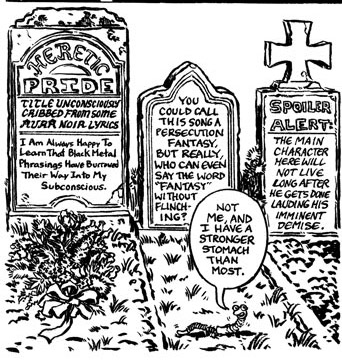
And yet I think I’d love “Heretic Pride” even if I encountered it with no grounding in the Mountain Goats’ stuff. This is what passes for an upbeat album from Darnielle: it’s full of joy, but that’s joy in the face of terror. Heretic Pride, by the Mountain Goats The title track, for instance, is a defiant hymn soaring out of the throat of some unspecifiedly nonconformist protagonist who has been dragged out of his house and through the streets toward his doom. Of this song, Darnielle writes: “Spoiler alert: The main character here will not live long after he gets done lauding his imminent demise.” (This commentary appears in notes to the album that were apparently provided in the press kit; an artist named Jeffrey Lewis took them and illustrated them in tabloid-comic strip form — the style of those salvation-in-six-frames handouts that evangelicals used to distribute, and perhaps still do.)

There are songs here (you can sample them at the 4AD site) about Chinese sea monsters and pulp novelists, murdered reggae singers and imaginary cults. Titles include “Lovecraft in Brooklyn” and “Marduk T-Shirt Men’s Room Incident.” The pace is livelier and more varied than on the Goats’ somber last outing, “Get Lonely”; superb drumming from Jon Wurster drives the faster numbers, and majestic string arrangements by Eric Friedlander bathe the slower ones.

If the album doesn’t sate you, you can also enjoy the satirical ditty about this year’s elections that Darnielle knocked off for a recent public radio show. Titled “Down to the Ark,” it imagines the whole civic process as the triumph of a satanic cult. You can listen to it here.

Three Mountain Goats shows are lined up here in the Bay Area next weekend. I intend to be at all of them! Come say hello.

LATE ADD: Darnielle dissects the characters in five of his songs in this interview on Emusic.

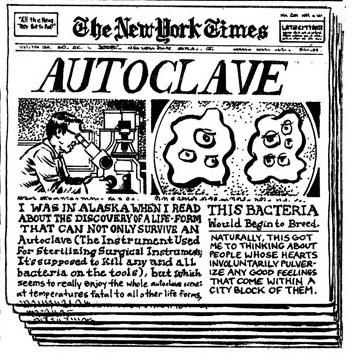
Autoclave, by the Mountain Goats

Code Reads update

Wednesday, February 20th, 2008

I haven’t been able to keep the Code Reads project going at all this year. And what with work proceeding full bore on my next book project, that, alas, is unlikely to improve much. I’m not quite ready to totally abandon it but I did want to acknowledge the situation. I think we’d just better consider it an erratic, wheneverly sort of thing.

But I am going to do a new one shortly — it will be on Mark Bernstein’s series of posts on what he calls “Neo-Victorian Computing.”

Spolsky: how programmers redefine their way around hard problems

Wednesday, February 20th, 2008

I only just caught up with Joel Spolsky’s amusing and insightful Yale talk posted last December — a return-of-the-prodigal-son sort of thing for this Yale graduate. (Here’s parts one, two and three.)

These quotes were worth highlighting:

Time and time again, you’ll see programmers redefining problems so that they can be solved algorithmically. By redefining the problem, it often happens that they’re left with something that can be solved, but which is actually a trivial problem. They don’t solve the real problem, because that’s intractable.

This is a failing, in one sense — it’s why certain Big Problems in the field never seem to get solved. On the other hand, in the face of deadlines or business pressures, we can surely see the value in a programmer’s ability to take some problem that’s impossible to solve (given available resources) and redefine it as a job that can actually be accomplished.

And:

Being able to write clearly on technical topics is the difference between being a grunt individual contributor programmer and being a leader.

The hardest problems facing most programmers don’t involve communicating with the computer; they arise in the course of communicating with people — colleagues, customers, users.

Eugenides on valentines: “cheapening and commodification”

Thursday, February 14th, 2008

Overheard at the end of Michele Norris’s interview with Jeffrey Eugenides on last night’s All Things Considered:

MN: Happy Valentine’s Day to you.

JE: Thanks for having me.

MN: I was going to ask you if you’re doing anything special for Valentine’s Day, but your someone special might be listening.

JE: I’ll tell you, one of the first things my wife and I decided when we got together was that we would never celebrate Valentine’s Day.

MN: What?

JE: One of the first things that made me fall in love with her was our mutual antipathy to Valentine’s Day.

MN: Wait a minute — an author who puts together a collection of love stories has total antipathy for Valentine’s Day?

JE: Oh yeah. Don’t you think it’s the cheapening and commodification of something rare that we’d all like to celebrate in private and on our own time?

MN: I personally like flowers and chocolate.

JE: Well, your special person, I hope, is listening.

I have always come down on Eugenides’ side of this argument. Fortunately, my “special person” does too.

The road goes ever oon

Tuesday, February 12th, 2008

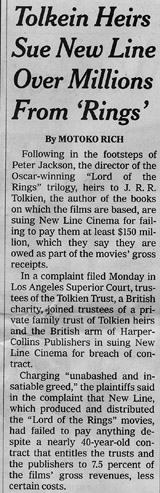
NYT on Tolkien films

I don’t know which is more lamentable here:

The revelation that the Tolkien estate has apparently received zero dollars for the (phenomenally good) movies New Line made of the “Lord of the Rings” trilogy…

or…

The inability of the New York Times, at this very late date, to spell the author’s name right in a headline.

Surely the paper’s staff is riddled with people weaned on “The Hobbit” and the trilogy — people whose brains, at the first peripheral-vision scan of that misspelling, light up with red “error” messages shooting from axon to dendrite?

[This image is from the National Edition on paper, distributed here in the Bay Area. One can only hope that it got fixed for the later editions…]

Obama and Clinton split the states alphabetically

Tuesday, February 5th, 2008

As of around 7:30 pm California time here on Super Tuesday night, a look at the New York Times web site shows a remarkable pattern in the Democratic primaries:

NYTimes Democrats

As you can see, Obama wins the states up until “M”; Hillary wins from M through Z. (If you can’t see, click the picture for a full-sized image.)

If the pattern holds, the Obama folks may have a big win in California on the way.

This is about as reliable as the numerology that sometimes passes for market-timing prediction on Wall Street. But, hey, it’s a pattern!